
What to Feed an Aquatic Turtle
Pellets by shell length, greens for adults, calcium and UVB: how to feed sliders and other water turtles without fouling the tank.
Sliders, cooters, painted, map and musk turtles all eat in the water. Their staple is a floating pellet or stick made for aquatic turtles. Most foods come in stages, because a turtle's diet changes as it grows.
Young turtles eat mostly animal protein. Adults eat more plants. The food is only part of it: a UVB lamp, a warm basking spot, a calcium source and a strong filter matter just as much.
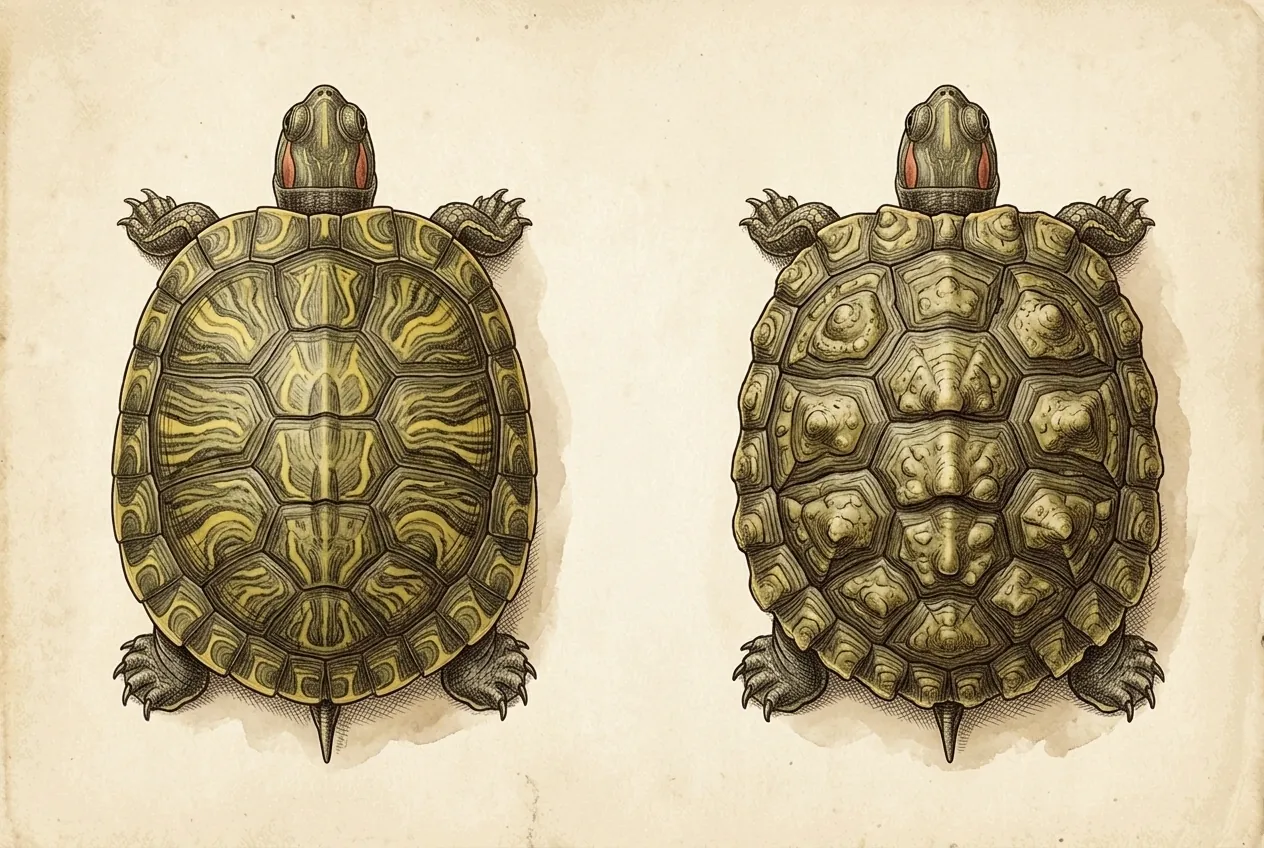 Smooth shell
At a glance
- How often Young once a day, adults pellets 3-5 days a week
- How much What it finishes in about five minutes
- Best staple A floating turtle pellet matched to shell length
- UVB Always a long UVB tube, even with D3 food
- Calcium A floating cuttlebone in the tank
- Avoid Iceberg lettuce, goldfish and rosy red minnows
Pick the food by shell length
Measure the top shell from front to back, then feed the matching stage. Don't guess.
| Shell length | Stage | What to feed |
|---|---|---|
| Under 2 inches | Hatchling | Hatchling food, mostly protein |
| 2 to 6 inches | Growing | Growth food, plus some greens |
| Over 6 inches | Adult | Adult or maintenance food, plus lots of greens |
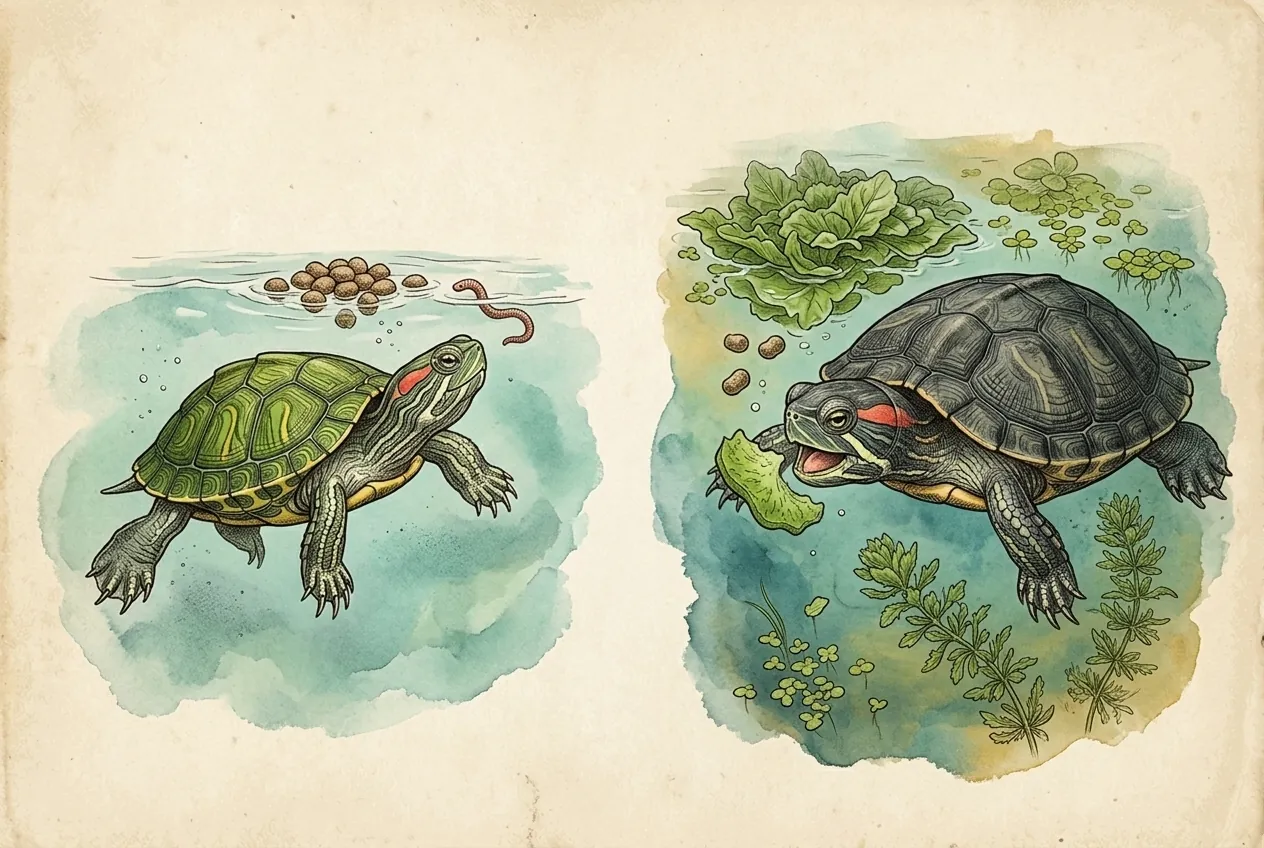
- Young turtle
- Adult turtle
- Young turtle
- Mostly pellets and protein.
- Adult turtle
- Mostly greens and water plants, with a few pellets.
- These are Zoo Med's boundaries, the only brand that prints measurements.
- Other brands use names like "juvenile" or "adult" without saying where one ends.
- Some foods, like Mazuri and Hikari, are one recipe for all ages.
Comparing turtle foods
Both approaches work. Follow the schedule that goes with the food you pick.
Stepped by age
Zoo Med and Exo Terra step protein down from 43% to 25% as the turtle grows.
One food for all ages
Mazuri and Hikari use one food around 40% for all ages. Mazuri suggests feeding it only three to five days a week.
Compare all 14 foods: protein, fat, fiber, calcium and D3
| Food | Life stage | Protein | Fat | Fiber | Calcium | Phosphorus | Vitamin D3 |
|---|---|---|---|---|---|---|---|
| Zoo Med Hatchling Formula | Hatchling | 43.0% min | 10.0% min | 3.0% max | 2.5–2.9% | 1.0% min | not listed |
| Exo Terra Hatchling | Hatchling | 43.0% min | 10.0% min | 1.0% max | 2.0–2.4% | 1.0% min | 2,100 IU/kg min |
| Zoo Med Growth Formula | Growing | 35.0% min | 5.0% min | 5.0% max | 0.9–1.3% | 1.0% min | not listed |
| Zoo Med Gourmet | Growing | 37.5% min | 6.5% min | 5.0% max | 1.2–1.6% | 0.9% min | not listed |
| Exo Terra Juvenile | Growing | 35.0% min | 5.0% min | 3.3% max | 2.0–2.4% | 1.0% min | 2,100 IU/kg min |
| Zoo Med Maintenance Formula | Adult | 25.0% min | 5.0% min | 8.0% max | 1.3–1.7% | 1.0% min | not listed |
| Exo Terra Adult | Adult | 25.0% min | 5.0% min | 8.0% max | 2.0–2.4% | 1.0% min | 2,100 IU/kg min |
| Zoo Med ReptiSticks | All ages | 35.0% min | 5.0% min | 3.0% max | 1.2–1.7% | 1.0% min | not listed |
| Mazuri Aquatic Turtle Diet | All ages | 40.00% min | 10.00% min | 5.00% max | 1.85–2.35% | 1.00% min | not listed |
| Mazuri Aquatic Turtle Gel | Growing and adult | 55.00% min | 15.00% min | 5.00% (printed as a minimum) | 2.50–3.50% | 1.50% min | not listed |
| Fluker's Floating Frenzy Sticks | Growing and adult | 36.5% min | 5.4% min | 7.8% max | 1.75% min | 1.15% min | not listed |
| Fluker's Aquatic Turtle Diet | Growing and adult | 34% min | 10% min | 6.5% max | not listed | not listed | not listed |
| Hikari Saki-Hikari Turtle | not listed | 41.0% min | 4.0% min | 2.0% max | 2.0% min | 1.0% min | 2,100 IU/kg min |
| Repashy Savory Stew (gel) | not listed | 35% min | 8% min | 9% max | 1.5% min | not listed | not listed |
Figures are each maker's guaranteed analysis. Moisture isn't listed for any of them.
Some popular foods, including Tetra ReptoMin, don't publish an analysis we could read, so they aren't in the table. That doesn't make them bad food.
No maker publishes a calcium-to-phosphorus ratio, so we don't list one.
How much and how often
Feed what your turtle finishes in about five minutes. Net out the rest.
A sample week
Young turtle
Adult
Feed Optional Rest day
Show as a table
| Life stage | Pellets | Greens |
|---|---|---|
| Young turtle | Once a day, every day | Some greens as it grows |
| Adult | 3 to 5 days a week | On the other days |
Adults don't get much exercise in a tank and put on weight easily.
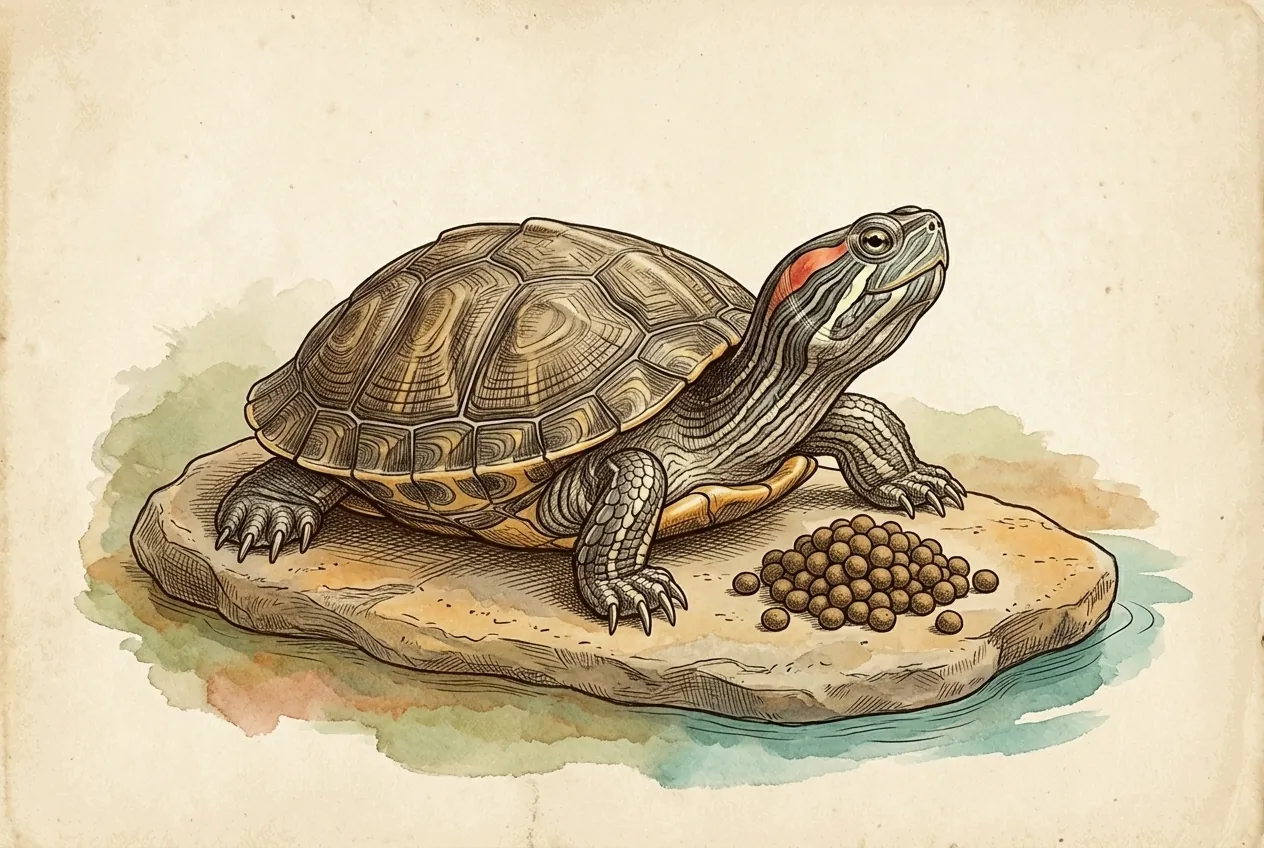
- Start small. Zoo Med suggests starting with about a teaspoon. Fluker's soft food works out to about a tablespoon a day for every 4 inches of shell.
- Check your bag. Brands differ: some say three minutes, some say five. Use the label if it gives one.
- Take out leftovers within the hour, sooner in a small tank.
- Feed in the water. Turtles need water to swallow. Drop food on the surface where it floats.
- Smooth shell
- Pyramided shell
- Smooth shell
- Slow, steady growth.
- Pyramided shell
- Each plate raised into a lumpy cone. Too much food pushes a young shell to grow too fast.
Keep the water clean
Every uneaten pellet turns into ammonia, so food and filtration go together.
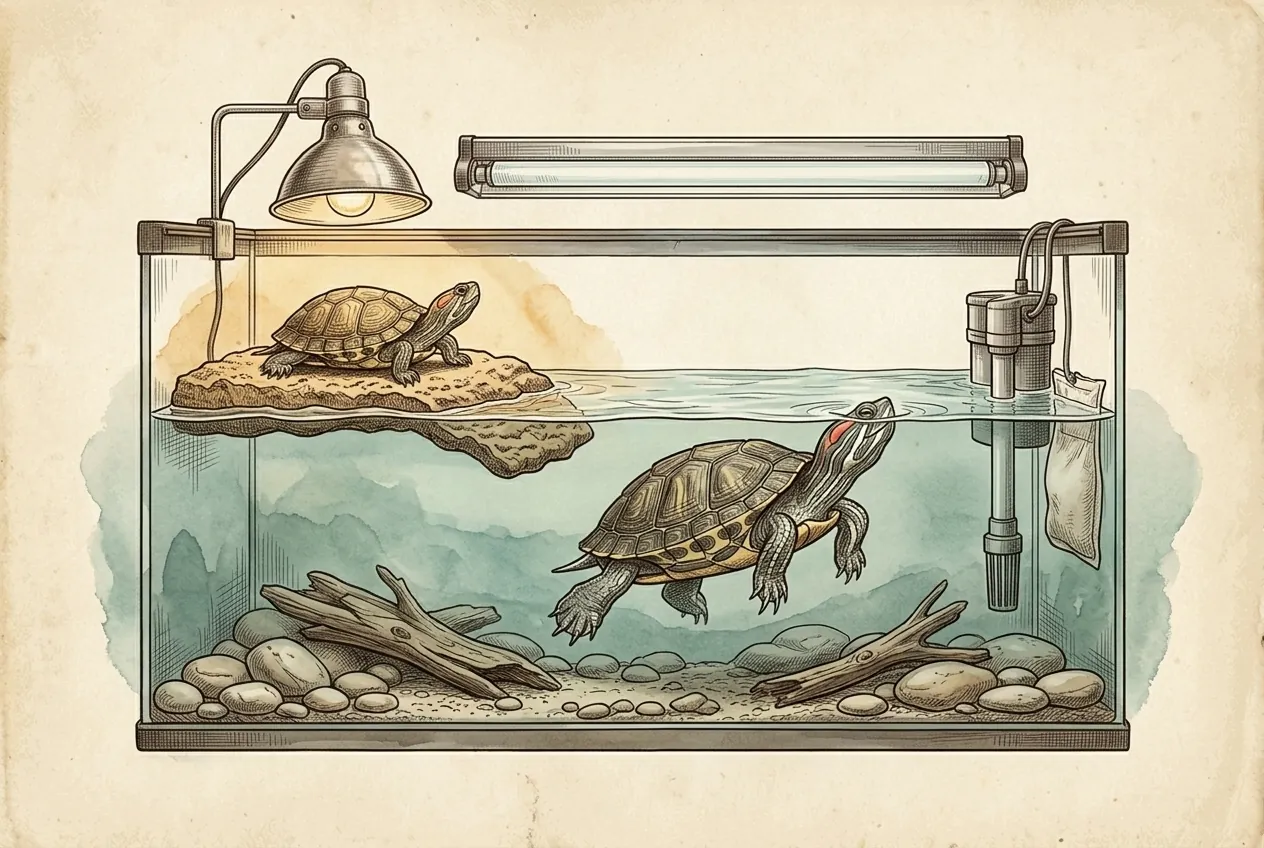
- Heat lamp: over a dry basking dock. For red-eared sliders, the dock is 90–95°F.
- Long UVB tube: the food never replaces it.
- Strong filter: one that pulls out solid waste. Fish-tank filters clog fast.
- Deep water: 74–78°F for red-eared sliders.
- Heat lamp: over a dry basking dock. For red-eared sliders, the dock is 90–95°F.
- Long UVB tube: the food never replaces it.
- Strong filter: one that pulls out solid waste. Fish-tank filters clog fast.
- Deep water: 74–78°F for red-eared sliders.
- Filter size: our care sheet recommends a canister rated for 2 to 3 times your water volume.
- Change 25% of the water each week, using conditioned tap water.
- Temperatures: follow the care sheet. For red-eared sliders that's 74–78°F water and a 90–95°F basking dock.
- Feed a little less rather than a little more.
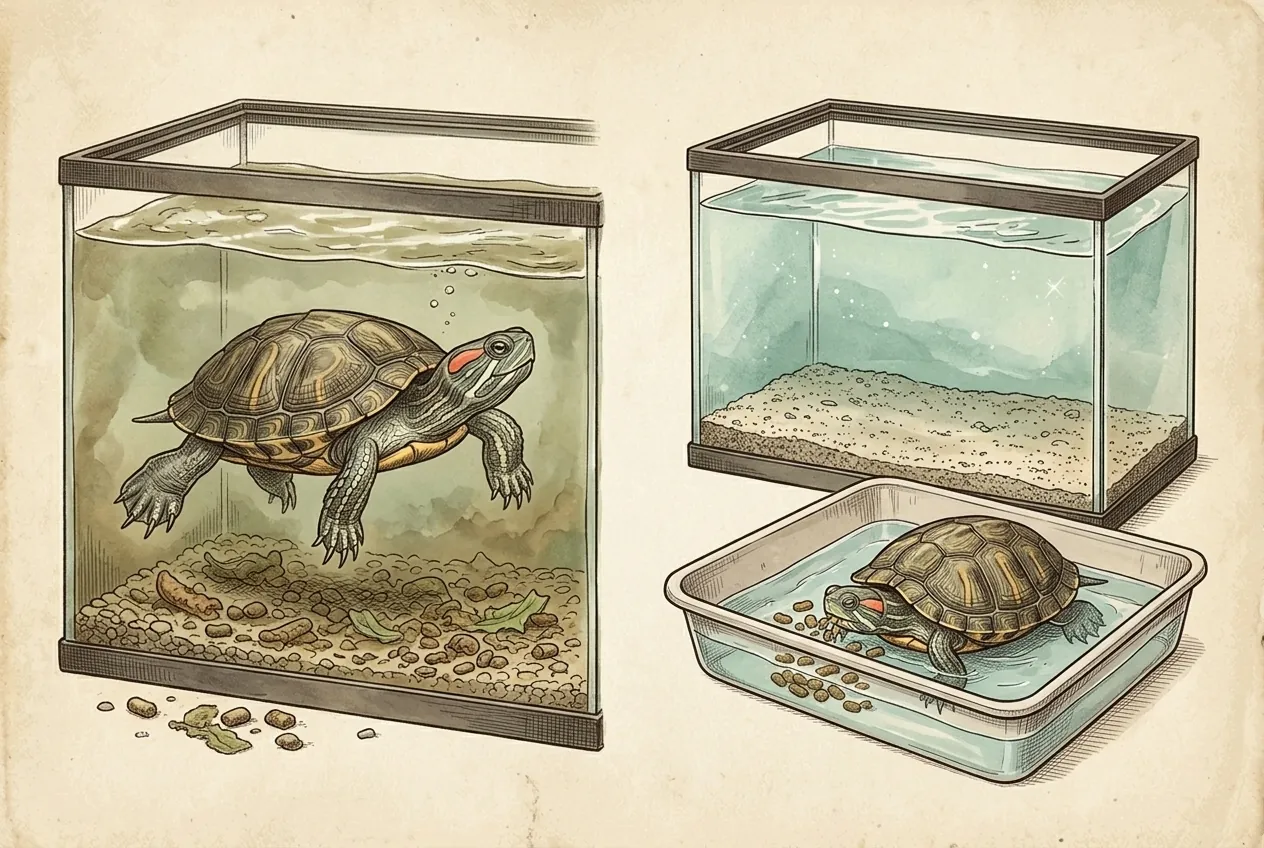
- Leftovers left in
- Fed in a tub
- Leftovers left in
- The water turns cloudy and dirty.
- Fed in a tub
- The main tank stays clear.
A turtle is a messy animal that eats in its own water. Some keepers feed in a separate tub:
- Fill a small tub with water from the tank.
- Feed the turtle there.
- Put it back once it has finished.
Greens and treats
Adults should eat mostly plants alongside their pellets. Young turtles can be offered greens too.
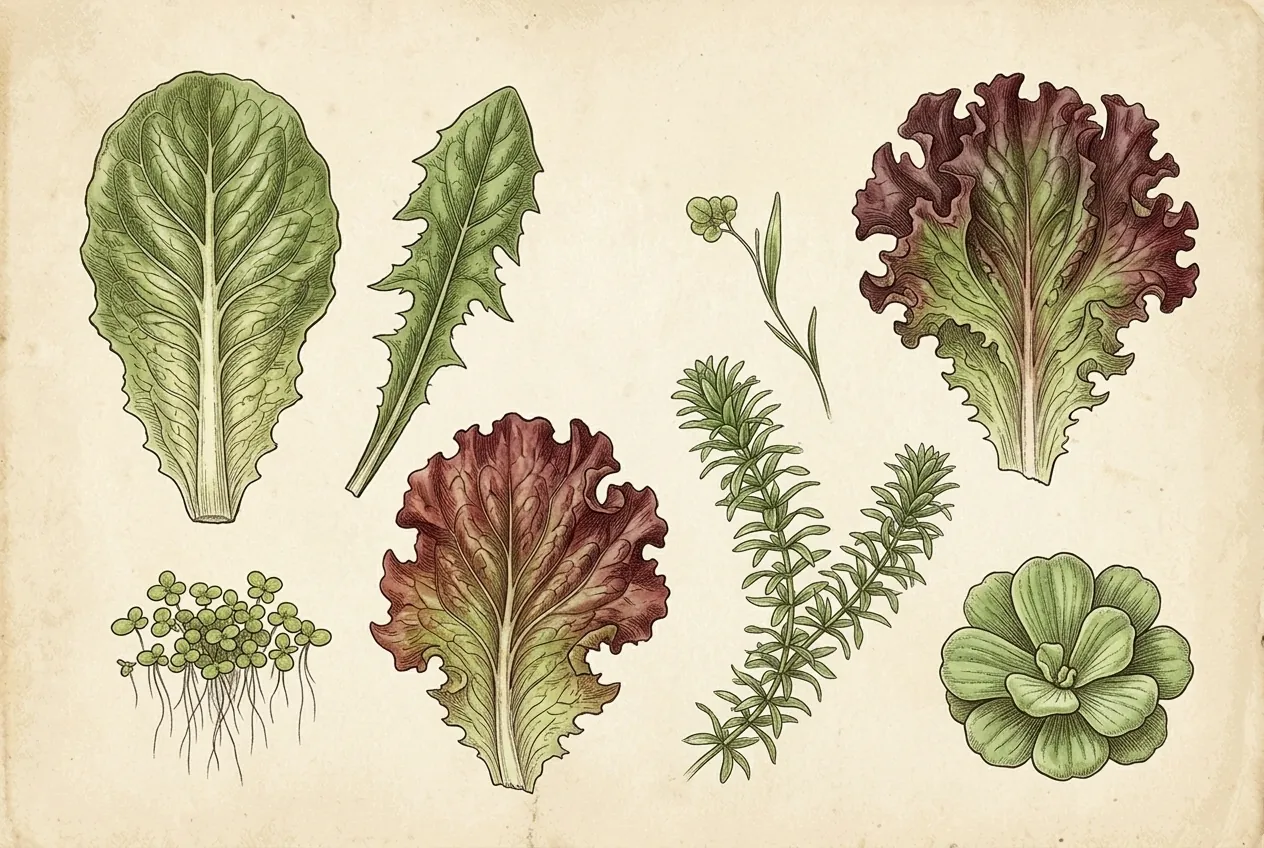
- Good greens: romaine, red leaf lettuce, dandelion and collard greens.
- Water plants: duckweed and anacharis give a turtle something to graze.
- Fruit and soft produce: berries, apple and squash are treats, not staples. Take out uneaten produce after a few hours.
- Protein treats: earthworms, freeze-dried shrimp and dried insects. Once or twice a week, per the treat food's label.
- Live fish: guppies or bait minnows now and then.
Calcium and UVB
The food never replaces the UVB lamp. This matters more than anything else on this page.
Why UVB
A turtle's shell is bone. Without UVB and heat, it can't use calcium, and it develops metabolic bone disease.
Even with D3
That's true even if the food has added vitamin D3.
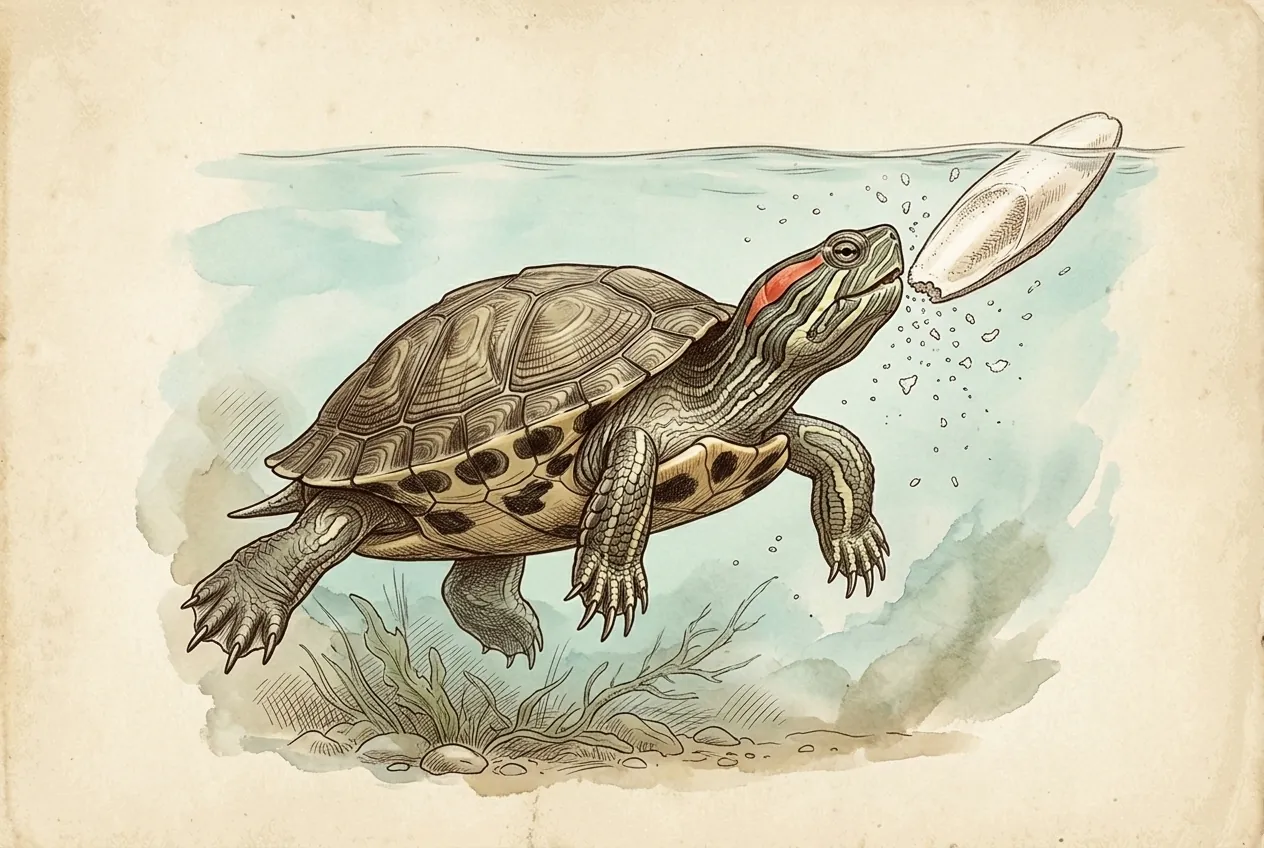
Add a calcium source to the tank. Calcium levels vary a lot between foods. A floating cuttlebone is cheap insurance, and Zoo Med recommends one on its own care page.
| Calcium extra | Calcium | How it works, per the maker's label |
|---|---|---|
| Zoo Med Turtle Bone (cuttlebone) | 37.0–42.0% | Floats; the turtle chews it as needed, which also helps keep the beak trim |
| Zoo Med Banquet Block | 25.0–29.0% | Food and calcium in one block |
Figures are the maker's guaranteed analysis.
About "complete" on the label
There's no official nutrition standard for turtle food the way there is for dog and cat food. No turtle food carries one, and that's normal.
What that means
"Complete" on a turtle label isn't a certified claim. Plan on greens, calcium and UVB whatever the box says.
Quick answers
What do I feed my turtle? A floating aquatic turtle pellet matched to its shell length, plus greens as it grows, a cuttlebone in the tank and a treat once or twice a week.
How much? What it finishes in about five minutes. Start with a teaspoon and net out the rest within the hour.
Do I need UVB if the food has vitamin D3? Yes. Always. Food can't stand in for the lamp.
My turtle's shell feels soft. Is it the food? It's much more often the lighting. Check the age of the UVB bulb and the basking temperature, add a cuttlebone, and see a reptile vet soon. A soft shell is serious.
Can I feed goldfish? We'd skip them. Goldfish and rosy red minnows contain thiaminase. Guppies or minnows now and then are a better pick.
Can I just leave food in the tank? Only Mazuri's dry diet is made for that. With everything else, net out leftovers so the water stays clean.
Shop this
Pick up in store or have it shipped.
Reviewed by our team 2026-11-06. Nutrition figures are each maker's published guaranteed analysis.