
What to Feed a Betta: Pellets, Treats and How Much
A betta eats a few pellets, not a pinch. How much and how often, floating vs sinking, bloodworms and frozen treats, and signs of overfeeding.
A betta is a small, mostly meat-eating fish that feeds at the surface. It eats a few pellets at a time, not a pinch.
Feed a betta pellet, add a treat now and then, and take out anything left over. Most betta food problems are really water problems from too much food.
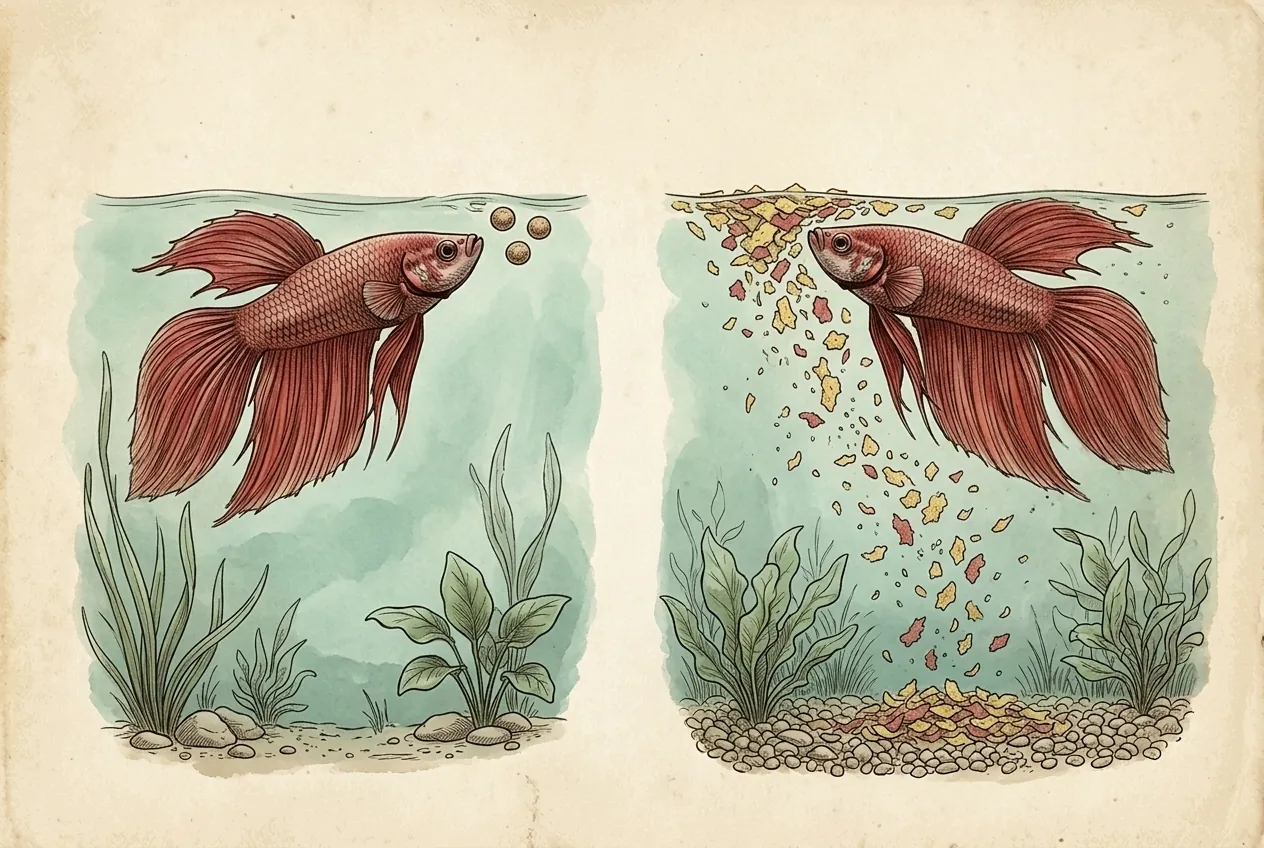 Right
At a glance
- Best staple A floating betta pellet
- How much 3-4 pellets, never more than 5
- How often Twice a day
- Treats Bloodworms a few times a week
- Leftovers Take out after a couple of minutes
- Avoid Pinches of flake, bloodworms as the staple
What to feed
A betta pellet is the staple. Bloodworms and other treats are extras.
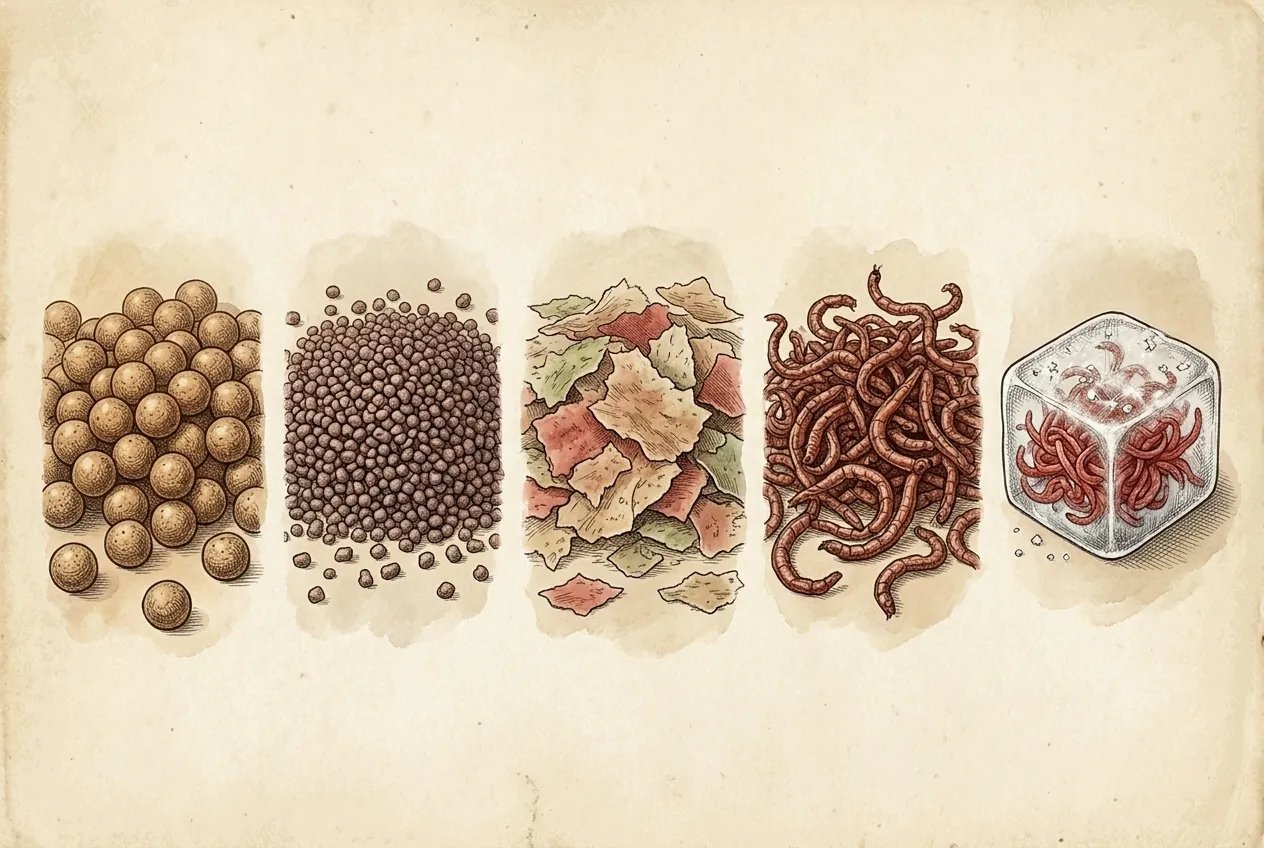
- Floating pellet
- Slow-sinking granule
- Betta flake
- Freeze-dried bloodworms
- Frozen piece
- Floating pellet
- The easiest staple to watch.
- Slow-sinking granule
- Fine, but watch where it lands.
- Betta flake
- Made for bettas, unlike community flake.
- Freeze-dried bloodworms
- A treat, not the staple.
- Frozen piece
- A treat. Thaw a small piece in tank water.
Pellets or granules
The everyday food. What makes it a betta food is the size: where makers list it, betta pellets run 0.25 mm to 1.5 mm, sized for a small mouth.
Betta flakes
Some makers sell flakes made for bettas. A tropical flake made for a school of community fish isn't the right everyday food for a betta.
Freeze-dried bloodworms
A treat. Hikari sells its own bloodworms as a treat. They are over 50% protein from one ingredient, so they go alongside pellets, not instead of them.
Frozen foods
Bloodworms or brine shrimp, as a treat. See the thawing steps below.
Floating or sinking?
Start with a floating pellet. You can see exactly what got eaten.
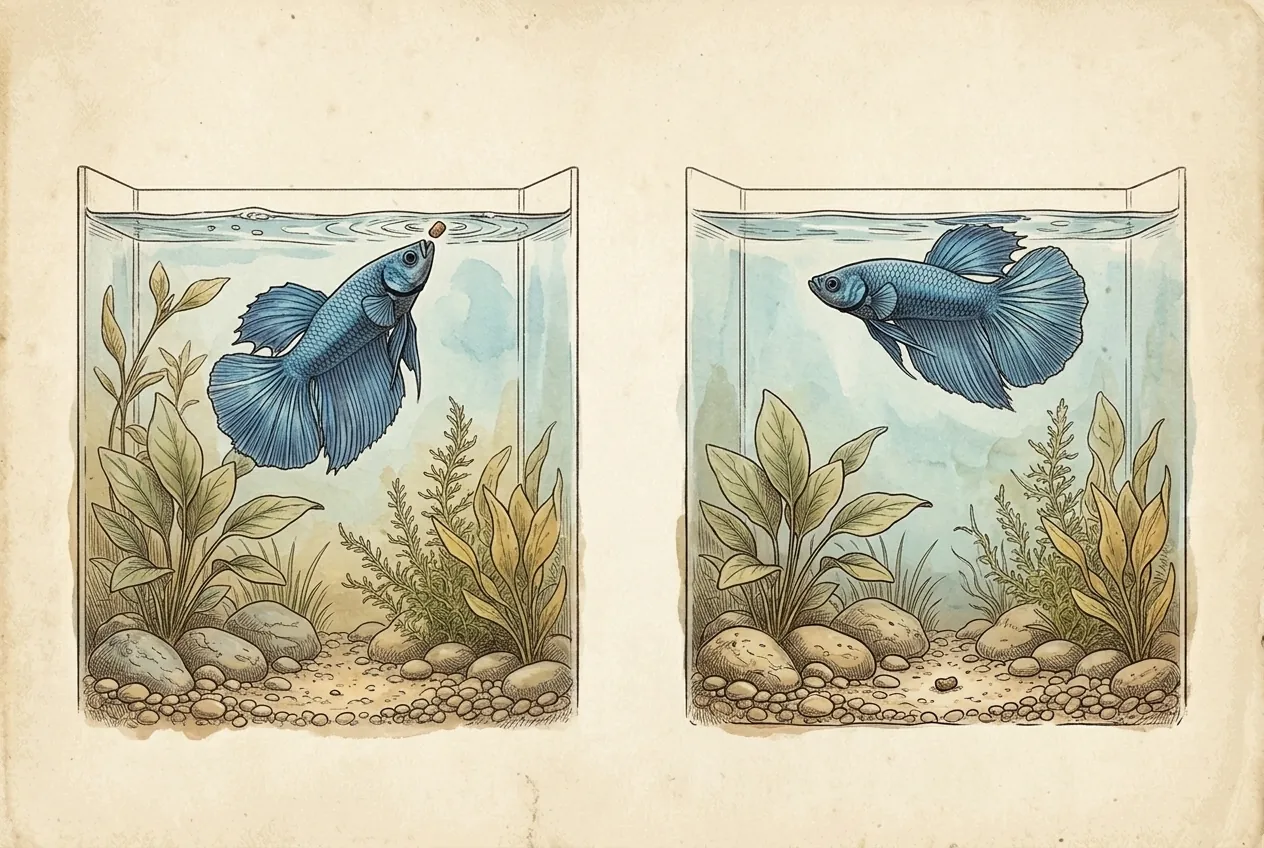
- Floating
- Sinking
- Floating
- Eaten at the surface, easy to count.
- Sinking
- Can land on the gravel unseen and rot.
- Bettas feed at the surface.
- Some betta foods float and some sink slowly. The bag says which.
- Aqueon is the only maker that ties floating pellets to surface feeding.
- A floating pellet lets a first-time keeper see what was eaten and what was missed.
- A slow-sinking food works too. Just watch where each piece lands and take out any that reach the bottom.
Compare 17 betta foods: form, size, protein, fat and feeding
Pick a betta pellet that prints its numbers. Where a maker prints no protein figure, compare on the first ingredient and the pellet size instead.
| Food | Form and size | Protein | Fat | How much, per the maker's label |
|---|---|---|---|---|
| Hikari Betta Bio-Gold | Floating pellet, 1.1-1.4 mm | 38.0% min | 4.0% min | 3 pellets up to 3 times a day for a 1.5-1.75" betta, plus 1 per 1/4" of growth. Never more than 5 at a feeding |
| Hikari Micro Pellets | Slow-sinking or semi-floating | 43.0% min | 7.0% min | 6 pellets morning and night under 1.5", plus 2 per 1/4" of growth |
| Fluval Bug Bites Betta Micro Granules | Slow-sinking granule, 0.25-1.0 mm | 45.0% min | 12.5% min | What it eats in 2 minutes, 2-3 times a day |
| Fluval Bug Bites Betta Flakes | Flake | 46.0% min | 7.5% min | What it eats in 2 minutes, 2-3 times a day |
| NorthFin Betta Bits | Slow-sinking pellet, 1 mm | 45% min | 5% min | 4-6 bits a day |
| NorthFin Super Betta | Floating pellet, 1 mm | 42% min | 5% min | not listed |
| Ocean Nutrition Atison's Betta Food | Floating pellet, 1.5 mm | 41.0% min | 6.0% min | Up to 7 pellets twice a day |
| Ocean Nutrition Atison's Betta Pro | Floating pellet, 1 mm | 38.0% min | 7.5% min | Twice a day, what it eats in a few minutes |
| Ocean Nutrition Atison's Betta Starter | Floating crumble for fry, 0.3-0.5 mm | 55.0% min | 9.0% min | Twice a day from day 3 to the end of month 1 |
| Zoo Med Micro Floating Betta Pellets | Floating pellet, size not listed | 40.0% min | 8.0% min | What it eats in 5 minutes, then scoop out leftovers |
| SFBB Betta Food (bloodworms) | Freeze-dried, one ingredient | 53.6% min | 3.2% min | Twice a day, eaten in 3 minutes, remove leftovers |
| Hikari Bio-Pure FD Blood Worms | Freeze-dried | 55% min | 4% min | A treat, up to 3 times a day, eaten within a minute |
| Repashy Spawn & Grow | Gel you mix with boiling water | 45% min | 10% min | Offer freely |
| Zoo Med Betta Banquet 7-Day Block | Vacation block | 3.5% min | 0.4% min | One block for a short trip. First ingredient is calcium sulfate |
| API Betta Pellets and Flakes | Pellet and flake | not listed | not listed | 2 or 3 minutes; the label gives both |
| Seachem NutriDiet Betta | Flake | not listed | not listed | What it eats in 2 minutes |
| Aqueon Betta Food and Nutrinsect Betta | Pellet | not listed | not listed | Nutrinsect: 2-3 times a day, eaten in 2 minutes, leftovers out after 5 |
Figures are each maker's guaranteed analysis. Staple pellets run 38% to 46% protein and 4% to 12.5% fat, all for the same fish. The vacation block is far lower, which is why it's a stopgap, not a week of food.
How much and how often
Three or four pellets, twice a day. Never more than five at one feeding.
- Right
- Too much
- Right
- Three or four pellets.
- Too much
- A pinch of flake is far more than a betta can eat.
Our advice fits inside every label we checked: three or four pellets, twice a day, never more than five in one go. Anything still there after a couple of minutes comes out.
- Why a count. Hikari's betta pellet sets 5 pellets as the most at one feeding. A count is hard to get wrong with a fish this small.
- Why not "a few minutes". Makers give anywhere from 1 minute to 5 minutes, and once to three times a day. Those don't line up.
- Growing fish. Hikari adds a pellet for each 1/4 inch of growth, still never more than 5 at a time.
| Fish | Staple pellets | Bloodworms and other treats |
|---|---|---|
| Adult betta | Twice a day, 3-4 pellets | A few times a week |
| Young betta, under 1.5 inches | Twice a day, a smaller pellet | Not listed by the makers |
For a young betta, Hikari's micro pellet suggests 6 small pellets morning and night. For a 1.5-1.75 inch betta, Hikari's Bio-Gold suggests 3 pellets up to three times a day.
How to feed
One pellet at a time. Watch each one go down.
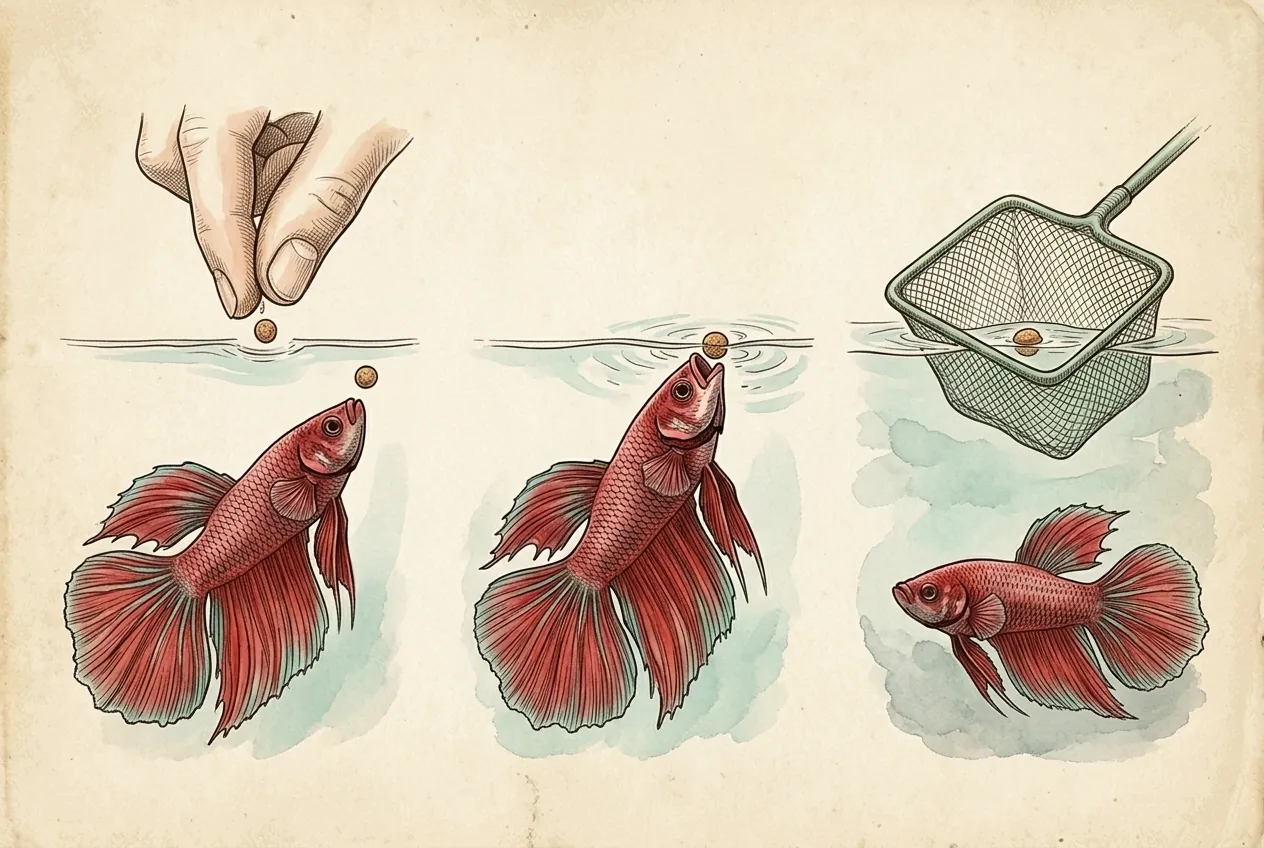
Drop in one pellet. Hikari's own care sheet says feed one at a time.
Watch it go down. Then add the next, up to your count, so nothing sinks unnoticed.
Take out leftovers. Anything left after a couple of minutes comes out with a small net or a turkey baster.
One pellet at a time, then lift out what's left.
- Space meals out. Hikari says at least three hours apart, and finish before lights out.
- Keep the water warm. A cold betta won't eat well. A heater and a thermometer come first.
Treats: bloodworms and frozen food
Treats a few times a week, alongside pellets. Frozen food never gets heated.
Freeze-dried bloodworms
We suggest soaking them in a little tank water for a minute first. Hikari's FAQ describes soaking freeze-dried food too.
Wash your hands
SFBB's label says bloodworms can cause an allergic reaction in some people. Wash your hands after handling them.
Frozen cubes for one betta
A whole cube is far too much for one small fish.
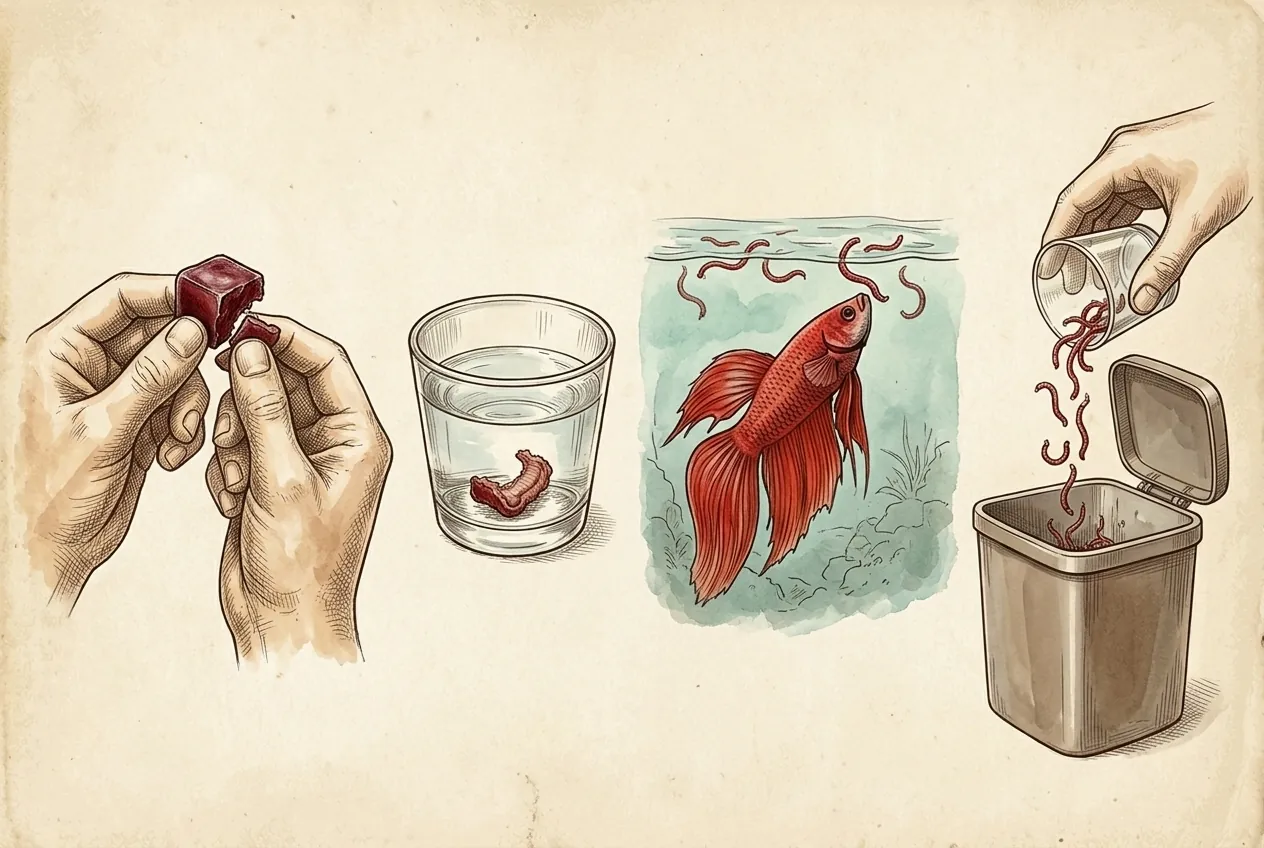
Break off a small piece of the frozen cube.
Let it thaw in a little cup of tank water.
Feed a few pieces to your betta.
Throw away the rest. Don't save it.
A small piece, thawed in tank water. Feed a few, toss the rest.
Do
- put the rest of the cube straight back in the freezer.
Don't
- use hot water or a microwave to thaw it.
- rinse thawed food through a net. SFBB says a lot of the nutrients wash away.
- refreeze food that has fully thawed.
Signs you're feeding too much
Uneaten food rots and raises ammonia. Take out leftovers.
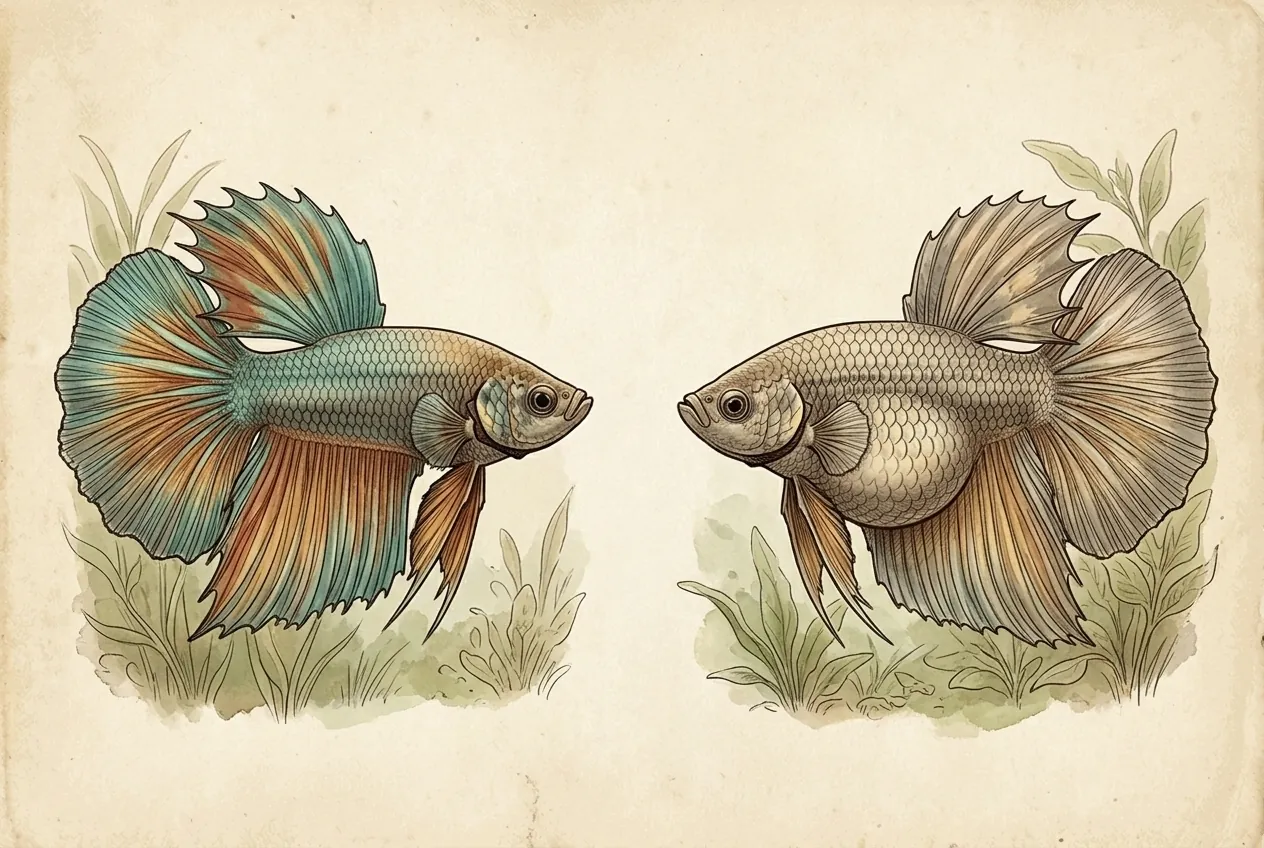
- Just right
- Too full
- Just right
- A slightly curved belly.
- Too full
- A round, swollen belly. Cut back.
Look at the belly
Fluval says a slightly curved belly is ideal. Judge by the fish, not the bag.
Look at the water
Hikari names ammonia spikes and cloudy water as what overfeeding does. Our betta care sheet adds bloating and swim bladder trouble.
Belly looks swollen? Cut back to a couple of pellets and skip a day. That's our own advice: no food maker prints a fasting day.
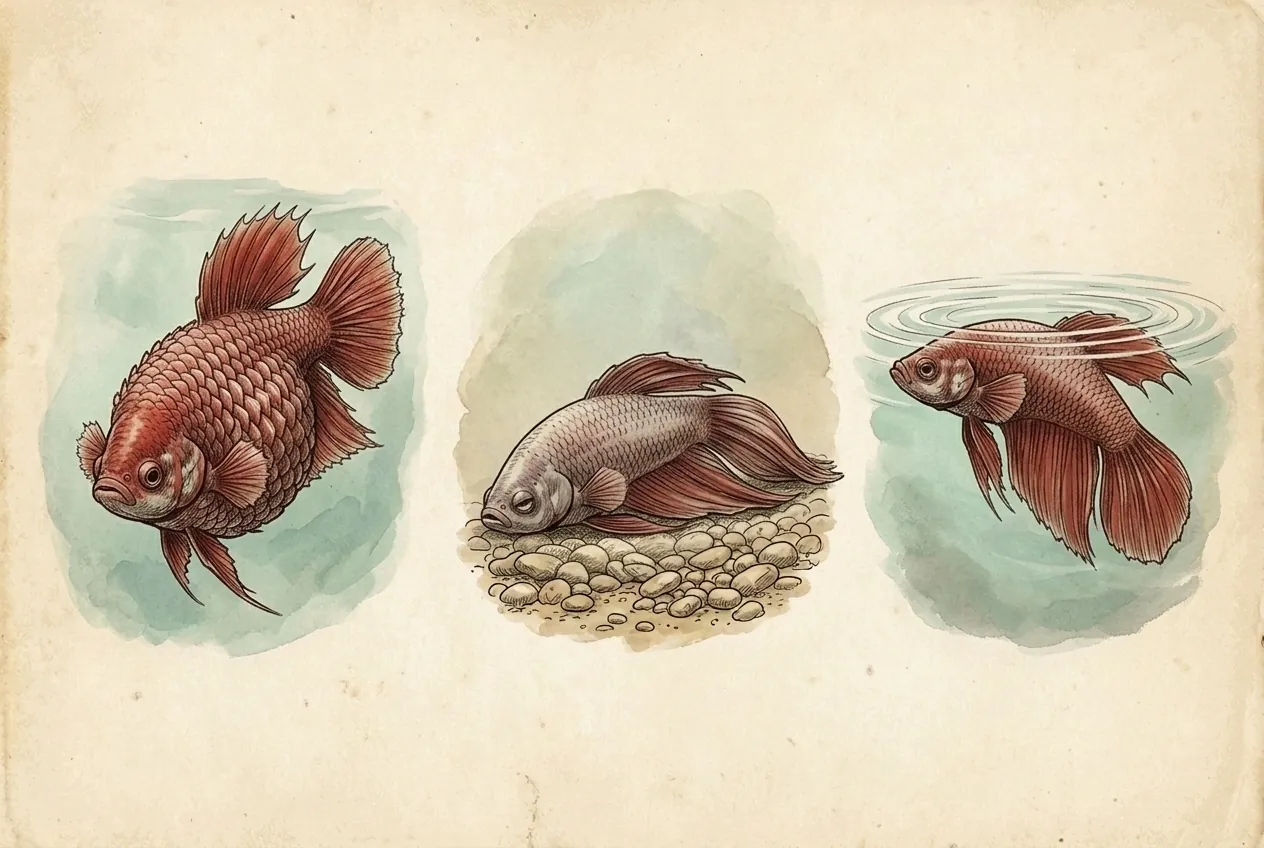
- Pinecone scales
- On the bottom
- Floating sideways
- Pinecone scales
- Scales stand out from a swollen body.
- On the bottom
- Lying still, fins clamped, not eating.
- Floating sideways
- Stuck at the top or can't stay down.
Some signs go beyond feeding:
- Scales standing out like a pinecone, with a badly swollen belly.
- Lying on the bottom, clamped fins, or not eating.
- Floating sideways, stuck at the top, or unable to stay down.
Feeding setup and storage
Heater, thermometer, a small net, and a food jar kept closed and out of the sun.
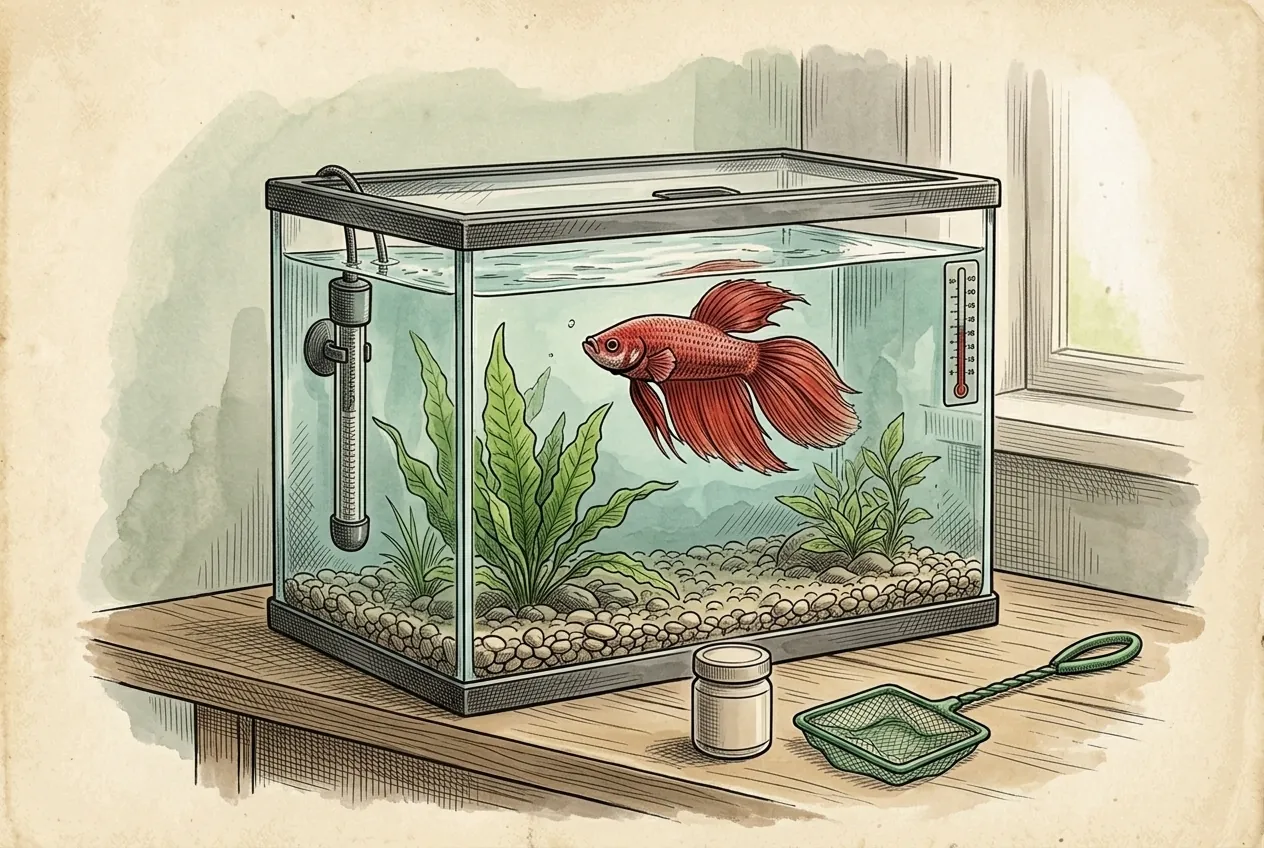
- Heater: a cold betta won't eat. This comes before food.
- Thermometer: shows what the water really is.
- Small net or baster: to lift out leftovers.
- Food jar: closed, cool and away from sun, heat and damp.
- Heater: a cold betta won't eat. This comes before food.
- Thermometer: shows what the water really is.
- Small net or baster: to lift out leftovers.
- Food jar: closed, cool and away from sun, heat and damp.
- Water care. A water conditioner and a test kit. The risk from overfeeding is a water risk, so water care is the answer.
- Buy the small jar. A betta eats a few pellets a day.
- After opening. Hikari says use it within 90 days. Fluval and Ocean Nutrition say 6 months.
- Keep it out of the sun. Hikari names sunlight, heat and humidity as what spoils it. Don't keep the jar on a sunny windowsill by the tank.
Going away
A vacation block is a stopgap, not a week of food. A helper with counted pellets is better.
- The 7-day block. Zoo Med's Betta Banquet lists calcium sulfate as its first ingredient. Its protein is 3.5%, against 38% or more in a betta pellet.
- Better, if you have help. Put a few pellets in a pill organizer, one per section, and have a neighbor drop one in every other day.
- Automatic feeder. Zoo Med says its Bettamatic feeds your betta every 12 hours.
Quick answers
How much do I feed my betta? Three or four pellets, twice a day, never more than five at once. Take out anything left after a couple of minutes.
Can my betta eat tropical flakes? For a few days, yes. A betta pellet is sized for its mouth and made for a mostly meat-eating fish, so it's the better staple.
Can bloodworms be the main food? No. They're a treat, a few times a week alongside pellets.
Do I thaw frozen food? For a betta, yes: thaw a small piece in a little cup of tank water. Never with hot water or a microwave.
My betta looks bloated. What do I do? Cut back to a couple of pellets and skip a day. If it also sits on the bottom, stops eating, or its scales stand out, bring us a water sample and see a vet who treats fish.
How long does an open jar last? Hikari says 90 days. Fluval and Ocean Nutrition say 6 months. Keep it closed, cool and out of the sun.
Is a 7-day block enough for a week away? It's a stopgap. It's mostly calcium sulfate with food in it. A neighbor with counted pellets is better.
Shop this
Pick up in store or have it shipped.
Reviewed by our team 2026-11-09. Nutrition figures are each maker's published guaranteed analysis.