
Frozen Fish Food: How to Thaw, Portion and Store It
Cubes vs flat packs, when to thaw (never with heat), portions for small tanks, which fish benefit, and the ice-crystal rule for refreezing.
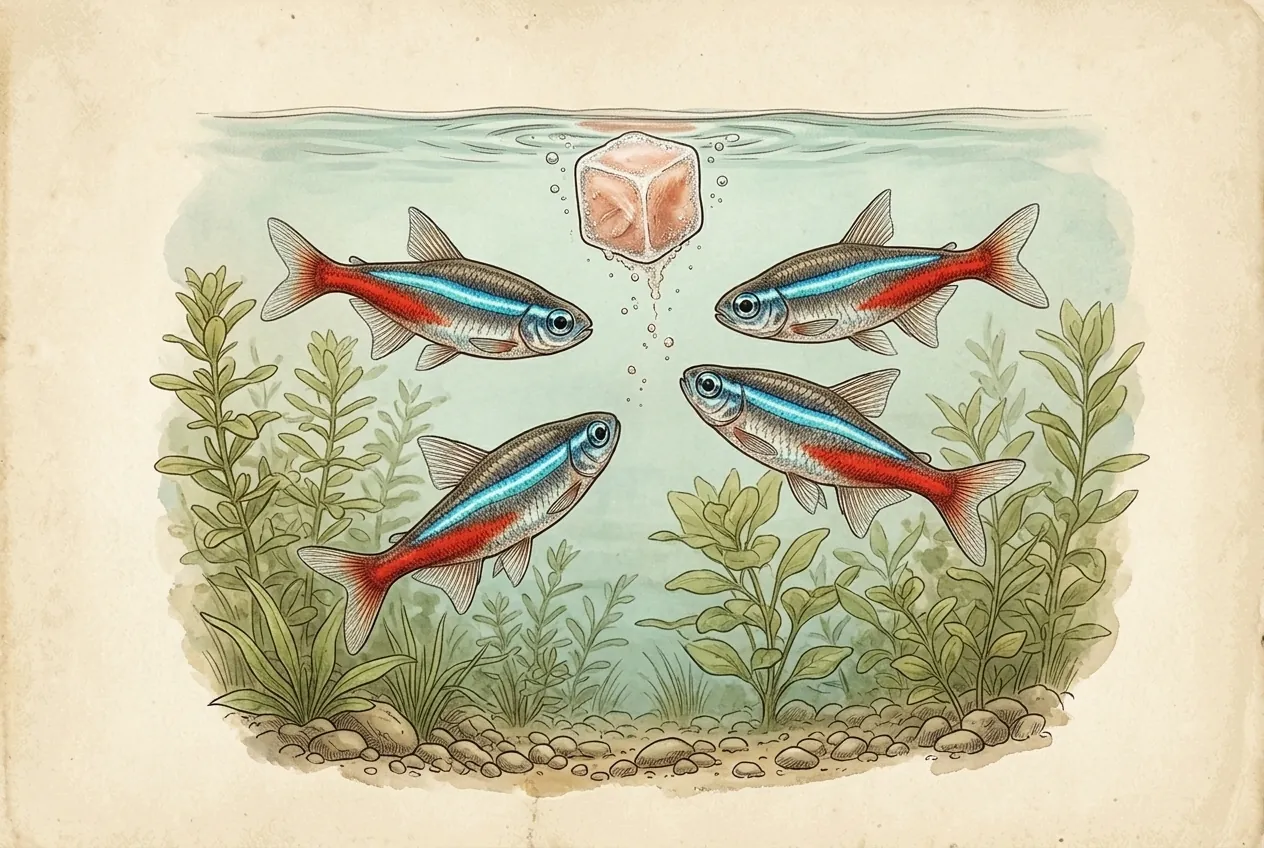
Frozen fish food is real bloodworms, brine shrimp, mysis, daphnia and more, frozen whole. It's the closest thing to live food most fish ever get.
Use it alongside a staple flake or pellet. Never heat it, feed only what gets eaten, and never refreeze a pack that has fully thawed.
At a glance
Cubes or flat packs
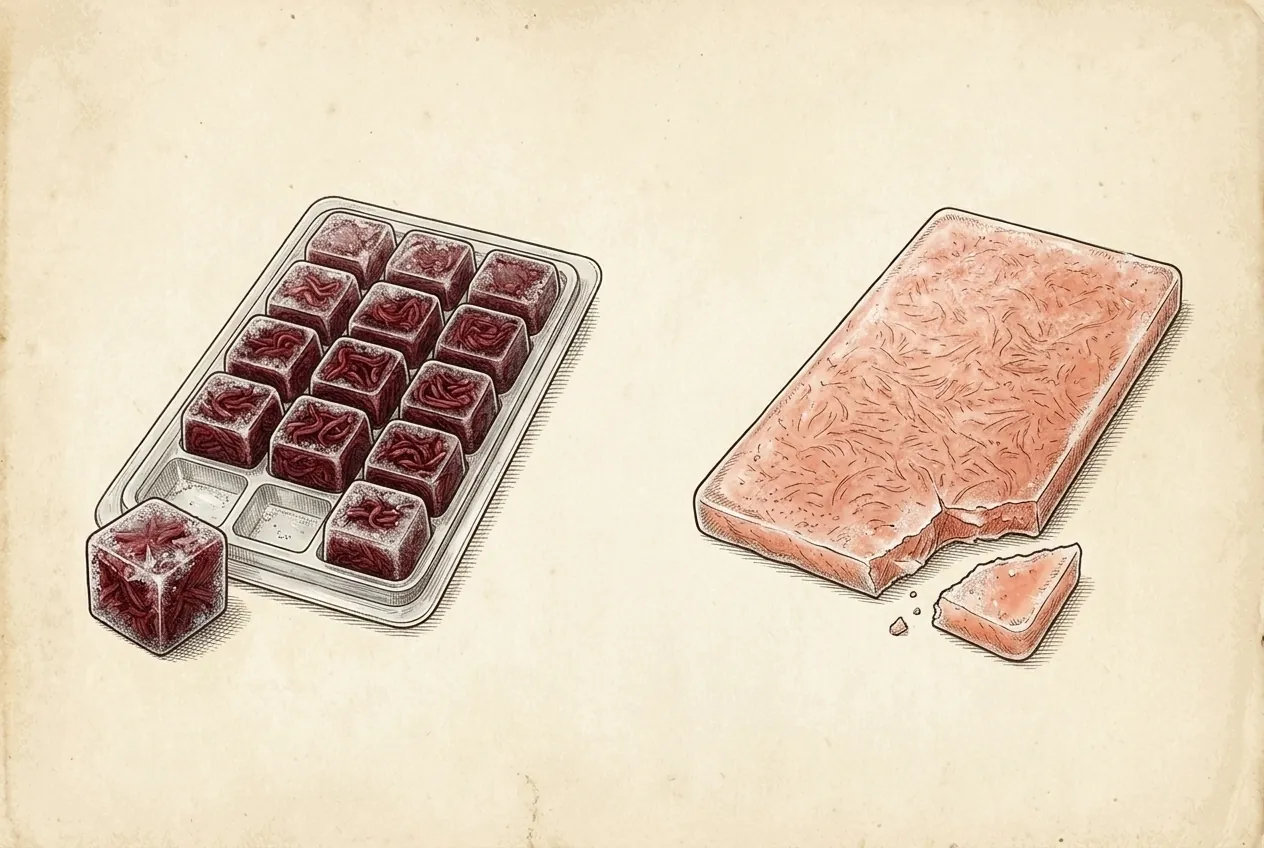
Cubes are ready-made portions. Flat packs are a slab you break or cut a piece off.
- Cube tray
- Flat pack
- Cube tray
- Pop out one portion at a time.
- Flat pack
- Break or cut off just what you need.
Cube tray
You pop out one portion at a time. It's the easiest way to start, and portion control for one tank.
Flat pack
One frozen slab. You break or cut off a piece. It works out cheaper per ounce if you feed several tanks.
Mini cubes
Some makers sell smaller cubes, handy for a small tank.
Why the protein looks low
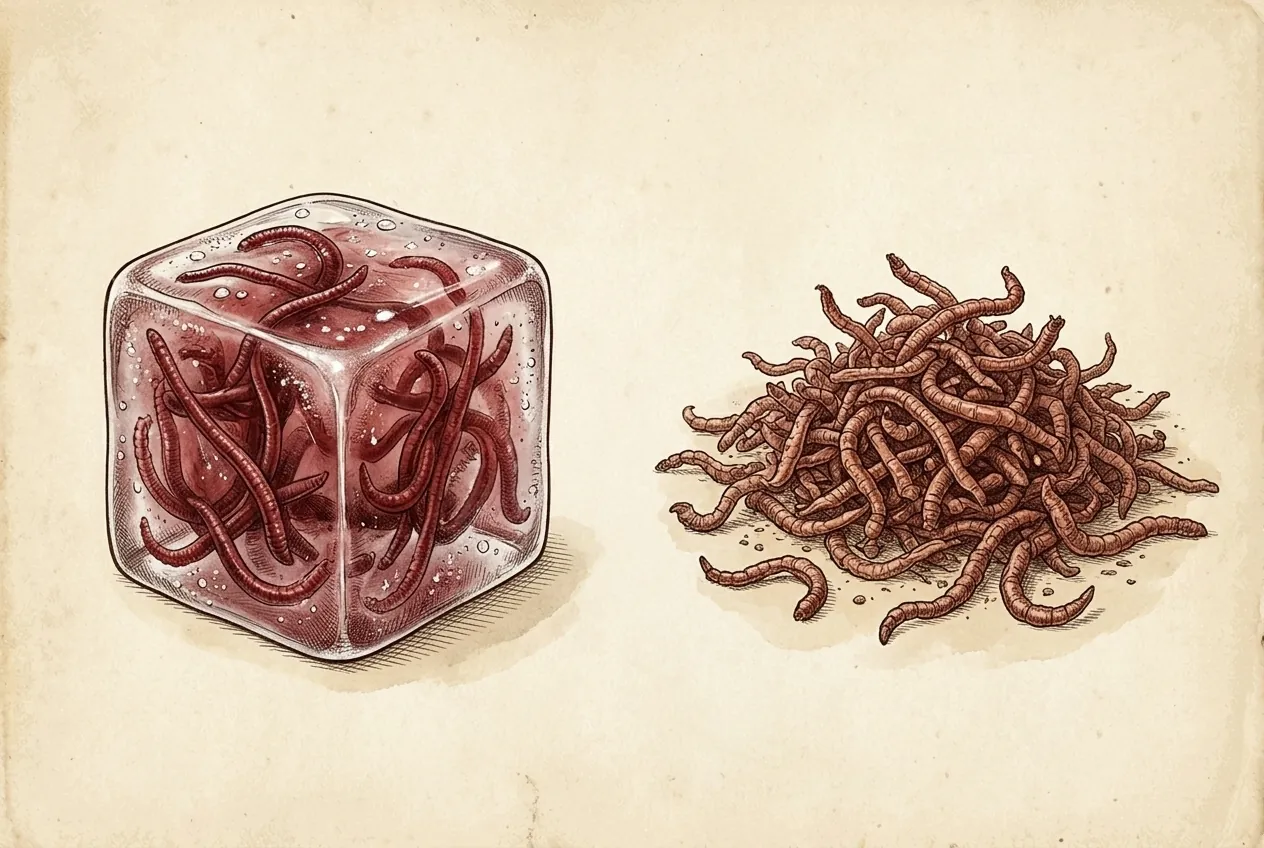
Frozen food is mostly water. A low protein number is wet weight, not a weak food.
- Frozen
- Freeze-dried
- Frozen
- Mostly water, like a live worm.
- Freeze-dried
- Water removed, so every number reads higher.
- The makers' labels put frozen food at about 85% to 96% water.
- Freeze-dried jars from the same brands are about 10% to 12% water.
- Labels report nutrients "as fed", per AAFCO, so water pulls every number down.
- So a 3.5% protein frozen bloodworm and a 44% protein freeze-dried one are the same worm, weighed wet and dry.
Fluval notes frozen food has less nutrition than a complete dry food, but gives fish a natural organism to eat. That's why it works best as a partner to a staple.
Compare 15 frozen foods: protein, fat, fiber, moisture and ash
Blends like Ocean Nutrition Formula One and Prime Reef carry added vitamins and are the closest thing to a complete frozen diet. Single foods such as bloodworms or brine shrimp are best as part of a varied menu.
| Food | What's in it | Cube or flat | Protein min | Fat min | Fiber max | Moisture max | Ash max | Extras, per the maker |
|---|---|---|---|---|---|---|---|---|
| Hikari Bio-Pure Blood Worms | Bloodworm | Both | 3.5% | 0.2% | 1.2% | 95% | not listed | Sterilized, vitamin-loaded |
| Hikari Bio-Pure Brine Shrimp | Brine shrimp | Both | 4% | 0.5% | 0.5% | 92% | not listed | Sterilized, vitamin-loaded |
| Hikari Bio-Pure Mysis Shrimp | Mysis | Both | 4.2% | 0.3% | 0.8% | 96.5% | not listed | Sterilized, vitamin-loaded |
| Hikari Bio-Pure Krill | Krill | Both | 1.5% | 1.5% | 0.5% | 96% | not listed | Sterilized, vitamin-loaded, added C, B2, B12 |
| Hikari Bio-Pure Daphnia | Daphnia | Cube | 2.5% | 0.5% | 0.9% | 94.5% | not listed | Sterilized, vitamin-loaded |
| Hikari Bio-Pure Mega-Marine | Blend | Cube | 2.8% | 0.6% | 1.0% | 96% | not listed | Sterilized, vitamin-loaded |
| SFBB Brine Shrimp, flat pack | Brine shrimp | Flat | 4.7% | 0.5% | 0.5% | 91.0% | 1.1% | not listed |
| SFBB Brine Shrimp, cubes | Brine shrimp | Cube | 4.0% | 0.4% | 0.5% | 92.0% | 1.1% | not listed |
| SFBB Bloodworms, flat pack | Bloodworm | Flat | 3.5% | 0.3% | 0.7% | 94.5% | 0.8% | not listed |
| SFBB Bloodworms, cubes | Bloodworm | Cube | 3.5% | 0.3% | 0.7% | 93.5% | 0.8% | not listed |
| SFBB Beefheart | Beefheart | Both | 8.9% | 1.6% | 0.2% | 89.6% | 1.0% | not listed |
| Ocean Nutrition Formula One | Seafood and algae blend | Cube | 14.5% | 1.5% | 0.7% | 84.8% | 2.2% | Vitamins A, B1, B2, B6, B12, C, E, K3 |
| Ocean Nutrition Prime Reef | Blend | Cube | 7.9% | 1.5% | 0.5% | 88.0% | 2.5% | Same vitamins plus biotin, niacin, folic acid |
| Ocean Nutrition Bloodworms | Bloodworm | Both | 3.2% | 0.2% | 0.7% | 95.1% | 0.4% | not listed |
| Ocean Nutrition Brine Shrimp | Brine shrimp | Both | 4.9% | 0.1% | 0.8% | 91.6% | 1.2% | not listed |
Figures are each maker's guaranteed analysis. SFBB's cube and flat pack numbers differ slightly.
Hikari lists no ash figure. Hikari is the only maker that says its frozen foods are sterilized, and it doesn't say how. No maker says any frozen food is irradiated.
Which fish benefit
Community fish, cichlids, discus, marine fish and turtles. Match the food to the mouth.
- Daphnia
- Bloodworms
- Beefheart
- Daphnia
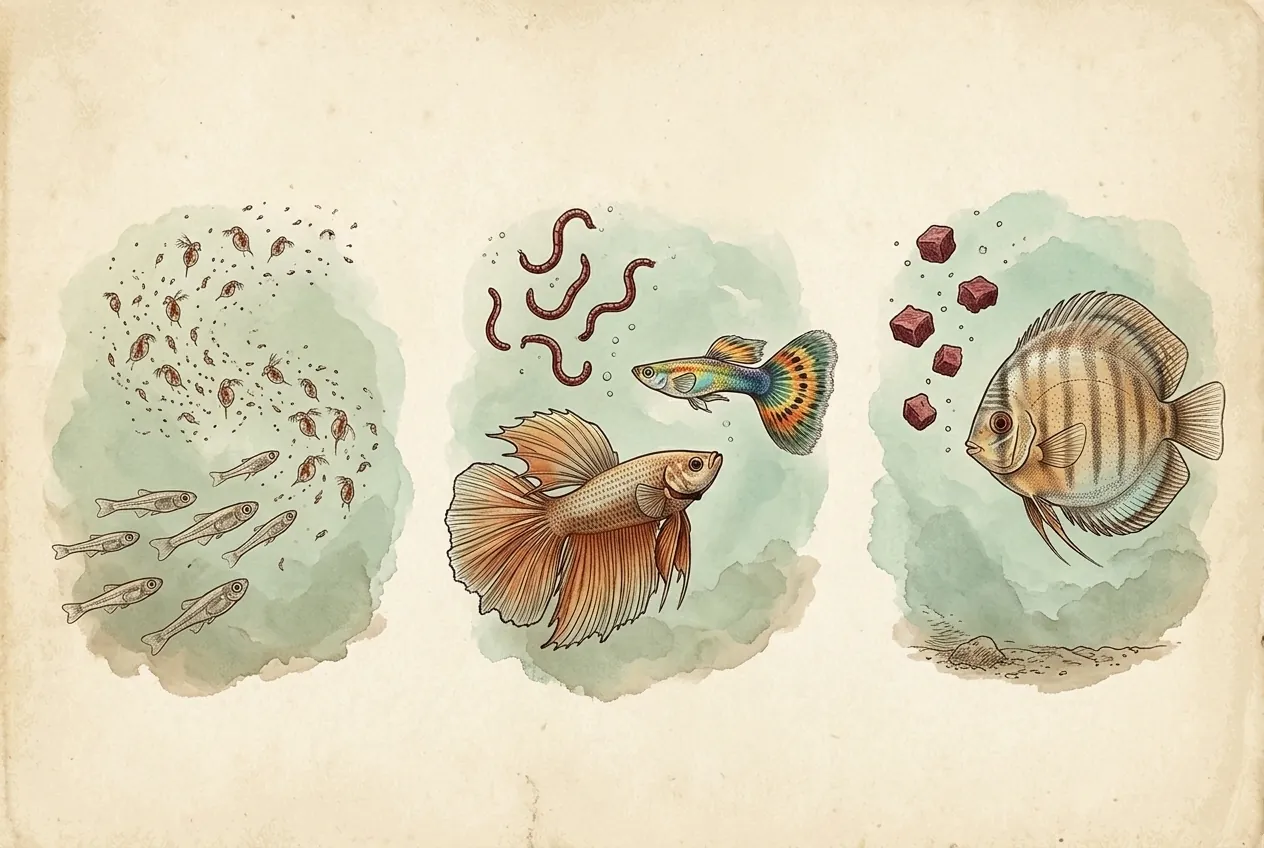
- Fry, small-mouthed fish, livebearers and egglayers, per Hikari.
- Bloodworms
- Most freshwater fish, including livebearers and American cichlids, per Hikari.
- Beefheart
- Discus, oscars, angels and other big carnivores, per SFBB.
Daphnia
Hikari aims it at fry, small-mouthed fish, egglayers, livebearers and smaller marine fish.
Bloodworms
Hikari lists most freshwater fish, especially livebearers, American cichlids, discus and eels.
Beefheart
SFBB aims it at discus, oscars, angelfish, South and Central American cichlids, and aquatic turtles.
Bettas
A frozen bloodworm or brine shrimp treat, alongside a betta pellet.
Baby fish
No maker gives a size rule. Whole bloodworms are big for fry, so pick daphnia, baby brine shrimp or rotifers.
Staple or treat? The makers split. Hikari calls frozen a supplement, and its mysis and krill a treat. SFBB says some keepers offer one or two frozen treats a week while others feed almost all frozen.
Thawing: the simple rule
Never heat it. Cubes can go in frozen. For a betta or one small fish, thaw a small piece in a cup of tank water.
Do
- drop a cube straight into a community tank, still frozen. Ocean Nutrition and SFBB both say so.
- break or cut a piece off a flat pack. SFBB says you can drop it in or thaw it in a cup first.
Don't
- use hot water or the microwave. SFBB says heat breaks down the nutrients.
- rinse thawed food through a net. SFBB says a lot of the nutrients wash away.
Why frozen? Ocean Nutrition says thawing gives outside bacteria a chance to get in. SFBB says a thawed cube can leave surface feeders without enough food.
For a betta or any single small fish, a whole cube is far too much. Thaw just a sliver:
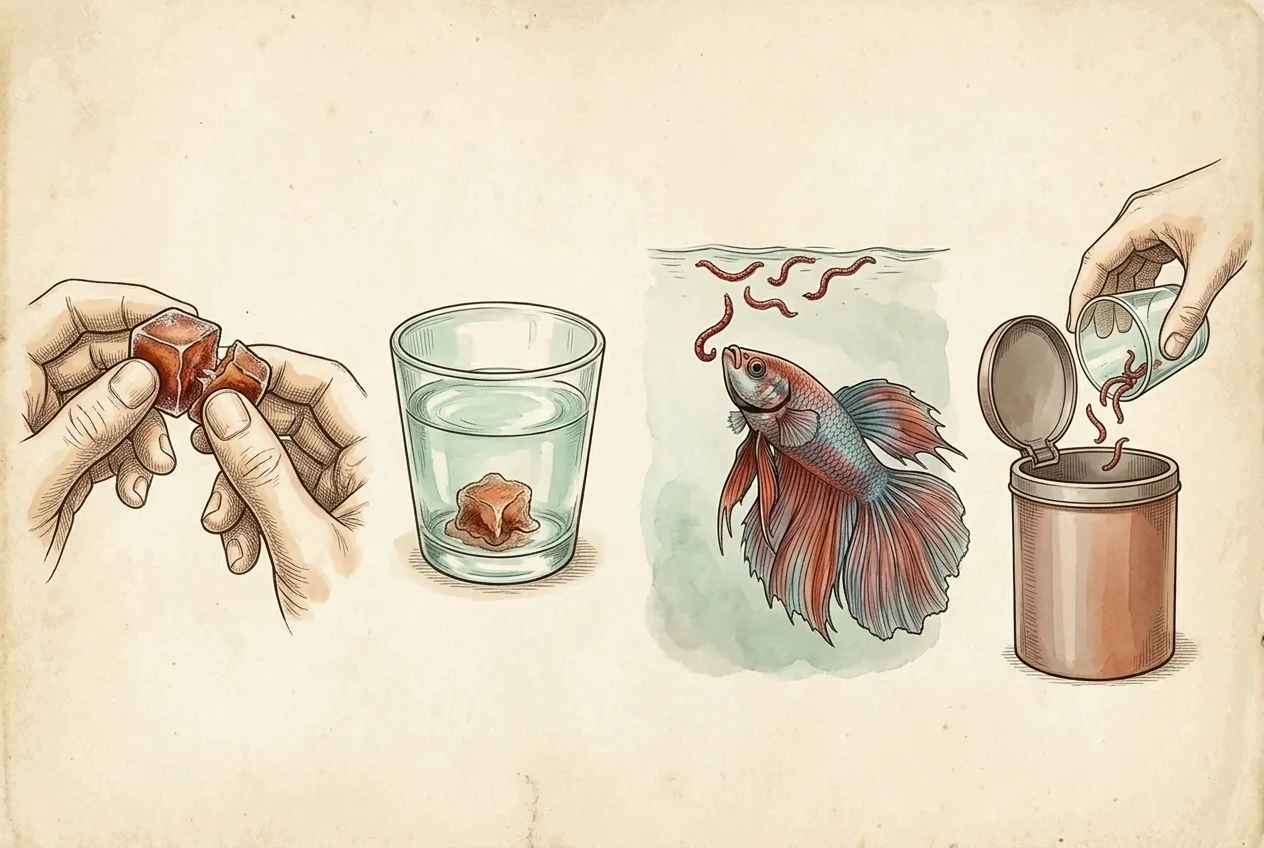
Break off a small piece of the cube or flat pack. Put the rest straight back in the freezer.
Thaw it in a little cup of water scooped from the tank. Same water, same temperature.
Feed a few pieces at a time and watch them get eaten.
Throw away the rest. Never refreeze food that has fully thawed.
Thaw a sliver, feed a few pieces, toss the rest.
How much and how often
Feed only what gets eaten, then take out the leftovers. The label is the final word.
The makers don't agree on the window. Each label gives its own:
| Maker's label | Eaten within | How often |
|---|---|---|
| Hikari | 30-45 seconds | Up to twice a day |
| Hikari Daphnia | About a minute | Up to 4 times a day |
| SFBB | 3 minutes | 1-3 times a day |
| Ocean Nutrition Formula foods | 5 minutes | 1-3 times a day |
| Ocean Nutrition single foods | 5 minutes | 2-3 times a day |
No label to hand? Our starting point is what your fish clean up in a minute or two, once a day.
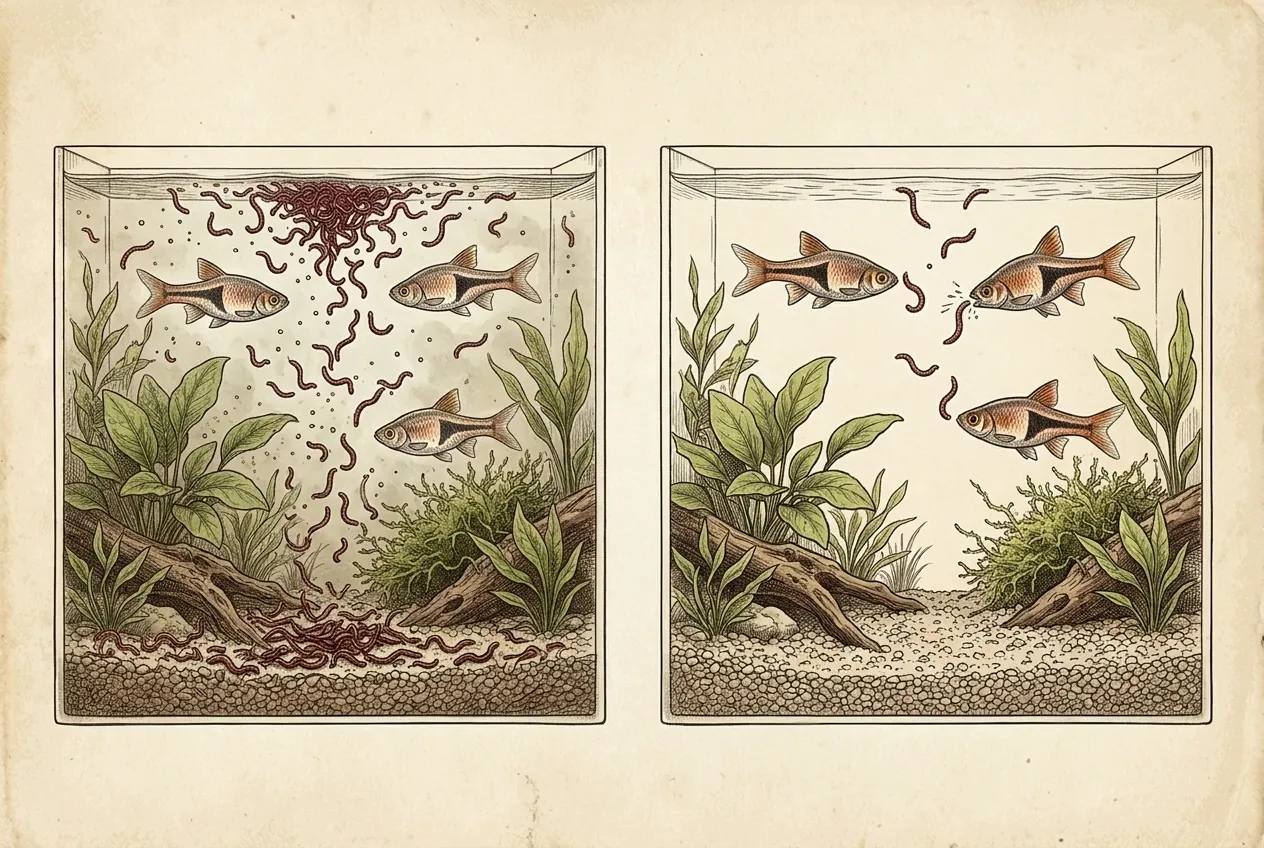
- Whole cube
- Small piece
- Whole cube
- Leftovers sink and rot.
- Small piece
- All eaten, nothing left behind.
Small tanks
A cube is sized for a bigger tank. Break it, or buy a mini-cube tray.
Leftovers
Every maker says to remove uneaten food. Uneaten food rots and raises ammonia; take out leftovers.
Feeding tools that help
A baster spreads food around. A net lifts out leftovers.
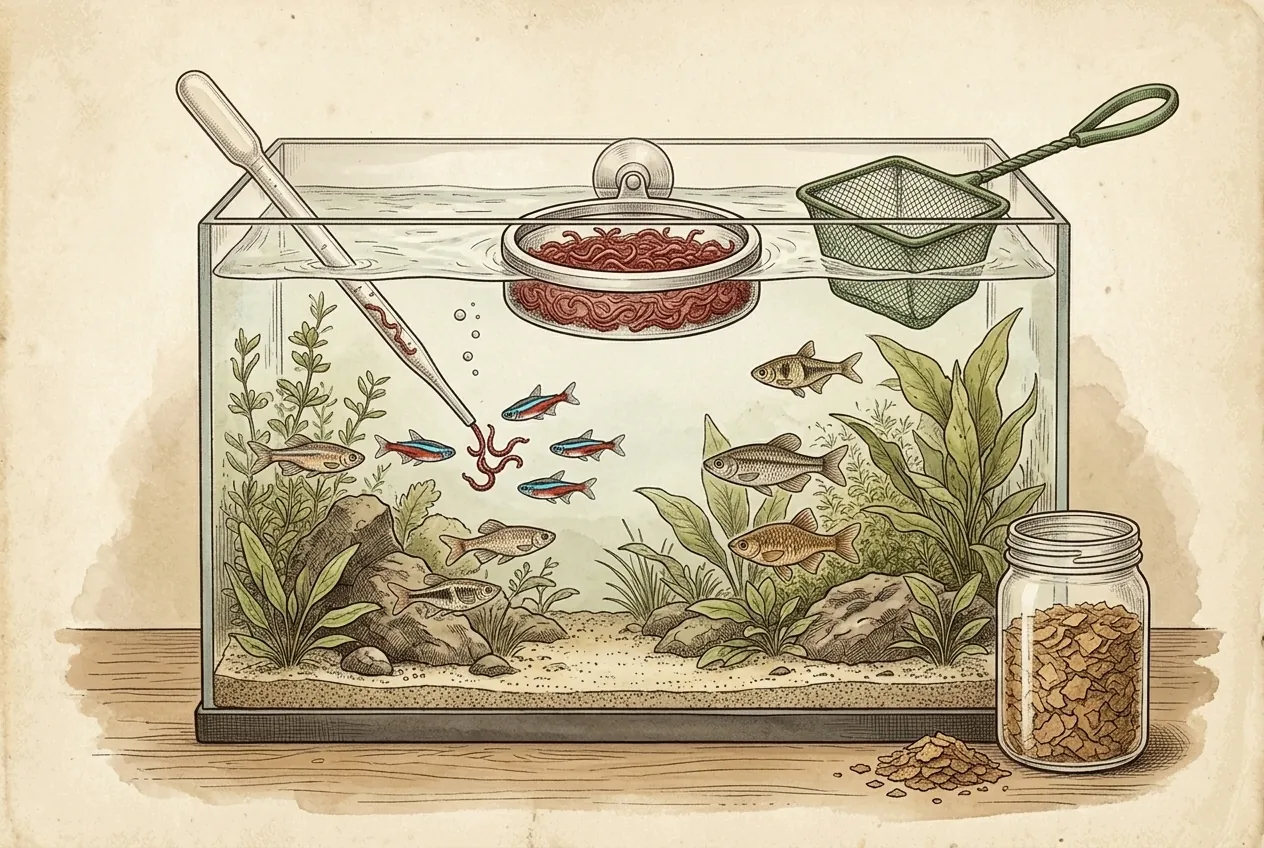
- Turkey baster: Aqueon suggests a baster or large syringe to feed a little at a time so every fish gets some.
- Feeding ring: Ocean Nutrition says its floating feeding station keeps food from scattering, frozen food included.
- Net: for lifting out anything not eaten.
- Staple food: a flake or pellet, because frozen is the extra.
- Baster or large syringe to spread food around the tank, per Aqueon.
- Floating feeding station to stop food drifting, per Ocean Nutrition.
- A net to take out leftovers.
- Worms for bottom feeders. SFBB suggests pressing a cube of tubifex firmly against the front glass below the waterline.
The drive home and refreezing
Ice crystals and cold to the touch: refreeze. Fully thawed: throw it out.
Make frozen food your last stop and go straight home.
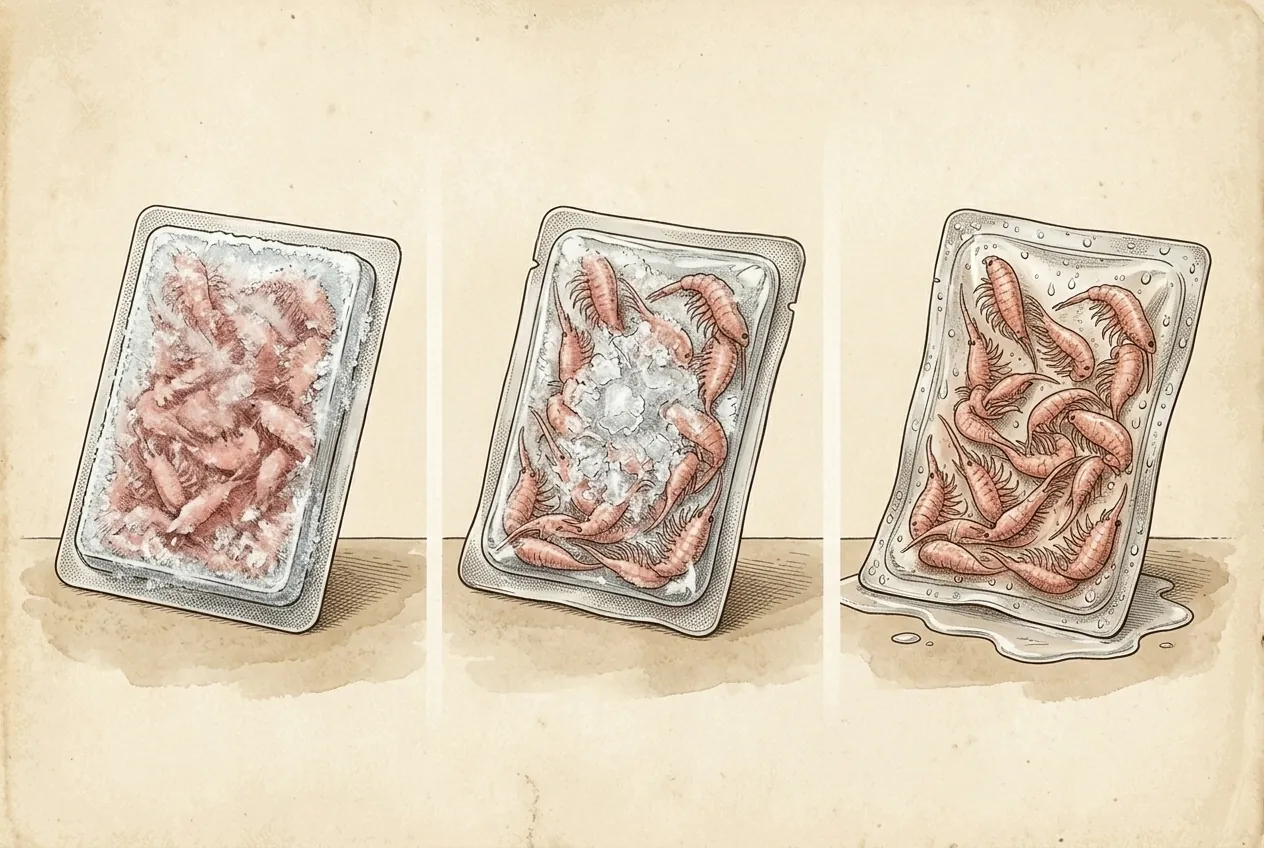
- Solid
- Ice crystals, cold
- Fully thawed
- Solid
- Straight in the freezer.
- Ice crystals, cold
- Refreeze within 2 hours.
- Fully thawed
- Throw it out.
- Still has ice crystals and cold to the touch: you can refreeze it.
- Kept at 40°F or below for no more than 2 hours: still OK to refreeze, per SFBB.
- Fully thawed and soft: throw it out. SFBB and Ocean Nutrition both say spoiled food can be toxic to fish.
- Don't trust your nose. SFBB says spoilage can start before it smells.
In the freezer. Keep it frozen solid and sealed. No maker prints a freezer temperature or a shelf life.
Safety for you and your fish
Wash your hands after handling, especially bloodworms.
Hikari, SFBB and Ocean Nutrition all print an allergy warning. Hikari says handling a frozen food can cause the same reaction as handling the live animal. Wash your hands right after and keep them away from your face.
Quick answers
Do I thaw frozen fish food first? Not for a community tank: drop the cube in frozen, as Ocean Nutrition and SFBB say. For a betta or one small fish, thaw a small piece in a cup of tank water. Never use heat.
Should I rinse it? No. SFBB says rinsing washes away nutrients. Don't pour thawed food through a net.
It went soft on the way home. Can I refreeze it? Only if it still has ice crystals and feels cold. If it has fully thawed, throw it out.
How much should I feed? Only what your fish eat in the time on your pack, from 30 seconds to 5 minutes depending on the maker. Then net out the leftovers.
Can frozen be my fish's only food? We suggest it alongside a flake or pellet. Hikari calls frozen a supplement. Blended formula foods come closest to a complete frozen diet.
Why is the protein so low next to freeze-dried? It's the same food weighed wet. Frozen is mostly water.
How long does it keep in the freezer? No maker prints a shelf life. Keep it frozen solid and sealed.
Shop this
Pick up in store or have it shipped.
Reviewed by our team 2026-11-09. Nutrition figures are each maker's published guaranteed analysis.