
Bromeliads, Air Plants, Ferns & Live Mosses
Neoregelia Tank Bromeliads • Tillandsia Air Plants • Vivarium Ferns • Mood, Sheet & Spikemoss
1. Canopy Mounting & Epiphyte Water Rules
2. Two Great Ways to Set Up Your Habitat
Mounting Neoregelia Tank Bromeliads (Never Bury the Cup!)
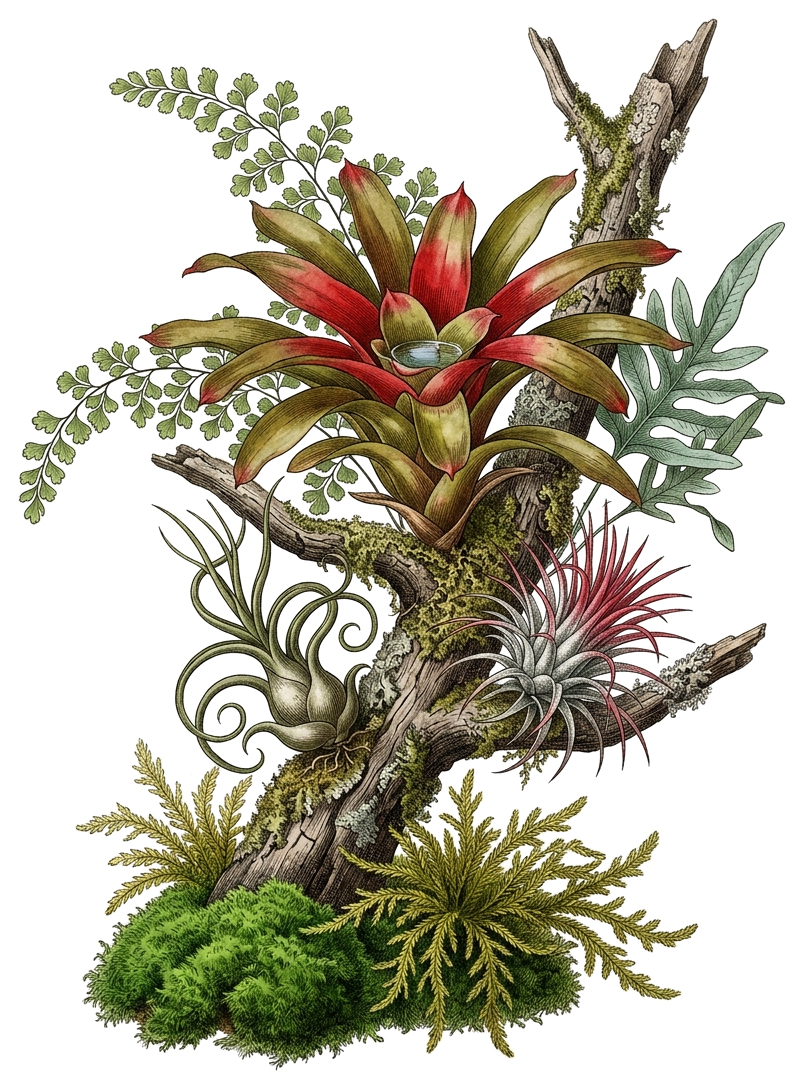
True tank bromeliads (Neoregelia, Vriesea, Guzmania) drink through their central leaf cup, while their wiry roots act as wood anchors:
Wedge Into Cork Bark, Driftwood, or Background Foam
Trim the woody stolon stub to 1–2", wedge it into a cork crevice (or pin with stainless wire / superglue gel), and keep the stem base out of wet soil. *(Note: Cryptanthus Earth Stars are terrestrial bromeliads and DO plant in well-drained floor soil.)*
Central Water Cup Care & How Bromeliad 'Pups' Grow
Keep the center cup filled with fresh RO or dechlorinated water (dart frogs use these pools as tadpole nurseries!) and flush weekly when misting. After blooming once, the mother plant sends out 1–4 baby 'pups' from its base—leave pups attached until half grown!
Air Plants (Tillandsia): Green-Leaf vs. Fuzzy Silver-Leaf Rule
Josh's Frogs warns: 'Avoid most Tillandsia [in wet frog tanks] – if they have a powdery silver coating on the leaves, they won't do well.'
Humid Vivarium Canopy (Smooth Green or Bulbous Base)
Tillandsia bulbosa, T. butzii, T. brachycaulos, T. caput-medusae, T. cyanea (Pink Quill), and T. ionantha ('Rubra', 'Fuego', 'Guat', 'Mexican') thrive mounted in the upper vivarium canopy where leaves dry within a few hours after misting.
Breezy Screen-Top & Semi-Arid Tanks (Fuzzy Silver Trichomes)
Tillandsia magnusiana, T. oaxacana, T. harrisii, and T. tectorum reflect desert sun and smother if kept constantly wet—mount near breezy screen tops or in semi-arid enclosures.
Live Mosses, Spikemoss (Selaginella) & Tissue-Culture Gel Cups
Mosses and clubmosses create humidity-buffering carpets across wood and soil:
Mood Moss, Sheet Moss, Java Moss & Selaginella Spikemoss
Press Mood Moss (Dicranum) onto sloped wood or soil mounds (never in standing puddles); use Sheet Moss or Java Moss in wetter drip zones; plant Selaginella ('Golden', 'Ruby Red', Peacock Spikemoss) and Baby's Tears (Soleirolia) in 75%+ RH.
How to Plant Sealed Tissue-Culture Cups (Rinse → Trim → Plant)
For sterile gel cups: 1. Gently RINSE all agar gel off the roots in lukewarm dechlorinated water, 2. TRIM into small portions, and 3. PLANT into damp substrate or moss under 80%+ RH while they acclimate.
3. Species-by-Species Cheat Sheet (10–75 Gal Vivariums)
Critical Epiphyte & Moss Survival Tips:
Tap water mineral salts crust over bromeliad cups, air plant trichomes & moss
Air plants breathe through leaves—if sopping wet 24/7, they smother & rot
Copper kills bromeliads & is toxic to frogs/inverts—use stainless wire or superglue gel!
If a red Neoregelia turns green, move it closer to your 6500K LED bar

4. Four Keys to a Happy, Thriving Bromeliads, Air Plants, Ferns & Live Mosses
Keep Bromeliad Stems Out of Mud
If a Neoregelia's base sits buried in wet soil, the lower leaves rot from the bottom up. Wedge it into wood or rock above the soil line!
Reviving a Thirsty Air Plant
If Tillandsia leaves curl inward, soak it 20–30 minutes in RO or dechlorinated water, then shake upside down so no water stays trapped in the crown.
Don't Bury Furry Fern Rhizomes
Blue Star Ferns (Phlebodium) and Rabbit's Foot Ferns grow from furry surface stems (rhizomes). Pin the rhizome on top of bark or sphagnum.
Keep Moss Unburied & Misted
Place live moss where it gets direct 6500K LED light (don't cover moss cushions with dead oak leaves) and mist daily with RO/distilled water.

Bring-Home Shopping Checklist
Tap items to check them off on your phone while you shop at Critter Cabana.
1. Cork Bark & Canopy Hardscape
2. Epiphyte, Fern & Moss Bundle
3. Pure Water & Misting Gear
Complete Reference Notes & Oregon Keeping Guide
Canopy Mounting & Epiphyte Water Rules
Epiphyte Roots Are Holdfasts, Not Mud Sponges — Mount on Cork or Wood!
Temperature & Humidity Zones
| Zone | Target | Notes |
|---|---|---|
| 1. Tank Bromeliads | Flush Cup Weekly | Mount on wood/background; keep central water cup 1/2–3/4 full of RO water |
| 2. Green-Leaf Tillandsia | Must Dry Between Mists | Smooth/bulbous species (bulbosa, ionantha) for humid upper canopy mounts |
| 3. Silver-Leaf Tillandsia | Rots If Kept Wet! | Fuzzy white trichomes (magnusiana, oaxacana) belong in breezy/semi-arid setups |
| 4. Vivarium Ferns | 60–85% RH • Damp Soil | Plant terrestrial ferns in airy ABG mix; mount Rabbit's Foot/Blue Star on cork |
| 5. Live Moss & Spikemoss | Zero Tap Minerals | Press onto damp cork or soil; mist ONLY with RO or distilled water |
Two Ways That Work (100% Stocked Store Options)
Mounting Neoregelia Tank Bromeliads (Never Bury the Cup!)
True tank bromeliads (Neoregelia, Vriesea, Guzmania) drink through their central leaf cup, while their wiry roots act as wood anchors:
- Wedge Into Cork Bark, Driftwood, or Background Foam: Trim the woody stolon stub to 1–2", wedge it into a cork crevice (or pin with stainless wire / superglue gel), and keep the stem base out of wet soil. (Note: Cryptanthus Earth Stars are terrestrial bromeliads and DO plant in well-drained floor soil.)
- Central Water Cup Care & How Bromeliad 'Pups' Grow: Keep the center cup filled with fresh RO or dechlorinated water (dart frogs use these pools as tadpole nurseries!) and flush weekly when misting. After blooming once, the mother plant sends out 1–4 baby 'pups' from its base—leave pups attached until half grown!
Air Plants (Tillandsia): Green-Leaf vs. Fuzzy Silver-Leaf Rule
Josh's Frogs warns: 'Avoid most Tillandsia [in wet frog tanks] – if they have a powdery silver coating on the leaves, they won't do well.'
- Humid Vivarium Canopy (Smooth Green or Bulbous Base): Tillandsia bulbosa, T. butzii, T. brachycaulos, T. caput-medusae, T. cyanea (Pink Quill), and T. ionantha ('Rubra', 'Fuego', 'Guat', 'Mexican') thrive mounted in the upper vivarium canopy where leaves dry within a few hours after misting.
- Breezy Screen-Top & Semi-Arid Tanks (Fuzzy Silver Trichomes): Tillandsia magnusiana, T. oaxacana, T. harrisii, and T. tectorum reflect desert sun and smother if kept constantly wet—mount near breezy screen tops or in semi-arid enclosures.
Live Mosses, Spikemoss (Selaginella) & Tissue-Culture Gel Cups
Mosses and clubmosses create humidity-buffering carpets across wood and soil:
- Mood Moss, Sheet Moss, Java Moss & Selaginella Spikemoss: Press Mood Moss (Dicranum) onto sloped wood or soil mounds (never in standing puddles); use Sheet Moss or Java Moss in wetter drip zones; plant Selaginella ('Golden', 'Ruby Red', Peacock Spikemoss) and Baby's Tears (Soleirolia) in 75%+ RH.
- How to Plant Sealed Tissue-Culture Cups (Rinse → Trim → Plant): For sterile gel cups: 1. Gently RINSE all agar gel off the roots in lukewarm dechlorinated water, 2. TRIM into small portions, and 3. PLANT into damp substrate or moss under 80%+ RH while they acclimate.
Species-by-Species Cheat Sheet (10–75 Gal Vivariums)

Little Prince, Josh's Frogs & Airplant Man — Epiphytes, Ferns & Moss
- Tank Bromeliads & Earth Stars (Neoregelia, Guzmania, Vriesea & Cryptanthus): Compact Neoregelia ('Fireball', 'Donger', 'Chiquita Linda', 'Tarzan') blush bright red under strong 6500K LED light! Mount on cork/wood at a 15°–30° angle so light hits the center cup and frogs can climb in. Compact Guzmania & Vriesea offer broader perches for tree frogs/geckos; Cryptanthus ('Pink Starlight', 'Elaine', 'Red', 'Absolute Zero') plant in floor soil.
- Vivarium Ferns (Floor & Bark) (Maidenhair, Lemon Button, Korean Rock, Blue Star & Rabbit's Foot): Floor/Mid-Zone Ferns: Lemon Button / Duffy Fern (Nephrolepis), Korean Rock Fern (Polystichum), Maidenhair (Adiantum), Brake Fern (Pteris), & Crispy Wave Bird's Nest (Asplenium) love evenly damp ABG soil. Epiphytic Ferns: Rabbit's Foot Fern (Davallia) & compact Blue Star Fern (Phlebodium) have furry surface rhizomes—mount on bark or keep rhizome above soil!
- Live Mosses & Spikemosses (Mood Moss, Sheet Moss, Selaginella, Soleirolia & Sagina): Mood Moss (lush cushions for mid-slopes), Sheet / Pillow Moss (flat carpets for bark & floor), Java Moss (amphibious/paludarium zones), Selaginella kraussiana / uncinata ('Golden', 'Aurea', 'Ruby Red' spikemosses), Baby's Tears (Soleirolia), & Irish/Scotch Moss (Sagina).
Critical Epiphyte & Moss Survival Tips:
- RO or Distilled Water ONLY: Tap water mineral salts crust over bromeliad cups, air plant trichomes & moss
- Airflow After Misting: Air plants breathe through leaves—if sopping wet 24/7, they smother & rot
- Never Use Copper Wire: Copper kills bromeliads & is toxic to frogs/inverts—use stainless wire or superglue gel!
- Bright Light = Red Color: If a red Neoregelia turns green, move it closer to your 6500K LED bar
Keeper Note: Safe Glues & Mounting Hardware: Never use copper wire around bromeliads, air plants, amphibians, or invertebrates. Use cyanoacrylate superglue gel (100% tank-safe once cured), aquarium silicone, plastic-coated plant ties, fishing line, or stainless steel pins.
Essential Keeper Rules & Pro Tips
- Keep Bromeliad Stems Out of Mud: If a Neoregelia's base sits buried in wet soil, the lower leaves rot from the bottom up. Wedge it into wood or rock above the soil line!
- Reviving a Thirsty Air Plant: If Tillandsia leaves curl inward, soak it 20–30 minutes in RO or dechlorinated water, then shake upside down so no water stays trapped in the crown.
- Don't Bury Furry Fern Rhizomes: Blue Star Ferns (Phlebodium) and Rabbit's Foot Ferns grow from furry surface stems (rhizomes). Pin the rhizome on top of bark or sphagnum.
- Keep Moss Unburied & Misted: Place live moss where it gets direct 6500K LED light (don't cover moss cushions with dead oak leaves) and mist daily with RO/distilled water.
Complete Store Setup Checklist
1. Cork Bark & Canopy Hardscape
- Virgin Cork Bark Flats, Cork Tubes, or Ghostwood / Driftwood
- Aquarium-Safe Cyanoacrylate Superglue Gel OR Stainless Pins
- Long-Fiber New Zealand Sphagnum Moss (Small Wisp for Roots)
2. Epiphyte, Fern & Moss Bundle
- 1–3 Neoregelia Tank Bromeliads (Mounted at Upper/Mid Angles)
- 2–3 Humidity-Matched Tillandsia Air Plants (Green vs. Silver)
- 1–2 Vivarium Ferns + Live Mood Moss, Sheet Moss, or Selaginella
3. Pure Water & Misting Gear
- RO / Distilled Water Jugs (Mandatory for Moss & Bromeliads!)
- Fine-Mist Hand Sprayer or Automatic Misting System (MistKing)
- 6500K Full-Spectrum Plant LED Bar (Maintains Red Blushing!)
How We Keep Them at Critter Cabana & Gresham Pet Supply
- Store-Shelf 10-Part Bioactive Recipes (Tropical, Arid & Invert): In our reptile rooms at Critter Cabana (Newberg) and Gresham Pet Supply, we build every bioactive vivarium from the bottom up—starting with a 1.5–2 inch LECA/hydroball drainage layer, a fine mesh substrate barrier, a 3–5 inch custom soil/bark/moss blend, and a thick top blanket of dry oak or magnolia leaf litter.
- Live Springtail & Isopod Cultures Ready to Seed: We breed and stock Temperate White Springtails, Dwarf White (Trichorhina tomentosa), Powder Blue & Powder Orange (Porcellionides pruinosus), Dairy Cow (Porcellio laevis), and Giant Canyon (Porcellio dilatatus) isopods so you can match your clean-up crew to your exact humidity and species.
- Grab Our Printable 1-Page Recipe or Tri-Fold Brochure: Ask our reptile team to walk you through scaling our 10-quart batch recipe to your exact tank size (18×18, 20L, 40B, or 4×2×2 PVC).
Common Questions (FAQ)
How deep should the soil layer be in a bioactive terrarium?
Aim for 3 to 5 inches of bioactive substrate above the mesh drainage barrier (and 4 to 6+ inches for burrowing species or heavy root plants) topped with a generous layer of leaf litter and cork bark flats.
Do arid bioactive setups (like Leopard Geckos or Bearded Dragons) need a drainage layer?
Usually no—in arid setups where you are not misting heavily, skip the LECA drainage layer and instead create a deep moisture gradient by watering only the cool/humid hide corner so isopods and springtails have a damp underground retreat.
Which isopods should I pick for a tropical vs. arid bioactive tank?
For humid tropical tanks (Dart Frogs, Crested Geckos, Ball Pythons), pair Temperate White Springtails with Dwarf White and Powder Orange/Blue isopods. For semi-arid setups (Leopard Geckos, Bearded Dragons, Corn Snakes), use Powder Blue/Orange or Giant Canyon isopods with a damp sphagnum moss pocket under cork bark.
Where can I buy bioactive soil ingredients, cork bark, and live isopods in Oregon?
We stock Zoo Med ReptiSoil, Eco Earth coco fiber, ReptiBark/Orchiata bark, sphagnum moss, leaf litter, LECA clay balls, substrate mesh, cork bark, and live springtail and isopod cultures at Critter Cabana in Newberg (514 E First St, 503-537-2887) and Gresham Pet Supply (2185 NW Burnside Rd, 503-665-7606).