
Tropical Bioactive Foliage, Vines & Aroids
Pothos • Scindapsus • Philodendron • Syngonium • Ficus pumila • Peperomia • Calathea & Begonia
1. The 4-Layer Bioactive Stack & Plant Prep

2. Two Great Ways to Set Up Your Habitat
Animal-Safe Grower Stock vs. General Nursery Pots
What makes a plant animal-safe is how it was grown and what was sprayed on it:
Vivarium-Grown Stock (Ready After Gentle Soil Rinse)
Plants grown specifically for vivariums (such as Josh's Frogs pesticide-free stock) are raised without systemic chemicals. Gently rinse loose potting media off roots in lukewarm dechlorinated water and plant!
General Garden Center Pots (3-to-6-Week Grow-Out Rule)
NEHERP notes: bare-rooting and rinsing are NOT pesticide-removing procedures. Any plant from a general nursery (or going with sensitive frogs where you want maximum caution) needs a 3–6+ week grow-out outside the animal tank. Never recommend a household bleach dip.
Zone Placement & Pruning inside 10 to 75 Gallon Tanks
Every plant on this guide is sized for standard 10 to 75 gallon terrariums—place each species by light and moisture zone:
Back Wall & Canopy Vines (Ficus pumila, Pothos, Scindapsus & Heartleaf Philodendron)
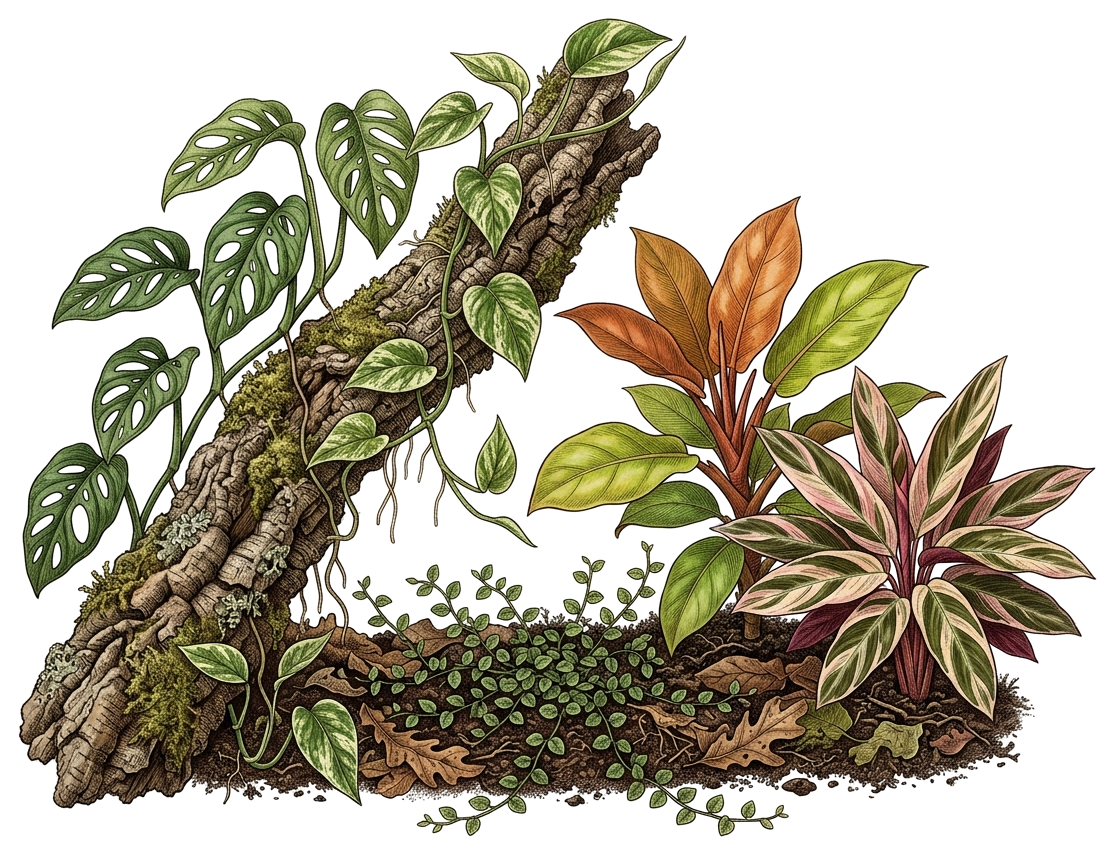
Pin Creeping Fig (Ficus pumila 'Variegated' & miniature 'Quercifolia' String of Frogs) to cork bark so its tiny aerial roots shingle the background, and drape compact Pothos ('N'Joy', 'Glacier', 'Manjula'), Satin Pothos (Scindapsus pictus), and Heartleaf Philodendron ('Brasil', 'Micans') across branches.
Well-Drained Mid-Zone vs. Moist Floor (Peperomia vs. Calathea & Pilea)
Grower Warning: Peperomia have semi-succulent stems and do not appreciate a soaked or saturated substrate—plant them in elevated, well-drained mid-zones! Save damp floor corners for compact Calathea, Fittonia, and Pilea.
Herbivore & Nibbler Check: Which Leaves Are Safe If Tasted?
Many tropical aroids contain calcium oxalate crystals that irritate mouths if chewed heavily:
For Insectivores, Frogs, Geckos & Snakes (Aroids: Pothos, Philodendron, Syngonium)
Crested Geckos, Dart & Tree Frogs, Chameleons, Ball Pythons, and Corn Snakes don't eat foliage—making sturdy vining aroids the #1 climbing and cover plants for their tanks!
For Plant-Nibblers (Callisia Turtle Vine, Peperomia, Pilea, Prayer Plants)
If your pet tastes leaves (such as Veiled Chameleons, Tortoises, or Blue Tongue Skinks), skip aroids/Dieffenbachia and choose Turtle Vine (Callisia repens), Peperomia, Pilea, Calathea/Maranta, or Spider Plants.

3. Species-by-Species Cheat Sheet (10–75 Gal Vivariums)
Watering, Pruning & Bioactive Care:
Never spray chlorinated tap water (kills springtails & burns Calathea tips)
Keep substrate moist like a wrung-out sponge; let leaves dry between mistings
Fertilizer beads burn amphibian skin—isopod castings feed roots naturally!
Tack vines to cork with stainless pins or superglue gel; prune Ficus monthly

4. Four Keys to a Happy, Thriving Tropical Bioactive Foliage, Vines & Aroids
Never Skip the Mesh Barrier
Without a fine mesh screen between your HydroBalls and soil, substrate fouls the drainage water table, turns anaerobic, and rots roots.
Remove Pots & Perlite Beads
Gently shake loose nursery peat and white perlite/fertilizer beads off roots (so reptiles never swallow white beads thinking they're calcium!).
Pair UVB With 6500K LED
Reptile UVB tubes don't emit the red/blue spectrum plants need for photosynthesis—add a 6500K plant LED bar on a 12-hour timer.
Cycle 2–4 Weeks If Possible
Planting and seeding springtails and isopods 2–4 weeks early lets roots anchor firmly before heavy geckos or snakes move in!

Bring-Home Shopping Checklist
Tap items to check them off on your phone while you shop at Critter Cabana.
1. Bioactive Substrate & Drainage
2. Balanced 3-Zone Plant Bundle
3. Lighting, Water & Clean-Up Crew
Complete Reference Notes & Oregon Keeping Guide
The 4-Layer Bioactive Stack & Plant Prep
Match Temp & Humidity to Your Animal First — Then Pick Plants for Each Zone!
Temperature & Humidity Zones
| Zone | Target | Notes |
|---|---|---|
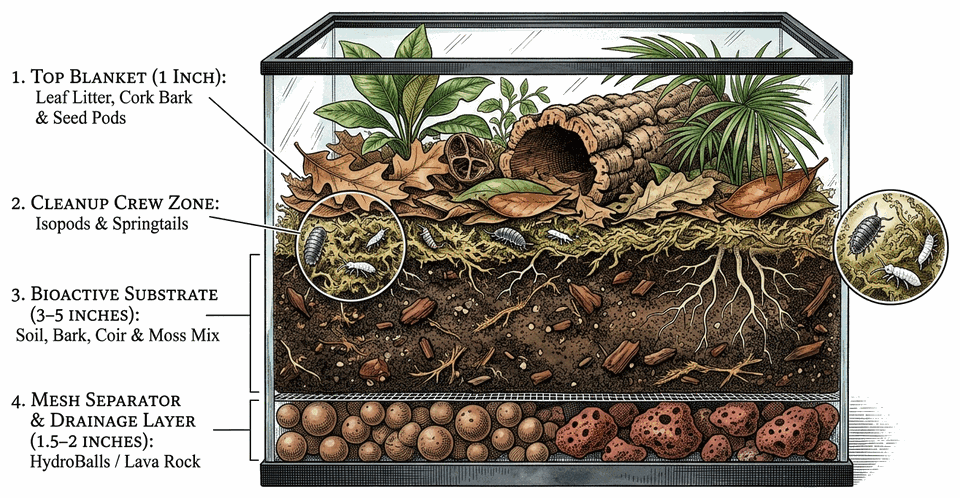
| 1. Drainage + Mesh | Prevents Root Rot | 1.5–2" HydroBalls/BioDrain + mandatory mesh screen barrier |
| 2. Bioactive Soil | Damp, Not Swampy | 3–5" ABG or Tropical Bioactive Mix pre-moistened before planting |
| 3. Leaf Litter & Crew | Feeds Plant Roots | 1" dry oak/magnolia leaves + Springtails & Isopods over roots |
| 4. Rinsing vs. Grow-Out | 3–6 Wk Quarantine | Rinsing removes loose dirt, NOT systemic nursery pesticides! |
| 5. 6500K Daylight LED | 10–12 Hours / Day | UVB bulbs help reptiles, but plants need 6500K full-spectrum LED |
Two Ways That Work (100% Stocked Store Options)
Animal-Safe Grower Stock vs. General Nursery Pots
What makes a plant animal-safe is how it was grown and what was sprayed on it:
- Vivarium-Grown Stock (Ready After Gentle Soil Rinse): Plants grown specifically for vivariums (such as Josh's Frogs pesticide-free stock) are raised without systemic chemicals. Gently rinse loose potting media off roots in lukewarm dechlorinated water and plant!
- General Garden Center Pots (3-to-6-Week Grow-Out Rule): NEHERP notes: bare-rooting and rinsing are NOT pesticide-removing procedures. Any plant from a general nursery (or going with sensitive frogs where you want maximum caution) needs a 3–6+ week grow-out outside the animal tank. Never recommend a household bleach dip.
Zone Placement & Pruning inside 10 to 75 Gallon Tanks
Every plant on this guide is sized for standard 10 to 75 gallon terrariums—place each species by light and moisture zone:
- Back Wall & Canopy Vines (Ficus pumila, Pothos, Scindapsus & Heartleaf Philodendron): Pin Creeping Fig (Ficus pumila 'Variegated' & miniature 'Quercifolia' String of Frogs) to cork bark so its tiny aerial roots shingle the background, and drape compact Pothos ('N'Joy', 'Glacier', 'Manjula'), Satin Pothos (Scindapsus pictus), and Heartleaf Philodendron ('Brasil', 'Micans') across branches.
- Well-Drained Mid-Zone vs. Moist Floor (Peperomia vs. Calathea & Pilea): Grower Warning: Peperomia have semi-succulent stems and do not appreciate a soaked or saturated substrate—plant them in elevated, well-drained mid-zones! Save damp floor corners for compact Calathea, Fittonia, and Pilea.
Herbivore & Nibbler Check: Which Leaves Are Safe If Tasted?
Many tropical aroids contain calcium oxalate crystals that irritate mouths if chewed heavily:
- For Insectivores, Frogs, Geckos & Snakes (Aroids: Pothos, Philodendron, Syngonium): Crested Geckos, Dart & Tree Frogs, Chameleons, Ball Pythons, and Corn Snakes don't eat foliage—making sturdy vining aroids the #1 climbing and cover plants for their tanks!
- For Plant-Nibblers (Callisia Turtle Vine, Peperomia, Pilea, Prayer Plants): If your pet tastes leaves (such as Veiled Chameleons, Tortoises, or Blue Tongue Skinks), skip aroids/Dieffenbachia and choose Turtle Vine (Callisia repens), Peperomia, Pilea, Calathea/Maranta, or Spider Plants.
Species-by-Species Cheat Sheet (10–75 Gal Vivariums)

Little Prince & Josh's Frogs Terrarium Stock — Light, Moisture & Pruning
- Compact Vining Aroids (Pothos, Scindapsus, Heartleaf Philodendron & Dwarf Syngonium): Pothos (Epipremnum 'N'Joy', 'Manjula', 'Glacier', 'Golden'), Satin Pothos (Scindapsus pictus 'Exotica', 'Silver Lady'), Heartleaf Philodendron (P. hederaceum 'Brasil', 'Micans'), & dwarf Syngonium ('Pixie') are bulletproof climbers for 10–75 gal tanks: moderate-to-bright 6500K LED, 60–80% RH, and easy tip-pruning whenever vines reach the screen top.
- Creepers & Semi-Succulents (Ficus pumila, Muehlenbeckia, Hoya & Peperomia): Creeping Fig (Ficus pumila 'Variegated' & tiny 'Quercifolia' String of Frogs) and Wire Vine (Muehlenbeckia) carpet backgrounds fast—trim monthly so they don't smother slower plants! Peperomia ('Napoli Nights', 'Rana Verde', 'Rosso', 'Frost', String of Turtles) & compact Hoya ('Krimson Queen', 'Curtsii') need airy, well-drained pockets (never soggy feet).
- Patterned Floor & Begonias (Compact Calathea, Begonia, Pilea, Fittonia & Cryptanthus): Compact Calathea / Maranta ('Freddie', 'Makoyana', 'Rattlesnake'), Fittonia (Nerve Plant), & Pilea ('Moon Valley', 'Aquamarine', 'Silver Tree') love 70%+ RH and RO/distilled water. Terrarium Begonias ('Stained Glass', ' Bowerae') & Jewel Orchids (Ludisia) need humid air but no standing water on leaves. Earth Stars (Cryptanthus) add low rosettes on the floor.
Watering, Pruning & Bioactive Care:
- RO or Dechlorinated Water: Never spray chlorinated tap water (kills springtails & burns Calathea tips)
- Water Soil, Not Just Leaves: Keep substrate moist like a wrung-out sponge; let leaves dry between mistings
- Skip Chemical Fertilizers: Fertilizer beads burn amphibian skin—isopod castings feed roots naturally!
- Pin & Prune Fast Vines: Tack vines to cork with stainless pins or superglue gel; prune Ficus monthly
Keeper Note: Why Did My New Plant Drop a Few Leaves? Moving a tropical plant from a greenhouse into an enclosed glass terrarium changes light spectrum and airflow overnight. Minor leaf drop on Ficus, Calathea, or Begonia in week 1–2 is normal—keep roots evenly moist (never waterlogged) under a 6500K LED and fresh vivarium-adapted leaves will flush out!
Essential Keeper Rules & Pro Tips
- Never Skip the Mesh Barrier: Without a fine mesh screen between your HydroBalls and soil, substrate fouls the drainage water table, turns anaerobic, and rots roots.
- Remove Pots & Perlite Beads: Gently shake loose nursery peat and white perlite/fertilizer beads off roots (so reptiles never swallow white beads thinking they're calcium!).
- Pair UVB With 6500K LED: Reptile UVB tubes don't emit the red/blue spectrum plants need for photosynthesis—add a 6500K plant LED bar on a 12-hour timer.
- Cycle 2–4 Weeks If Possible: Planting and seeding springtails and isopods 2–4 weeks early lets roots anchor firmly before heavy geckos or snakes move in!
Complete Store Setup Checklist
1. Bioactive Substrate & Drainage
- 1.5–2" Clay Drainage (Zoo Med HydroBalls / BioDrain)
- Non-Toxic Substrate Mesh Barrier Screen
- 3–5" Tropical Bioactive Soil Mix (ABG / ReptiSoil Mix)
- 1" Dried Oak or Magnolia Leaf Litter + Cork Bark
2. Balanced 3-Zone Plant Bundle
- 1–2 Canopy Climbers (Pothos, Scindapsus, or Heartleaf Philodendron)
- 1–2 Creepers / Mid-Zone (Ficus pumila, Peperomia, Syngonium)
- 1–2 Floor Accents (Calathea, Pilea, Fittonia, Cryptanthus)
3. Lighting, Water & Clean-Up Crew
- Full-Spectrum 6500K Plant LED Bar + 12-Hr Timer
- RO / Distilled Water or ReptiSafe Dechlorinator
- Temperate White Springtails + Dwarf White / Powder Orange Isopods
How We Keep Them at Critter Cabana & Gresham Pet Supply
- Store-Shelf 10-Part Bioactive Recipes (Tropical, Arid & Invert): In our reptile rooms at Critter Cabana (Newberg) and Gresham Pet Supply, we build every bioactive vivarium from the bottom up—starting with a 1.5–2 inch LECA/hydroball drainage layer, a fine mesh substrate barrier, a 3–5 inch custom soil/bark/moss blend, and a thick top blanket of dry oak or magnolia leaf litter.
- Live Springtail & Isopod Cultures Ready to Seed: We breed and stock Temperate White Springtails, Dwarf White (Trichorhina tomentosa), Powder Blue & Powder Orange (Porcellionides pruinosus), Dairy Cow (Porcellio laevis), and Giant Canyon (Porcellio dilatatus) isopods so you can match your clean-up crew to your exact humidity and species.
- Grab Our Printable 1-Page Recipe or Tri-Fold Brochure: Ask our reptile team to walk you through scaling our 10-quart batch recipe to your exact tank size (18×18, 20L, 40B, or 4×2×2 PVC).
Common Questions (FAQ)
How deep should the soil layer be in a bioactive terrarium?
Aim for 3 to 5 inches of bioactive substrate above the mesh drainage barrier (and 4 to 6+ inches for burrowing species or heavy root plants) topped with a generous layer of leaf litter and cork bark flats.
Do arid bioactive setups (like Leopard Geckos or Bearded Dragons) need a drainage layer?
Usually no—in arid setups where you are not misting heavily, skip the LECA drainage layer and instead create a deep moisture gradient by watering only the cool/humid hide corner so isopods and springtails have a damp underground retreat.
Which isopods should I pick for a tropical vs. arid bioactive tank?
For humid tropical tanks (Dart Frogs, Crested Geckos, Ball Pythons), pair Temperate White Springtails with Dwarf White and Powder Orange/Blue isopods. For semi-arid setups (Leopard Geckos, Bearded Dragons, Corn Snakes), use Powder Blue/Orange or Giant Canyon isopods with a damp sphagnum moss pocket under cork bark.
Where can I buy bioactive soil ingredients, cork bark, and live isopods in Oregon?
We stock Zoo Med ReptiSoil, Eco Earth coco fiber, ReptiBark/Orchiata bark, sphagnum moss, leaf litter, LECA clay balls, substrate mesh, cork bark, and live springtail and isopod cultures at Critter Cabana in Newberg (514 E First St, 503-537-2887) and Gresham Pet Supply (2185 NW Burnside Rd, 503-665-7606).