
Bioactive Setup
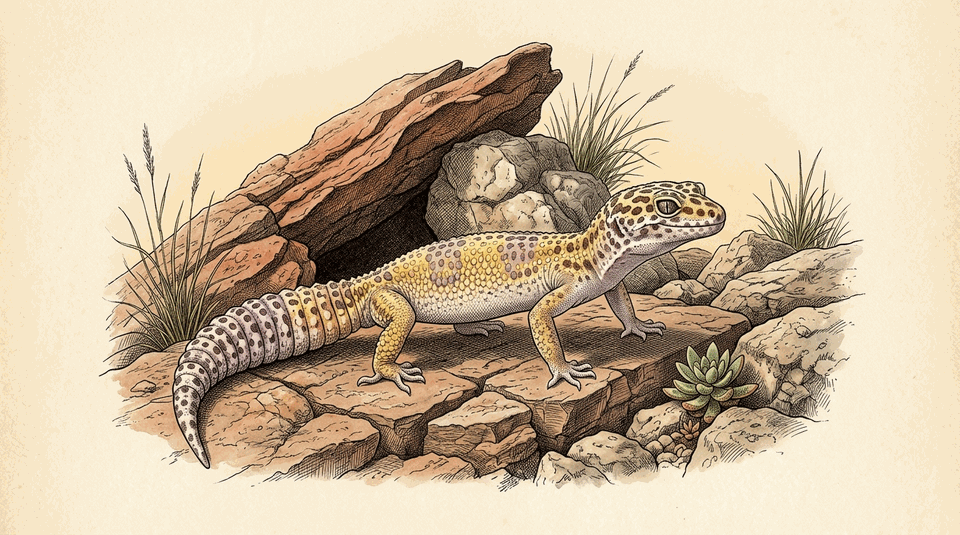
1. Habitat Layout & Temperature Gradient
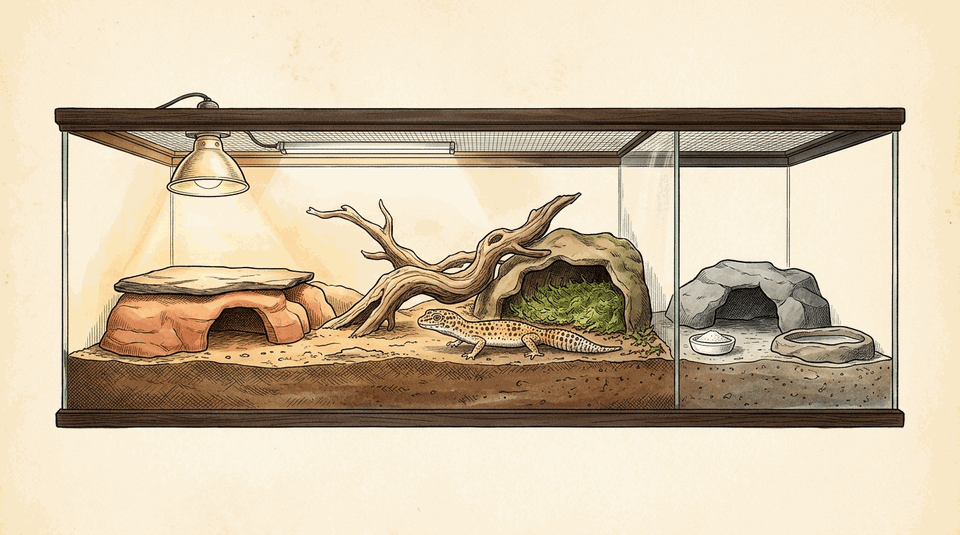
Concept: Bioactive Vivarium / Terrarium Setup | Applicable To: Reptiles, Amphibians, Invertebrates

Critter Cabana & Gresham Pet Supply — Keeping Your Pet Healthy & Thriving
What is a Bioactive Enclosure?
A bioactive enclosure is a self-sustaining miniature ecosystem. Instead of sterile paper towels or artificial turf that must be constantly replaced, a bioactive setup uses living soil, live plants, and a "Clean-Up Crew" (micro-invertebrates) to break down animal waste (feces, shed skin, uneaten food) and convert it into nutrients for the plants.
The Goal: To replicate nature. While it requires more effort and cost upfront, a properly functioning bioactive enclosure smells earthy and fresh, requires far less cleaning, and provides massive mental enrichment for your animal.
The 4 Essential Layers
Building from the bottom up ensures proper drainage and prevents the soil from turning into a swamp.
1. The Drainage Layer (False Bottom)
- Purpose: To catch excess water from misting or watering plants, keeping the soil above it from becoming waterlogged (which causes root rot and bacterial blooms).
- Materials: LECA (Lightweight Expanded Clay Aggregate, often sold as Hydroballs), lava rock, or plastic egg crate.
- Depth: 1.5 to 2 inches deep.
- Note for Arid Setups: In very dry enclosures (like for a Bearded Dragon), a drainage layer is usually unnecessary since you won't be heavily watering.
2. The Barrier Layer (Substrate Mesh)
- Purpose: A physical barrier to prevent the soil layer from falling down into the drainage layer and clogging it.
- Materials: Fiberglass window screen mesh, weed blocker fabric, or specialized terrarium mesh.
- Application: Cut to the exact footprint of the tank and lay it flat over the drainage layer.
3. The Substrate Layer (The Soil)
- Purpose: To anchor the plants, hold moisture, and house the clean-up crew. It must be light, airy, and nutrient-dense.
- Materials:
- Tropical (Frogs, Crested Geckos): ABG (Atlanta Botanical Gardens) mix, or a blend of organic topsoil, sphagnum moss, orchid bark, tree fern fiber, and horticultural charcoal.
- Arid (Bearded Dragons, Leopard Geckos): A mix of organic topsoil (without fertilizers/perlite), play sand, and excavator clay.
- Depth: 2 to 4 inches (deeper if you have burrowing animals or large rooted plants).
4. The Leaf Litter Layer
- Purpose: This is the most critical layer for the Clean-Up Crew. Leaves provide a micro-climate where isopods and springtails can hide, breed, and eat. As the leaves decay, they become food.
- Materials: Dried, sterilized Live Oak, Sea Grape, Magnolia, or Indian Almond leaves.
- Application: Cover the entire floor of the terrarium (especially for amphibians, as it keeps the soil off their skin).
The Clean-Up Crew (CUC)
The CUC are the unsung heroes of the bioactive tank. They eat the mold, fungus, and animal waste.
Springtails
- What they do: Microscopic white insects that eat mold, fungus, and bacteria. They are the primary defense against terrarium rot.
- Environment: They thrive in high humidity and moisture. In arid tanks, they will stick to the damp soil underneath the water bowl.
Isopods (Roly-Polys / Woodlice)
- What they do: Larger detritivores that act as the heavy lifters, eating solid waste (feces, dead leaves, shed skin).
- Which species to choose?
- Tropical/High Humidity: Dwarf White (excellent because they burrow and hide from hungry frogs), Powder Orange, or Dairy Cow (fast breeders).
- Arid/Dry: Giant Canyon or Powder Blue/Orange (they tolerate dryness better, but still require a damp hide).
- Avoid: Do not use massive, hard-shelled isopods for delicate animals, as they can sometimes nibble on resting reptiles.
IMPORTANT: Your animal will occasionally eat the CUC. This is normal and provides a healthy, natural hunting experience. You may need to replenish the CUC every 6-12 months.
Plants & Lighting

Choosing Plants
Select plants that match your animal's environment and destructiveness.
- Heavy/Destructive Reptiles (Ball Pythons, Monitors): Sturdy plants like Snake Plants (Sansevieria), Pothos, or large bromeliads mounted on the walls.
- Delicate Amphibians/Geckos: Ferns, creeping figs (Ficus pumila), and delicate bromeliads.
- Arid Setups: Spineless succulents, Aloe vera, Haworthia, or elephant feed (Portulacaria afra).
Lighting for Plants
Your reptile needs UVB, but your plants need full-spectrum white light (6500K) for photosynthesis.
- Use high-quality LED plant lights (like Fluval Plant Nano, Jungle Dawn, or Arcadia LumenIZE).
- Standard room lighting or purely UVB lighting is not strong enough to keep live plants alive.
Maintenance & Best Practices

- The Cycling Period: After building the tank, add the plants and CUC. Wait 4 weeks before adding your animal. This gives the plants time to root and the CUC time to breed. If you put a hungry reptile in on day one, it will trample the unrooted plants and eat all the isopods.
- Spot Cleaning: A bioactive tank is not "no maintenance." You must still spot-clean large pieces of feces that the isopods cannot break down quickly enough.
- Feeding the CUC: If your animal is small and doesn't produce much waste, you must feed your CUC! Drop in a piece of squash, carrot, or specialized isopod food once a week.
- Watering: Water the plants at the roots, but don't flood the tank. If the water level in the drainage layer reaches the soil mesh, use a siphon or turkey baster to suck the excess water out.
What We Stock & Use in Our Stores
These are products we carry and recommend for building bioactive setups. Ask any associate for help finding them in-store.
| Category | Product | Notes |
|---|---|---|
| Enclosure | Exo Terra Natural Terrarium / Zilla Micro Habitat | Essential front-opening access |
| Substrate | Zilla Jungle Mix (Tropical) or Zilla Desert Mix (Arid) | High-quality base for soil mixing |
| Moss/Moisture | Zilla Frog Moss or Exo Terra Forest Moss | Mix into substrate to retain humidity |
| Decor & Hides | Zilla Rock Lair / Exo Terra Caves | Rock Lair creates a perfect humid hide for CUC |
| Lighting | Exo Terra Compact Top / Zilla Pro Sol | Fixtures for plant grow bulbs and UVB |
| Humidity Control | Exo Terra Fogger or Rain System | Essential for tropical bioactive tanks |
Guide compiled by Critter Cabana & Gresham Pet Supply.
Last updated: 2026-08-04
Naturalist Bioactive Substrate & Cleanup Crew Visual Guide
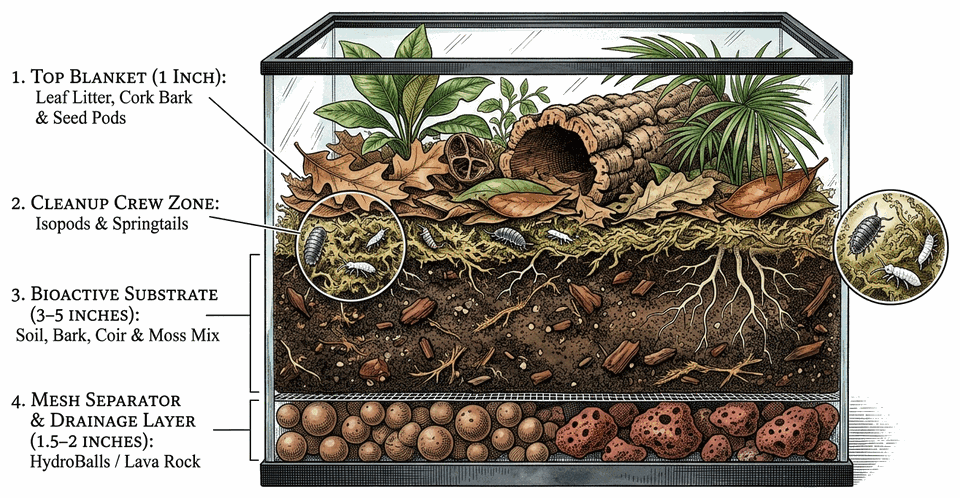
Store-Shelf Bioactive Substrate Recipes (10-Part Scoop Formulas)
Use any cup or scoop as "1 Part" to mix these exact store-shelf formulas at home:
1. Tropical & Forest Bioactive Mix (60–90% Humidity)
For Crested & Gargoyle Geckos, Dart Frogs, White's Tree Frogs, Ball Pythons, Rainbow Boas, Cuban False Chameleons & Tropical Plants
- 4 Parts — Zoo Med Reptisoil (humus, peat, sand & carbon base)
- 3 Parts — Zoo Med ReptiBark OR Forest Floor Cypress Mulch (creates air pockets so soil never packs into mud)
- 2 Parts — Zoo Med Eco Earth (Loose Coconut Fiber) (holds moisture evenly)
- 1 Part — Zoo Med New Zealand Sphagnum Moss (chopped and mixed in for humid micro-pockets)
- Underlayer: 1.5"–2" Zoo Med HydroBalls (or washed pea gravel) + Pangea / ReptiSafe Terrarium Mesh separator screen
- Top Blanket: 1" Seed Pods & Oak / Magnolia / Sea Grape Leaf Litter
- Best Stocked Isopods: Dwarf White (Trichorhina tomentosa — #1 for Frogs, Geckos & Tarantulas), Powder Orange / Blue (P. pruinosus), or Zebra / Cubaris + Tropical Springtails
2. Arid & Desert Bioactive Mix (30–50% Humidity)
For Leopard Geckos, Bearded Dragons, Uromastyx, Western Hognose Snakes, Corn Snakes & Arid Tarantulas
- 5 Parts — Zoo Med Reptisoil (holds burrow moisture beneath a dry surface)
- 3 Parts — Zoo Med ReptiSand OR Exo Terra Stone Desert (true natural quartz sand — never use calcium sand!)
- 1 Part — Zoo Med Excavator Clay Burrowing Substrate (binds tunnels so burrows hold their shape)
- 1 Part — Sphagnum Moss / Cypress Mulch (tucked into the lower layer & under the water dish as a moist oasis)
- Underlayer: No HydroBalls needed for arid tanks — pour the 4"–5" mix directly onto the tank floor!
- Top Blanket: Flat Cork Bark Slabs, Slate Basking Stones & Crushed Dry Leaf Litter
- Best Stocked Isopods: Powder Orange / Powder Blue (Porcellionides pruinosus) or Dalmatian / Koi / Spanish Orange (Porcellio scaber) + Springtails (with a damp moss oasis under cork bark)
3. Millipede, Isopod & Burrowing Invert Mix (65–80% Humidity)
For Giant Millipedes, Isopod Display Colonies, Terrestrial Tarantulas & Asian Forest Scorpions
- 5.5 Parts — Zoo Med Reptisoil (100% pesticide-free, fertilizer-free humus base)
- 2 Parts — California Vivarium Supply (
CVS#879112) Rotting Hardwood (their #1 daily food source!) - 1.5 Parts — California Vivarium Supply (
CVS#306646) Black Oak Leaves / Josh's Frogs Magnolia & Sea Grape Leaves (crushed into the dirt and layered on top) - 1 Part — CaribSea Reptilite (
#007100Natural Aragonite Calcium Sand) (slow-release calcium carbonate they eat to build thick exoskeletons after molting!) - Best Stocked Isopods: Zebra (A. maculatum), Magic Potion / Orange Vigor (A. vulgare), Cubaris Cappuccino / Papaya, Dairy Cow (P. laevis), or Dwarf White (Molt Safety Note: no isopod is 100% molt-safe! Never house protein-hungry P. laevis Dairy Cows with molting Tarantulas or Millipedes — use Springtails only or Dwarf Whites as the gentlest choice!)
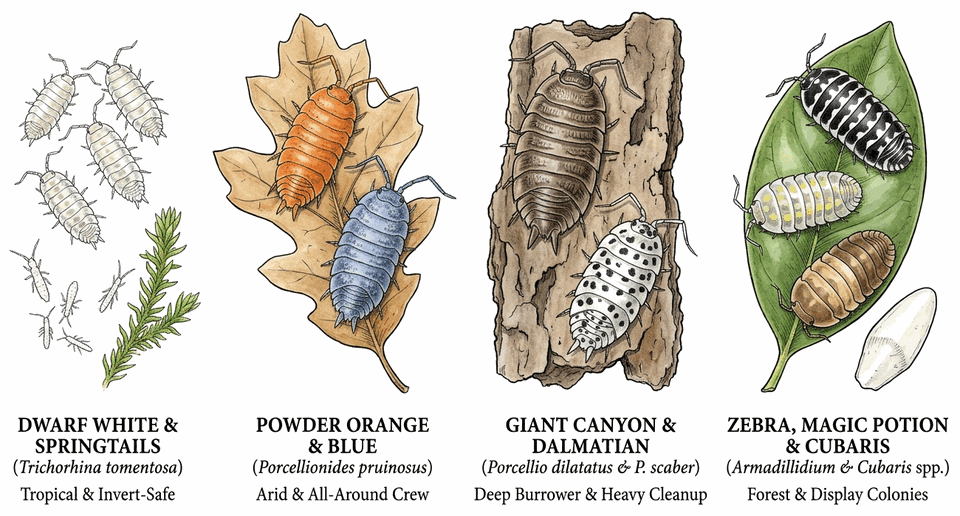
Stocked Isopod & Springtail Species Selector (Seed 1–2 Cultures of 10–25 ct + 1x 8oz Springtails)
| Isopod / Cleanup Crew Group | Species Stocked in Our Reptile Room | Best Biome & Target Animals | Key Keeper Notes |
|---|---|---|---|
| 1. Dwarf White & Springtails | Trichorhina tomentosa (25ct / 50ct) + Tropical White & Orange Springtails | Tropical Rainforest (70–90% RH) • Dart Frogs, Crested Geckos, Millipedes, Tarantulas & Scorpions | Tiny (3–4mm) blind soil burrowers; gentlest choice around molting pets (or use Springtails only with heavy molters) & a favorite snack for Dart Frogs! |
| 2. Powder Orange, Blue & Oreo | Porcellionides pruinosus (Powder Orange, Powder Blue, Oreo Crumble) | Arid, Semi-Arid & All-Around (40–80% RH) • Leopard Geckos, Bearded Dragons, Corn & Hognose Snakes, Ball Pythons | Fast runners that thrive in drier setups as long as you keep a damp moss & cork bark hydration corner under the water dish. |
| 3. Dalmatian/Koi (P. scaber) & Giant Canyon (P. dilatatus) | Porcellio scaber (Dalmatian, Koi, Lemon, Spanish Orange) & Porcellio dilatatus (Giant Canyon) | Heavy-Duty Reptile Cleanup • P. scaber (45–75% RH) for semi-arid/humid; P. dilatatus (60–80% RH) for deep moist soil | P. scaber handles drier top layers; *Giant Canyons (P. dilatatus) REQUIRE moist 4–5" soil & a damp moss patch* under cork bark (never for bone-dry desert tanks!). |
| 4. Zebra, Magic Potion & Cubaris | Armadillidium maculatum (Zebra), A. vulgare (Magic Potion, Orange Vigor, Punta Cana), Cubaris (Cappuccino, Little Sea, Papaya) & P. laevis (Dairy Cow) | Forest Terrariums & Display Colonies (60–80% RH) • Dedicated Isopod Bins, Planted Terrariums | Feed Oak Leaves, Rotting Hardwood & Cuttlebone. (Keep protein-hungry Dairy Cows in display bins or with tough lizards, never with molting tarantulas!) |
How Many Bags Should I Buy for a 3.5"–5" Bioactive Bed?
| Common Enclosure Size | Total Volume Needed | What to Grab on the Shelf |
|---|---|---|
| 10-Gal / 12"×12" Base (Inverts, Isopods, Slings) | ~10–12 Quarts (3–4" deep) | 1× 10qt Reptisoil + 1× 4qt ReptiBark + 1× Leaf Litter |
| 18"×18" Base / 20-Gal Long (Crested Gecko, Dart Frog) | ~20–25 Quarts (3.5–4.5" deep) | 1× 24qt Reptisoil (or 2× 10qt) + 1× 8qt ReptiBark/Eco Earth (+ 2 bags HydroBalls if tropical) |
| 40-Gal Breeder / 36"×18" Base (Ball Python, Bearded Dragon, Corn Snake) | ~45–55 Quarts (4–5" deep) | 2× 24qt Reptisoil + 1× 24qt ReptiBark (or 2× 10lb ReptiSand for Arid) |
(Note: Hermann's & Mediterranean Tortoises need a large Tortoise Table or Outdoor Pen with damp-underneath soil/cypress, not an arid glass tank.)
Which Sand Bag Should I Grab? (Our Store Recommendations)
| Store Sand Product | Mineral Type | Our Store Recommendation |
|---|---|---|
Zoo Med ReptiSand (#760101 Desert White / Red) | 100% Pure Quartz / Silica | Recommended for Reptile Bioactive Mixes — holds burrows & never clumps when misted |
Exo Terra Stone Desert (#231398 / #231367) & ZM Excavator Clay (#740103) | Natural Silica Sand & Clay | Recommended for Sculpted Desert Burrows |
CaribSea Reptilite (#007100 Natural Aragonite) | 100% Calcium Carbonate | Recommended for Isopod & Millipede Mixes (even though the bag pictures reptiles, we prefer quartz for reptiles and use Reptilite as a 10% shell-building calcium boost in Isopod/Millipede dirt!) |
Staff Back-Room Bulk 6-Ingredient Tub Recipes (10-Quart Batch) & Mixing Bin SOP
- Batch Scaling: 1 Batch (10 Quarts) = ~1.8" in an 18"×18". Mix 2–3 Batches (20–25 qt) per 18"×18" tank, and 4–5 Batches (45–55 qt) per 40-Gallon Breeder (36"×18").
- Tropical / Forest Bulk Mix:
3 scoops Doug Fir Mulch(Sell: ReptiBark#750249) +2 scoops Peat Moss(Sell: Reptisoil#752106/#752243) +2 scoops Coco Coir(Sell: Eco Earth#790108/#790245) +2 scoops Chopped Sphagnum Moss(Sell:#200294) +1 scoop Washed Play Sand(Sell:#760101) over1.5"–2" Rinsed Lava Rock(Sell: HydroBalls#720105). - Arid / Desert Bulk Mix:
3 scoops Peat Moss+3 scoops Washed Play Sand+2 scoops Coco Coir+1 scoop Fine Doug Fir Mulch+1 scoop Sphagnum Moss(no lava rock layer needed). - Invert / Isopod / Millipede Bulk Mix:
4 scoops Peat Moss+2 scoops Rotting Wood / Fine Fir(Sell: CVS Rotting Hardwood#879112) +2 scoops Crushed Oak Leaves(Sell: CVS Black Oak Leaves#306646) +1 scoop Chopped Sphagnum+1 scoop CaribSea Reptilite(#007100). - 3 Staff Mixing Bin Rules: (1) Wear an N95/dust mask when scooping dry peat moss, coco coir, and play sand; (2) Pre-wet with Reptisafe water until sponge-damp (zero drips) and snip long sphagnum fibers to 1"; (3) Label every tub with Mix Date + Recipe and use damp tubs within 30 days (keep lid vented so damp mix never molds).
How We Keep Them at Critter Cabana & Gresham Pet Supply
- Beating Dry Oregon Furnace Air (and Summer Heat Spikes): Across the Willamette Valley and Portland Metro, running the house furnace all winter drops indoor humidity to 25–35%, which quickly causes stuck sheds and dehydration in screen-top tanks. To hold
balanced humidityreliably for Bioactive Setup, our crew uses a deep 3–5" substrate bed (or our store-shelf 10-Part Bioactive Mix of ReptiSoil, Coco Fiber, Orchiata Bark, Sphagnum Moss, and Leaf Litter), a dedicated humid hide packed with damp sphagnum moss, and partial screen cover when needed. - Thermostat & Linear UVB Standard: Every heating element in our Newberg and Gresham reptile rooms runs on a thermostat probe set to
species-appropriate warm zoneon the warm side with acomfortable room temperaturecool retreat, paired withspecies-appropriate lightingon a 12-hour day/night timer. In summer, if an upstairs room climbs above 82°F, a dimming thermostat automatically backs down the basking lamp so the cool side never overheats. - Stocked at Newberg & Gresham: We stock reptile enclosures, thermostats, Arcadia & Zoo Med UVB lighting, bioactive substrate ingredients, live Springtails, Dwarf White, Powder Blue/Orange, Dairy Cow, and Giant Canyon isopods, and gut-loaded crickets, dubia roaches, hornworms, and frozen-thawed rodents at Critter Cabana (Newberg) and Gresham Pet Supply.
Common Questions (FAQ)
What size tank does an adult Bioactive Setup actually need?
An adult Bioactive Setup needs at least an appropriately sized enclosure so you can maintain a true thermal gradient from species-appropriate warm zone on the warm/basking side down to comfortable room temperature on the cool side.
How do I keep Bioactive Setup humidity at balanced humidity during dry Oregon winters?
Oregon winter furnace heat dries out thin bedding fast. Use a 3–5 inch moisture-retaining substrate mix (such as Zoo Med ReptiSoil blended with coco fiber, Orchiata bark, and sphagnum moss), provide an enclosed humid hide, and cover 50–70% of an open screen top with HVAC foil tape or a PVC panel if ambient humidity drops too low.
What is the best bioactive clean-up crew for a Bioactive Setup?
Pair Temperate White Springtails with a humidity-matched isopod species (such as Powder Blue/Orange for semi-arid setups or Dwarf White / Dairy Cow isopods for humid forest setups) in a 3–5 inch bioactive soil and leaf-litter bed. You can pick up our 1-Page or Tri-Fold Bioactive Substrate Recipe Guide and live cultures at Critter Cabana (Newberg) or Gresham Pet Supply.
Where can I get Bioactive Setup setup supplies, live feeders, and thermostats in Oregon?
We stock our full reptile, amphibian, and bioactive setup supplies—including enclosures, thermostats, Arcadia and Zoo Med UVB lighting, bioactive substrates, live isopods/springtails, and live or frozen feeders—at Critter Cabana in Newberg (514 E First St, 503-537-2887) and Gresham Pet Supply (2185 NW Burnside Rd, 503-665-7606).