
Fire-Bellied Toad
Bombina orientalis
1. Habitat Layout & Temperature Gradient
Species: Bombina orientalis | Difficulty: 1/5 — Beginner | Hardiness: 4/5 — Hardy

Critter Cabana & Gresham Pet Supply — Keeping Your Pet Healthy & Thriving
At a Glance

| Common Name | Oriental Fire-Bellied Toad |
| Species | Bombina orientalis |
| Origin | Ponds and streams of Korea, Northeastern China, and Russia |
| Adult Size | 2 inches |
| Lifespan | 10 to 15 years |
| Diet Type | Insectivore (Small crickets, fruit flies, chopped earthworms) |
| Activity | Diurnal (Highly active during the day) |
| Temperament | Very active and entertaining. They spend their time hopping between land and water. |
| Handleability | None. They secrete a mild toxin from their skin when stressed. While harmless to humans unless ingested or rubbed in the eyes, you must wash your hands thoroughly if you touch them. |
| Difficulty | 1/5 — Beginner (Excellent starter amphibians) |
| Hardiness | 4/5 — Hardy (Tolerate cooler temperatures very well) |
Why We Love Them: With their bright green, warty backs and brilliant red-orange undersides, they are a fantastic display animal. Because they are active during the day, they are much more entertaining to watch than many nocturnal frog species.
The Toxin Warning

WASH YOUR HANDS: Fire-Bellied Toads secrete a mild defensive toxin called bombesin. It will not hurt you, but it is highly irritating to mucous membranes. Always wash your hands thoroughly after tank maintenance, and never rub your eyes. Never house them with other species of reptiles or amphibians, as their toxins will kill their tank mates.
Housing & Enclosure
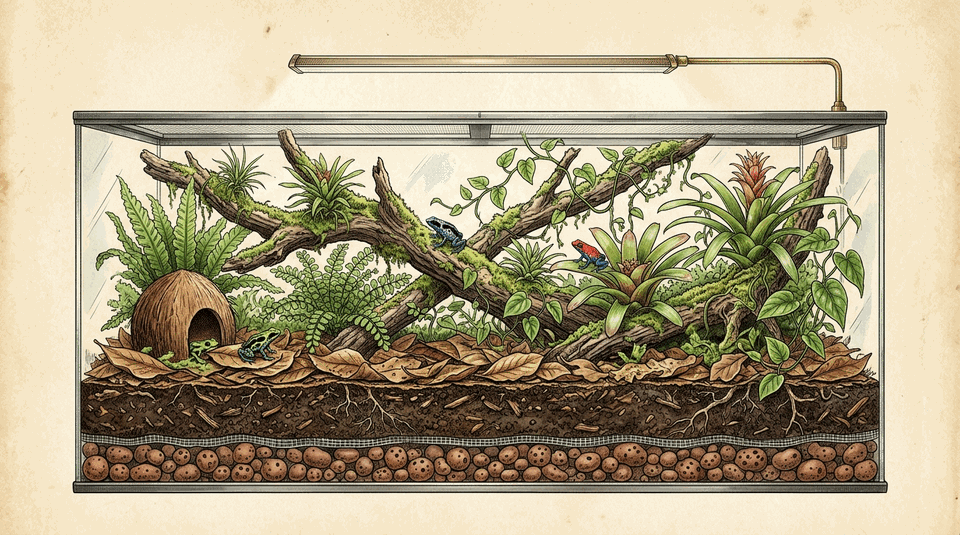
Terrarium Setup (The Paludarium)
- Type: Semi-Aquatic. They require an enclosure that is roughly 50% land and 50% water.
- Size: A 10-gallon tank is sufficient for a pair; a 20-gallon "long" is ideal for a group of 4-5.
- The Setup: You can create a divided tank using plexiglass/silicone, build a sloped shoreline using gravel and large rocks, or simply provide a very large, shallow water dish that takes up half the tank.
Water Quality
- Depth: The water should be 2 to 4 inches deep. Include rocks or floating cork bark so they can easily climb out.
- Filtration: Use a small, low-flow internal filter (like a ReptoFilter) to keep the water clean, but you must still perform 25% water changes weekly.
- Dechlorination: Always treat the water with a dechlorinator (like Seachem Prime). Tap water chlorine will kill them.
Environment & Husbandry
Temperature & Heating
- They prefer cooler temperatures. 65°F to 75°F is perfect. They generally do not require any supplemental heating unless your house drops below 60°F. Temperatures above 80°F will stress them.
Lighting & Humidity
- Lighting: A low-level UVB bulb (Zoo Med ReptiSun 5.0) is recommended for bone health and to display their bright colors.
- Humidity: Keep the land portion damp to maintain 70-80% humidity. Use Coco Coir (Eco-Earth) covered with live moss (Sphagnum or Frog Moss).
Diet & Feeding

- Staple Diet: Small crickets, flightless fruit flies, small dubia roaches, and chopped earthworms.
- Feeding Schedule: Feed adults 2 to 3 small insects every other day.
- Supplementation: Dust insects with Calcium + D3 twice a week, and a multivitamin once a week. Note: A diet rich in carotenoids (gut-loading crickets with carrots or sweet potato) helps keep their red bellies bright.
What We Stock & Use in Our Stores
| Category | Product | Notes |
|---|---|---|
| Housing | Aqueon 20-Gallon Long Tank | Perfect footprint for a 50/50 water/land split |
| Filtration | Tetra Fauna ReptoFilter (90GPH) | Creates a gentle waterfall and keeps water clean |
| Water | Zoo Med ReptiSafe Water Conditioner | Essential for removing chlorine and chloramines |
| Substrate | Zoo Med Frog Moss | Retains moisture perfectly on the land section |
Care sheet compiled by Critter Cabana & Gresham Pet Supply.
Last updated: 2026-08-04
How We Keep Them at Critter Cabana & Gresham Pet Supply
- Beating Dry Oregon Furnace Air (and Summer Heat Spikes): Across the Willamette Valley and Portland Metro, running the house furnace all winter drops indoor humidity to 25–35%, which quickly causes stuck sheds and dehydration in screen-top tanks. To hold
70-80%reliably for Fire-Bellied Toad, our crew uses a deep 3–5" substrate bed (or our store-shelf 10-Part Bioactive Mix of ReptiSoil, Coco Fiber, Orchiata Bark, Sphagnum Moss, and Leaf Litter), a dedicated humid hide packed with damp sphagnum moss, and partial screen cover when needed. - Thermostat & Linear UVB Standard: Every heating element in our Newberg and Gresham reptile rooms runs on a thermostat probe set to
65-75°Fon the warm side with acomfortable room temperaturecool retreat, paired withspecies-appropriate lightingon a 12-hour day/night timer. In summer, if an upstairs room climbs above 82°F, a dimming thermostat automatically backs down the basking lamp so the cool side never overheats. - Stocked at Newberg & Gresham: We stock reptile enclosures, thermostats, Arcadia & Zoo Med UVB lighting, bioactive substrate ingredients, live Springtails, Dwarf White, Powder Blue/Orange, Dairy Cow, and Giant Canyon isopods, and gut-loaded crickets, dubia roaches, hornworms, and frozen-thawed rodents at Critter Cabana (Newberg) and Gresham Pet Supply.
Common Questions (FAQ)
What size tank does an adult Fire-Bellied Toad actually need?
An adult Fire-Bellied Toad needs at least 10-20 Gallon (50/50 Water and Land) so you can maintain a true thermal gradient from 65-75°F on the warm/basking side down to comfortable room temperature on the cool side.
How do I keep Fire-Bellied Toad humidity at 70-80% during dry Oregon winters?
Oregon winter furnace heat dries out thin bedding fast. Use a 3–5 inch moisture-retaining substrate mix (such as Zoo Med ReptiSoil blended with coco fiber, Orchiata bark, and sphagnum moss), provide an enclosed humid hide, and cover 50–70% of an open screen top with HVAC foil tape or a PVC panel if ambient humidity drops too low.
What is the best bioactive clean-up crew for a Fire-Bellied Toad?
Pair Temperate White Springtails with a humidity-matched isopod species (such as Powder Blue/Orange for semi-arid setups or Dwarf White / Dairy Cow isopods for humid forest setups) in a 3–5 inch bioactive soil and leaf-litter bed. You can pick up our 1-Page or Tri-Fold Bioactive Substrate Recipe Guide and live cultures at Critter Cabana (Newberg) or Gresham Pet Supply.
Where can I get Fire-Bellied Toad setup supplies, live feeders, and thermostats in Oregon?
We stock our full reptile, amphibian, and bioactive setup supplies—including enclosures, thermostats, Arcadia and Zoo Med UVB lighting, bioactive substrates, live isopods/springtails, and live or frozen feeders—at Critter Cabana in Newberg (514 E First St, 503-537-2887) and Gresham Pet Supply (2185 NW Burnside Rd, 503-665-7606).