
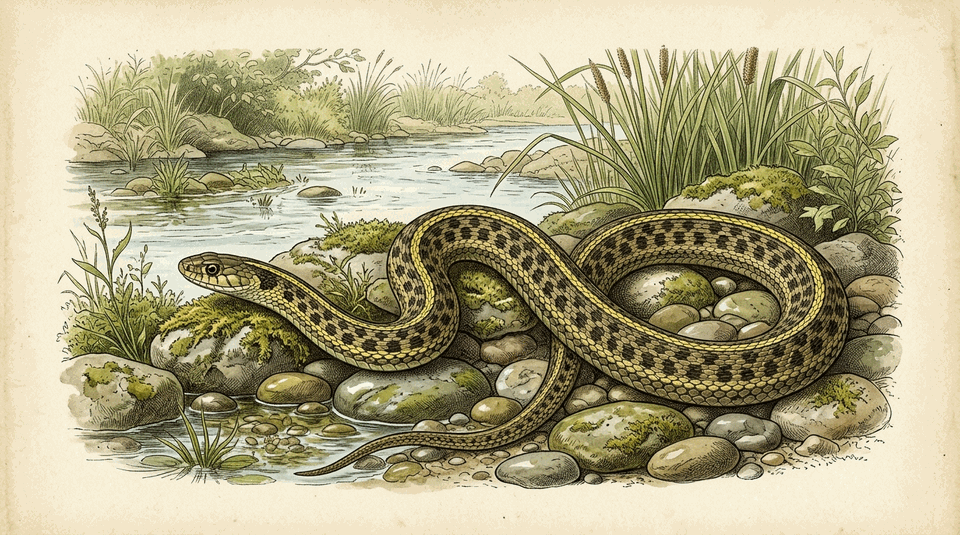
Checkered Garter Snake
Thamnophis marcianus
1. Dry Land Floor + Big Swimming Bowl Setup

2. Two Great Ways to Set Up Your Habitat
What to Feed: Rotational Menu vs. Mouse-Heavy
Garter snakes have super fast daytime metabolisms and love variety:
Option A: Thawed Pinky/Fuzzy Mice + Nightcrawlers + Safe Fish
Rotating whole pinky/fuzzy mice (which have natural bone calcium!), chopped earthworms, and tilapia strips is the gold standard.
Option B: Worm & Fish Strip Mix (For Tiny Babies)
If a baby is eating mostly chopped worms and fish fillets without mouse bones, dust their food 1–2× a week with Calcium + D3 powder!
Daytime Basking & Shade Lighting
Because Garter Snakes are active daytime hunters, overhead light makes them thrive:
Option A: 50W Halogen Basking Bulb + 5%–6% Shade UVB
Makes their checkerboard pattern glow while helping them synthesize natural Vitamin D3.
Option B: Overhead Basking Lamp + Dappled Leafy Vines
If you pick a red-eyed Albino morph, drape leafy vines under the lamp so they can bask comfortably in dappled shade.
Solo vs. Same-Sex Buddy Tank
Garter snakes are one of the only social snakes—with one huge dinner-time catch:
Option A: Kept Solo (Zero Dinner Drama!)
Easiest way to make sure your snake gets 100% of its meal.
Option B: Same-Sex Pair in a Roomy 40-Gal Tank
If you keep two same-sized garters together, always feed them separately or on opposite ends with tongs—if two garters grab opposite ends of the same worm, one snake can accidentally swallow the other!

3. Feeding Schedule & The Huge 'Goldfish Warning'
READ THIS BEFORE BUYING FISH — Safe vs. Toxic:
Tilapia fillets, Salmon, Trout, Cod, Live Guppies/Platies
Thawed Pinky/Fuzzy Mice & Canadian Nightcrawlers
Feeder Goldfish & Rosy Reds cause fatal seizures!
Compost red wigglers ooze foul yellow toxin—use Nightcrawlers!

4. Four Keys to a Happy, Thriving Checkered Garter Snake
Dry Bedding = Healthy Skin
Even though wild garters swim in creeks, they bask on dry banks! Wet, swampy cage bedding gives them bacterial scale rot fast. Keep the bedding dry and let them swim in their big water bowl.
Dinner on a Little Plate!
Put a flat jar lid or plastic dish in the tank as their 'dinner plate'—they'll come running out as soon as they see you open the door!
Baby Musk Passes Fast
Nervous babies rarely bite, but they love to wiggle and smear smelly musk on your hands! Handle gently over a towel for 5–10 minutes twice a week and they stop musking once they trust you.
Fun 'Fishing' Days
Dropping a few tilapia strips or safe live guppies into their clean water bowl lets them dive and 'fish' just like in the wild!

Bring-Home Shopping Checklist
Tap items to check them off on your phone while you shop at Critter Cabana.
Tank & Dry Bedding
Daytime Basking & UVB
Hides, Swim Bowl & Food
Complete Reference Notes & Oregon Keeping Guide
Dry Land Floor + Big Swimming Bowl Setup
Big Rule: Keep Their Bedding Dry & Give Them a Big Water Bowl to Swim In!
Temperature & Humidity Zones
| Zone | Target | Notes |
|---|---|---|
| Warm Basking Perch | 88°–90°F | Flat rock or branch under the basking lamp |
| Warm Side Air Temp | 80°–85°F | Active daytime hunting & exploring zone |
| Keep Bedding Dry! | Dry Floor! | Wet bedding causes scale blisters—keep air 40–55% RH |
| Cool Side & Swim Bowl | 70°–75°F | Cool end with a wide dechlorinated water basin |
| Nighttime Temp Drop | 65°–72°F | Lights off at night |
Two Ways That Work (100% Stocked Store Options)
What to Feed: Rotational Menu vs. Mouse-Heavy
Garter snakes have super fast daytime metabolisms and love variety:
- Option A: Thawed Pinky/Fuzzy Mice + Nightcrawlers + Safe Fish: Rotating whole pinky/fuzzy mice (which have natural bone calcium!), chopped earthworms, and tilapia strips is the gold standard.
- Option B: Worm & Fish Strip Mix (For Tiny Babies): If a baby is eating mostly chopped worms and fish fillets without mouse bones, dust their food 1–2× a week with Calcium + D3 powder!
Daytime Basking & Shade Lighting
Because Garter Snakes are active daytime hunters, overhead light makes them thrive:
- Option A: 50W Halogen Basking Bulb + 5%–6% Shade UVB: Makes their checkerboard pattern glow while helping them synthesize natural Vitamin D3.
- Option B: Overhead Basking Lamp + Dappled Leafy Vines: If you pick a red-eyed Albino morph, drape leafy vines under the lamp so they can bask comfortably in dappled shade.
Solo vs. Same-Sex Buddy Tank
Garter snakes are one of the only social snakes—with one huge dinner-time catch:
- Option A: Kept Solo (Zero Dinner Drama!): Easiest way to make sure your snake gets 100% of its meal.
- Option B: Same-Sex Pair in a Roomy 40-Gal Tank: If you keep two same-sized garters together, always feed them separately or on opposite ends with tongs—if two garters grab opposite ends of the same worm, one snake can accidentally swallow the other!
Feeding Schedule & The Huge 'Goldfish Warning'

Fast Eaters & Fast Poopers: Feed Babies Every 3–4 Days • Adults Every 5–7 Days
- Babies (Every 3–4 Days): Chopped Pinky Mice, Earthworm Pieces & Tilapia Strips: Chop into bite-sized pieces on a plastic lid or offer from tongs; dust worm/fish meals with Calcium.
- Sub-Adults (Every 4–5 Days): Whole Pinky/Fuzzy Mice + Nightcrawlers: Once they can swallow whole pinkies/fuzzies, mouse bones give them great natural calcium.
- Adults (Every 5–7 Days): Fuzzy/Hopper Mice, Nightcrawlers & Safe Fish Strips: Keep portions moderate so they stay sleek and active.
READ THIS BEFORE BUYING FISH — Safe vs. Toxic:
- SAFE FISH (No Thiaminase!): Tilapia fillets, Salmon, Trout, Cod, Live Guppies/Platies
- Staple Whole Foods: Thawed Pinky/Fuzzy Mice & Canadian Nightcrawlers
- BIG NO-NO: Goldfish & Minnows!: Feeder Goldfish & Rosy Reds cause fatal seizures!
- Skip Red Wiggler Compost Worms: Compost red wigglers ooze foul yellow toxin—use Nightcrawlers!
Keeper Note: Why NEVER Feed Goldfish or Rosy Red Minnows? Feeder goldfish and rosy red minnows are packed with an enzyme called thiaminase that destroys Vitamin B1 in snakes, causing fatal neurological seizures! Stick strictly to grocery store tilapia/salmon strips, live guppies/platies, Canadian nightcrawlers, and pinky/fuzzy mice!
Essential Keeper Rules & Pro Tips
- Dry Bedding = Healthy Skin: Even though wild garters swim in creeks, they bask on dry banks! Wet, swampy cage bedding gives them bacterial scale rot fast. Keep the bedding dry and let them swim in their big water bowl.
- Dinner on a Little Plate!: Put a flat jar lid or plastic dish in the tank as their 'dinner plate'—they'll come running out as soon as they see you open the door!
- Baby Musk Passes Fast: Nervous babies rarely bite, but they love to wiggle and smear smelly musk on your hands! Handle gently over a towel for 5–10 minutes twice a week and they stop musking once they trust you.
- Fun 'Fishing' Days: Dropping a few tilapia strips or safe live guppies into their clean water bowl lets them dive and 'fish' just like in the wild!
Complete Store Setup Checklist
Tank & Dry Bedding
- 20-Gal Long or 40-Gal Breeder Terrarium + Screen Clips
- Shredded Aspen Snake Bedding OR Dry-Top Cypress / Reptile Soil
- Climbing Branches, Cork Bark & Shady Leaf Vines
Daytime Basking & UVB
- 50W–75W Basking Bulb + Ceramic Dome on Thermostat
- Low-Output 5%–7% Shade Linear UVB Bar
- Digital Thermometer & Hygrometer Gauge
Hides, Swim Bowl & Food
- 2 Snug Caves + Enclosed Humid Moss Shed Box
- Large Heavy Water Bowl + Reptile Water Dechlorinator
- Frozen Pinky/Fuzzy Mice + Nightcrawlers + Calcium w/ D3
- Feeding Tongs & Small Flat Dinner Dish
How We Keep Them at Critter Cabana & Gresham Pet Supply
- Beating Dry Oregon Furnace Air (and Summer Heat Spikes): Across the Willamette Valley and Portland Metro, running the house furnace all winter drops indoor humidity to 25–35%, which quickly causes stuck sheds and dehydration in screen-top tanks. To hold
50–70% RHreliably for Checkered Garter Snake, our crew uses a deep 3–5" substrate bed (or our store-shelf 10-Part Bioactive Mix of ReptiSoil, Coco Fiber, Orchiata Bark, Sphagnum Moss, and Leaf Litter), a dedicated humid hide packed with damp sphagnum moss, and partial screen cover when needed. - Thermostat & Linear UVB Standard: Every heating element in our Newberg and Gresham reptile rooms runs on a thermostat probe set to
88°–90°Fon the warm side with a70°–75°Fcool retreat, paired withRecommended (5%–6% Shade UVB)on a 12-hour day/night timer. In summer, if an upstairs room climbs above 82°F, a dimming thermostat automatically backs down the basking lamp so the cool side never overheats. - Stocked at Newberg & Gresham: We stock reptile enclosures, thermostats, Arcadia & Zoo Med UVB lighting, bioactive substrate ingredients, live Springtails, Dwarf White, Powder Blue/Orange, Dairy Cow, and Giant Canyon isopods, and gut-loaded crickets, dubia roaches, hornworms, and frozen-thawed rodents at Critter Cabana (Newberg) and Gresham Pet Supply.
Common Questions (FAQ)
What size tank does an adult Checkered Garter Snake actually need?
An adult Checkered Garter Snake needs at least 20L to 40-Gal so you can maintain a true thermal gradient from 88°–90°F on the warm/basking side down to 70°–75°F on the cool side.
How do I keep Checkered Garter Snake humidity at 50–70% RH during dry Oregon winters?
Oregon winter furnace heat dries out thin bedding fast. Use a 3–5 inch moisture-retaining substrate mix (such as Zoo Med ReptiSoil blended with coco fiber, Orchiata bark, and sphagnum moss), provide an enclosed humid hide, and cover 50–70% of an open screen top with HVAC foil tape or a PVC panel if ambient humidity drops too low.
What is the best bioactive clean-up crew for a Checkered Garter Snake?
Pair Temperate White Springtails with a humidity-matched isopod species (such as Powder Blue/Orange for semi-arid setups or Dwarf White / Dairy Cow isopods for humid forest setups) in a 3–5 inch bioactive soil and leaf-litter bed. You can pick up our 1-Page or Tri-Fold Bioactive Substrate Recipe Guide and live cultures at Critter Cabana (Newberg) or Gresham Pet Supply.
Where can I get Checkered Garter Snake setup supplies, live feeders, and thermostats in Oregon?
We stock our full reptile, amphibian, and bioactive setup supplies—including enclosures, thermostats, Arcadia and Zoo Med UVB lighting, bioactive substrates, live isopods/springtails, and live or frozen feeders—at Critter Cabana in Newberg (514 E First St, 503-537-2887) and Gresham Pet Supply (2185 NW Burnside Rd, 503-665-7606).