
Madagascar Hissing Cockroach
Gromphadorhina portentosa
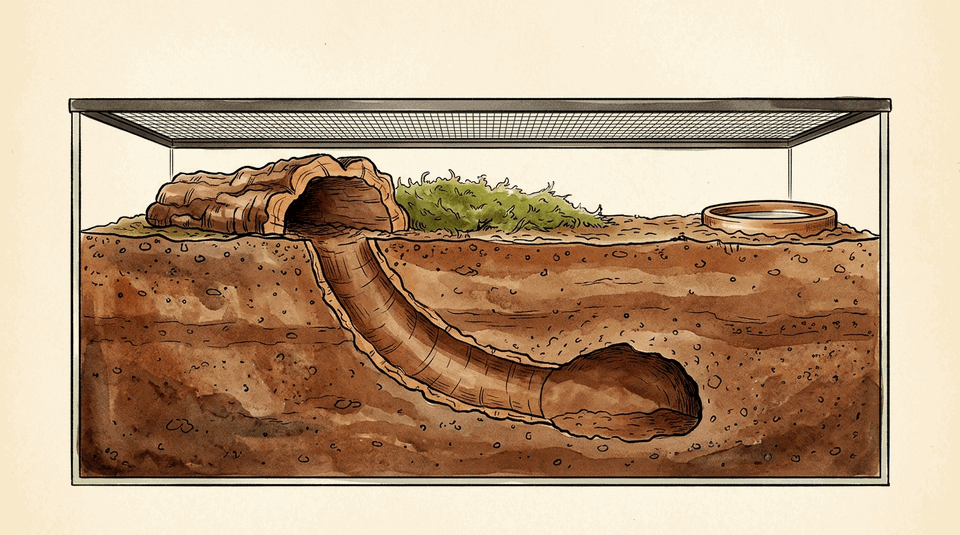
1. Habitat Layout & Temperature Gradient
Species: Gromphadorhina portentosa | Difficulty: 1/5 — Beginner | Hardiness: 5/5 — Bulletproof

Critter Cabana & Gresham Pet Supply — Keeping Your Pet Healthy & Thriving
At a Glance

| Common Name | Madagascar Hissing Cockroach (MHC) |
| Species | Gromphadorhina portentosa |
| Origin | Tropical rainforests of Madagascar |
| Adult Size | 2 to 3 inches long (They are huge, wingless roaches) |
| Lifespan | 2 to 5 years |
| Diet Type | Omnivore / Scavenger (Fruits, veggies, dry protein) |
| Activity | Nocturnal (They hide during the day and forage at night) |
| Temperament | Very docile. They do not bite or fly, but they will hiss loudly when startled. |
| Handleability | Excellent. They are slow-moving and tolerate handling well. |
| Venom | None |
| Urticating Hairs | No |
| Difficulty | 1/5 — Beginner |
| Hardiness | 5/5 — Bulletproof |
Why We Love Them: Hissing Cockroaches are the ultimate low-maintenance exotic pet. They are completely wingless, completely harmless, and look like ancient, armored trilobites. They are famous for their defense mechanism: when startled or handled, they force air through their breathing pores (spiracles) to produce a remarkably loud "hissing" sound!
Safety Information
Allergy Warning: While they do not bite or sting, cockroaches shed proteins in their feces (frass) and old exoskeletons. Frequent handling or inhaling dust from their enclosure can trigger allergic reactions or asthma in some people. If you develop itchy skin or watery eyes, wear gloves when cleaning their tank.

Housing & Enclosure
Enclosure Type & Size
- Type: Terrestrial
- Minimum: A Large Critter Keeper or a 5-gallon tank is perfect for a small group (3-5 roaches).
- Escape Prevention (CRITICAL): Unlike Dubia roaches, Hissing Cockroaches are excellent climbers. They can easily scale smooth glass or plastic. You must have a tight-fitting, locking screen lid. You can also smear a 2-inch band of petroleum jelly (Vaseline) around the top inner rim of the tank; they cannot walk over it.
Substrate
- Recommended: Coconut fiber (Eco Earth) or peat moss mixed with leaf litter.
- Depth: 2 to 3 inches. They enjoy digging and the deep substrate helps maintain humidity.
Décor & Enrichment
- Hides: They require dark places to hide during the day. Cardboard egg crates, curved cork bark, or half-logs work perfectly.
- Water Dish: Roaches are terrible swimmers and will drown in open water. Do not use a water bowl. Instead, use Fluker's Cricket Quencher (water crystals) or place a soaked sponge/cotton ball in a very shallow dish.
Temperature
| Zone | Temperature |
|---|---|
| Ambient | 75–85°F (24–29°C) |
| Avoid dropping below | 65°F (18°C) |
- Heating: They are from tropical Madagascar. If your house is cold, stick a small reptile heating pad to the side of the tank (not the bottom, so they can escape the heat by burrowing).
Humidity
- Target Range: 60–80% (Moderate-High).
- How to Maintain: Mist the enclosure every 1–2 days. The coconut fiber substrate should be damp to the touch, but never soaking wet or muddy.
Diet & Nutrition

Hissing Cockroaches are scavengers and thrive on a varied diet.
Primary Diet
- Fresh Foods (Provide daily): Apples, carrots, romaine lettuce, squash, and sweet potatoes.
- Dry Staples (Leave in tank): High-quality dry dog/cat kibble, commercial roach chow, or Repashy Bug Burger for protein.
Feeding Schedule
| Life Stage | Frequency |
|---|---|
| All Stages | Always leave a dry staple available. Offer fresh fruits/veggies 2-3 times a week. |
Foods to Avoid
- Avoid: Citrus fruits (Can be too acidic)
- Avoid: Iceberg lettuce (Zero nutritional value)
- Avoid: Rotting food: Always remove fresh food after 48 hours before it molds. Mold is fatal to a roach colony.
Molting & Reproduction
Molting
- Like all insects, they must shed their exoskeleton to grow. A freshly molted roach will be pure, ghostly white. Do not handle them during this time. Their new shell needs 24-48 hours to harden and turn brown/black.
- They will often eat their own shed skin to recycle the nutrients.
Breeding
- Sexing: Adult males have two large, prominent "horns" (bumps) on their pronotum (the shield behind their head). Females have a smooth pronotum. Males use these horns to headbutt each other for dominance.
- Livebearers: Females incubate a long, yellow egg case (ootheca) internally and give birth to 20-40 live babies (nymphs) at once.
What We Stock & Use in Our Stores
These are products we carry and recommend for this species. Ask any associate for help finding them in-store.
| Category | Product | Notes |
|---|---|---|
| Enclosure | Zilla / Exo Terra Large Critter Keeper | Ensure the lid snaps completely shut |
| Substrate | Zoo Med Eco Earth | Retains moisture perfectly |
| Heating | Zoo Med ReptiTherm Under Tank Heater (Mini) | Place on the side of the tank if your home is cold |
| Hydration | Fluker's Cricket Quencher | Safe hydration without the drowning risk |
| Food | Repashy Bug Burger | Incredible complete nutrition for all roaches |
Care sheet compiled by Critter Cabana & Gresham Pet Supply. For questions, ask any livestock specialist in-store.
Last updated: 2026-08-04
How We Keep Them at Critter Cabana & Gresham Pet Supply
- Oregon Winter Furnace Air vs. Molting Humidity: When Pacific Northwest furnaces kick on from October through April, indoor room humidity drops fast and dries out small enclosures from the top down. Rather than misting the spider or invert directly (which stresses terrestrial species and invites stagnant mold), we keep Madagascar Hissing Cockroach at
60-80% (Moderate-High)by using a deep moisture-retaining substrate bed (ReptiSoil + Coco Fiber + Sphagnum Moss), overflowing the water dish slightly into one corner, and maintaining cross-ventilation. - Safe Room Heating in the Willamette Valley: If your house drops below 65°F on winter nights, never stick a heat pad on the bottom of a burrowing invertebrate tank—they dig down to escape heat and will cook themselves. Use a low-wattage side-mounted heat mat on a digital thermostat or warm the room ambiently to
species-appropriate warm zone. - Stocked at Newberg & Gresham: At Critter Cabana (Newberg) and Gresham Pet Supply, we stock acrylic and glass invertebrate enclosures, cork bark flats and tubes, bioactive substrates, flightless fruit flies (D. melanogaster and D. hydei), pinhead to adult crickets, dubia roaches, and live Temperate White Springtail and Isopod cultures.
Common Questions (FAQ)
How do I keep my Madagascar Hissing Cockroach warm and humid enough during an Oregon winter?
Target species-appropriate warm zone and 60-80% (Moderate-High). When Oregon winter furnaces dry out the air, use a deep 3–5 inch substrate mix of Zoo Med ReptiSoil and coco fiber, keep a shallow water dish filled, and dampen one corner of the substrate rather than misting the animal directly. Never put a heat mat underneath a burrowing invertebrate enclosure.
What size enclosure does a Madagascar Hissing Cockroach need?
An adult Madagascar Hissing Cockroach thrives in 5-Gallon Tank or Large Critter Keeper with secure ventilation. For terrestrial tarantulas and scorpions, floor space and deep substrate matter most (keep open fall height low so heavy-bodied species cannot rupture their abdomen); for arboreal species, prioritize vertical cork bark tubes and cross-ventilation.
Can I put isopods in a Madagascar Hissing Cockroach bioactive enclosure?
Around molting tarantulas and scorpions, skip protein-hungry large isopods and stick to Temperate White Springtails (or gentle Dwarf White isopods in humid detritivore setups) so a soft, newly molted animal is never nibbled.
Where can I find Madagascar Hissing Cockroach, cork bark, and feeder insects in Oregon?
We stock live invertebrates, tarantulas, jumping spiders, cork bark flats and tubes, bioactive substrates, and gut-loaded feeder insects at our two exotic animal stores: Critter Cabana in Newberg (514 E First St, 503-537-2887) and Gresham Pet Supply (2185 NW Burnside Rd, 503-665-7606).