
What to Feed Community Fish (Tetras, Guppies, Corys & More)
Flakes, micro pellets or sinking food? How to feed top, middle and bottom swimmers in one tank, how much, how often, and keeping food fresh.
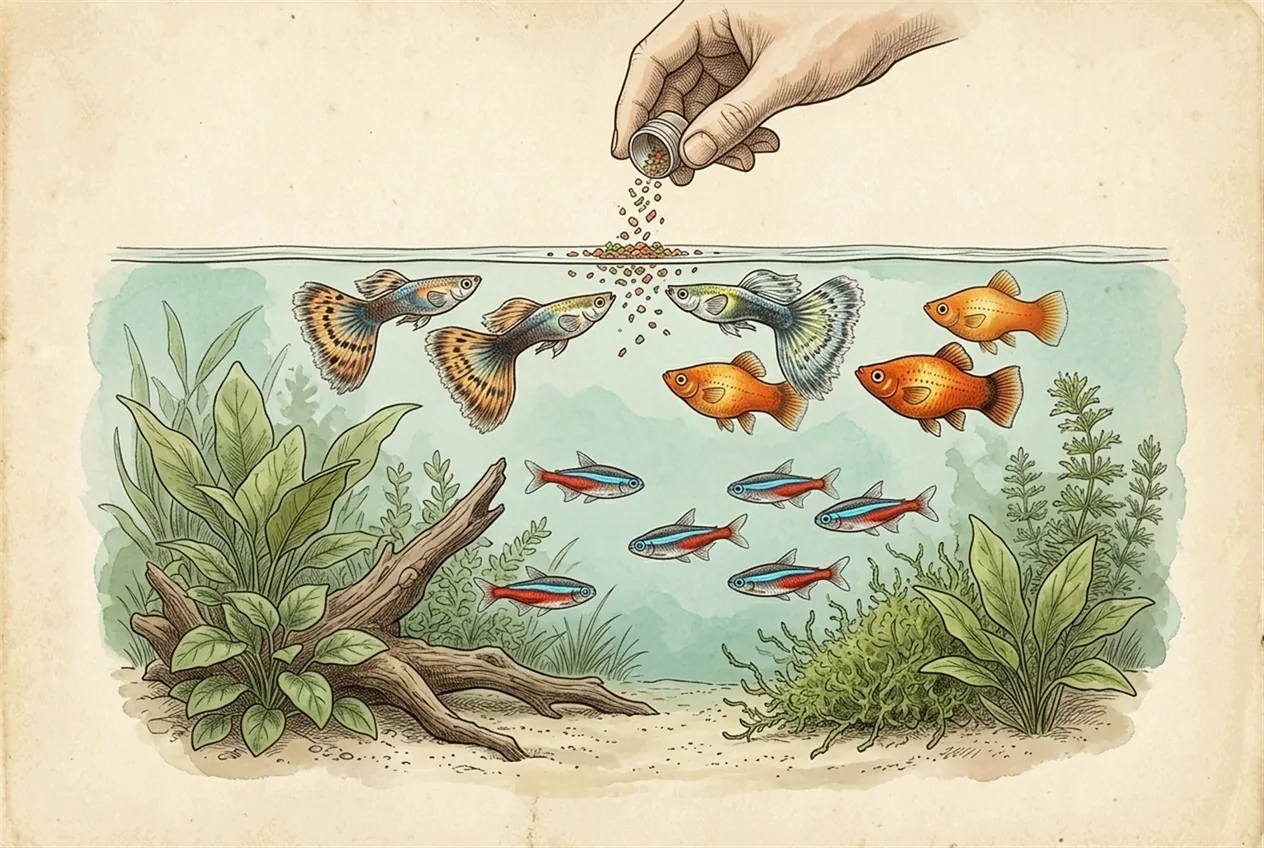
Tetras, guppies, platies, corys and their tankmates all eat a good dry staple. The trick is getting food to every fish, because they eat at different levels of the tank.
Pick foods by where each fish eats and how big its mouth is. Then feed small amounts and take out anything left over.
At a glance
- Best staple Flakes or micro pellets, plus a sinking food
- How much What they finish in 1 to 3 minutes
- How often 2-3 small meals a day, per most labels
- Leftovers Take out what's left after a few minutes
- Freshness Use within 90 days to 6 months of opening
- Avoid Flakes alone for corys, big pinches, wet fingers
Who eats where
Fish tend to stay near the top, the middle or the bottom. Each layer needs food that reaches it.
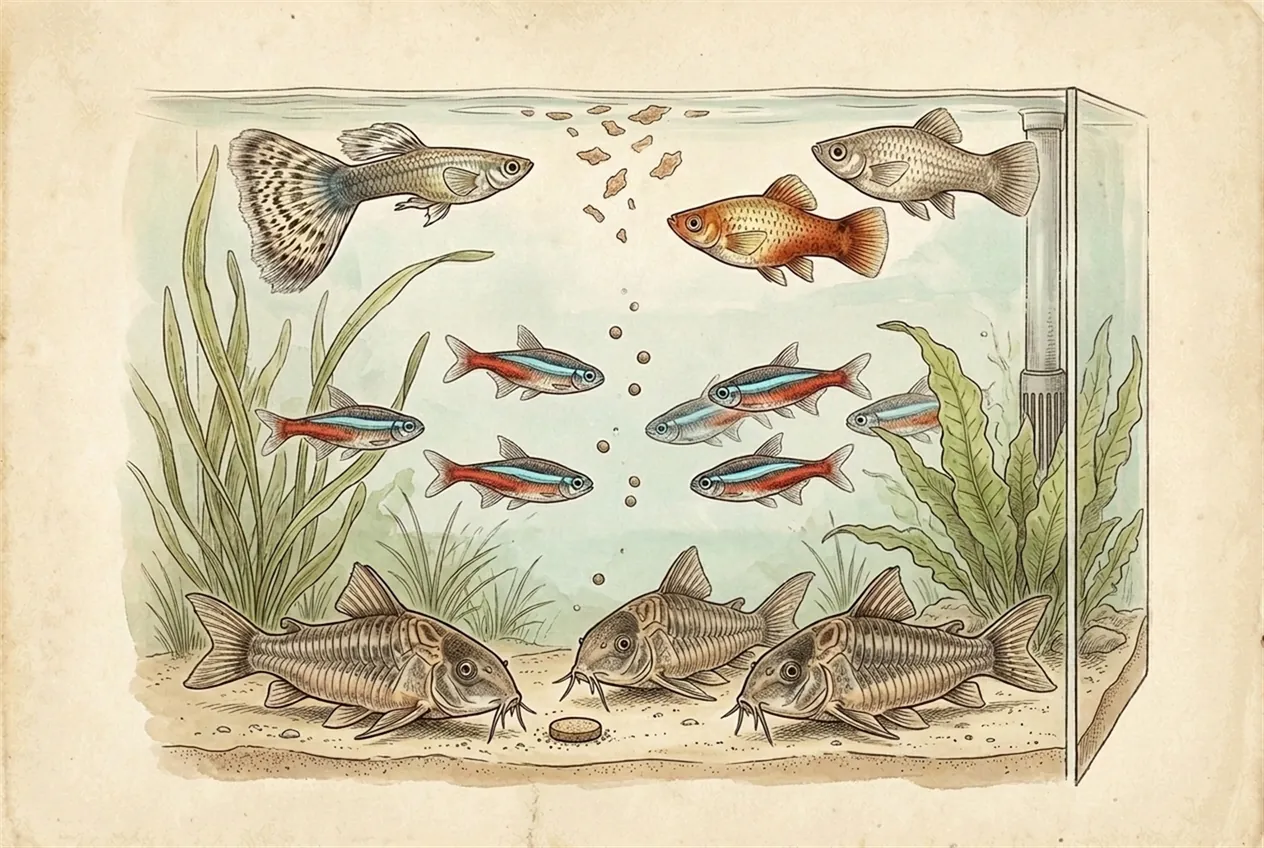
- Top: guppies and platies eat at the surface. Flakes float, so they suit these fish.
- Middle: tetras pick food as it drifts down. Micro pellets sink slowly through their level.
- Bottom: corys and loaches eat off the floor. They need a food that sinks.
- Top: guppies and platies eat at the surface. Flakes float, so they suit these fish.
- Middle: tetras pick food as it drifts down. Micro pellets sink slowly through their level.
- Bottom: corys and loaches eat off the floor. They need a food that sinks.
- Top swimmers: guppies, platies and other livebearers.
- Middle swimmers: tetras, rasboras, danios and barbs.
- Bottom swimmers: corys, loaches and other catfish.
Flakes float first, then drift. Micro pellets sink slowly. Granules and wafers sink faster and reach the bottom.
Flakes, micro pellets or sinking food
Flakes for the top, micro pellets for small mouths and mid-water, something that sinks for the bottom.
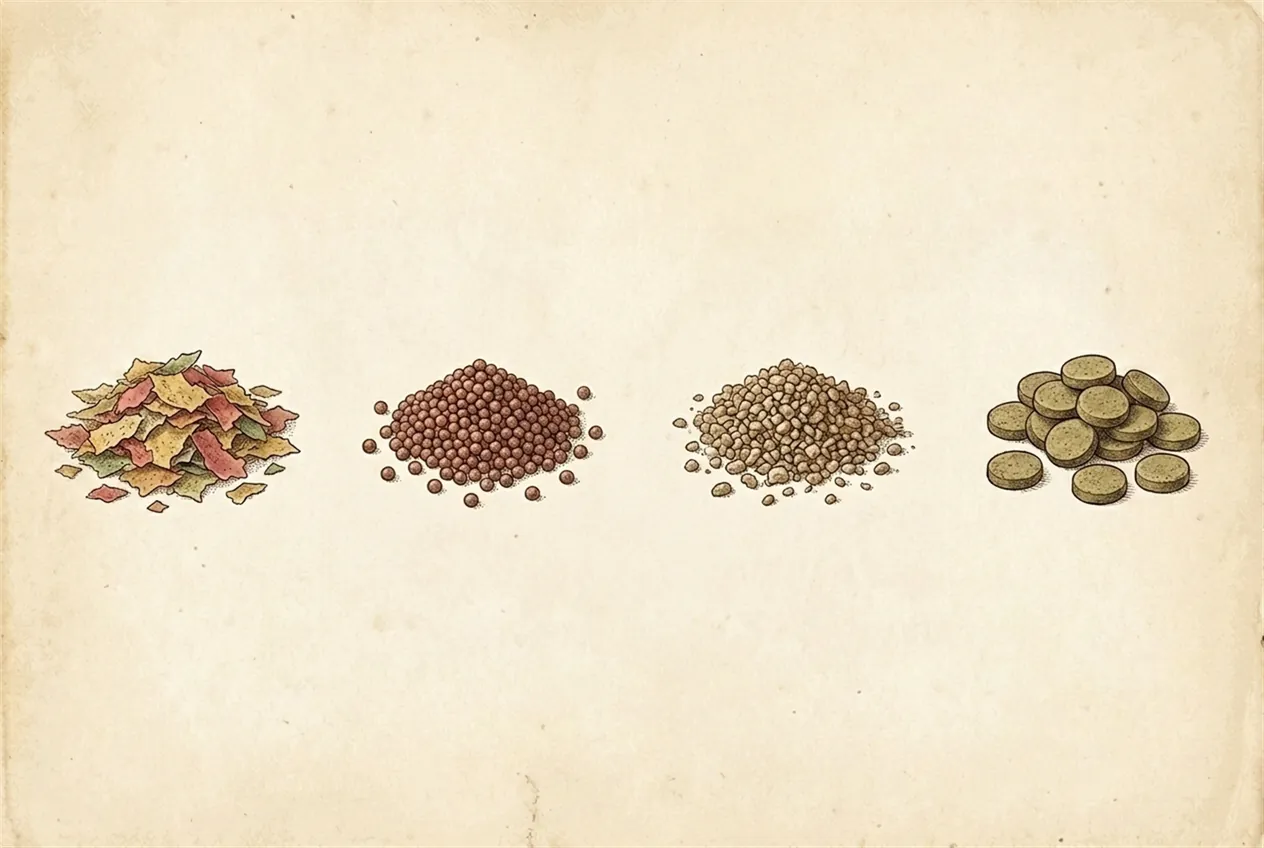
- Flakes
- Micro pellets
- Granules
- Wafers
- Flakes
- Float, then drift. For top and middle swimmers.
- Micro pellets
- Sink slowly. Good for small mouths.
- Granules
- Sink faster. Suit larger fish.
- Wafers
- Slow-sinking. Reach the bottom.
Flakes
Tetra says its tropical flakes are for top- and mid-feeding fish. They float, then drift down.
Micro pellets
Hikari makes its Micro Pellets for small-mouth fish such as tetras and barbs. They sink slowly through the middle of the tank.
Granules
Aqueon says its granules sink faster than flakes and suit larger fish.
Wafers
Hikari says its Micro Wafers sink slowly and reach several levels of the tank, bottom included.
- Too big
- Right size
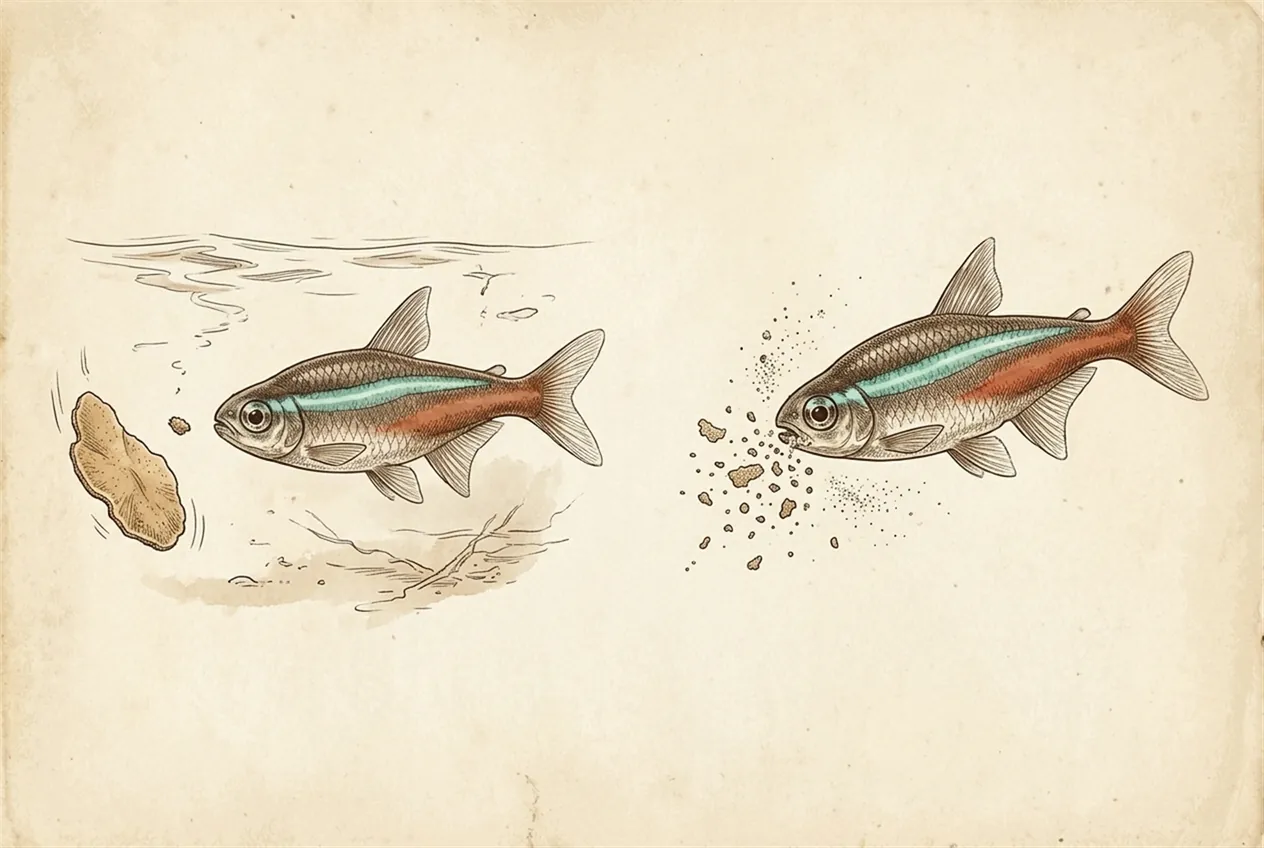
- Too big
- The piece sinks uneaten.
- Right size
- Crumbled flake or micro pellets.
Small mouths
Neons and other tiny fish do best on micro pellets or crushed flake.
Crumble it
Crush flakes into smaller pieces for tiny fish, or switch to micro pellets.
A bite it can't swallow
ends up on the bottom, where it rots.
One good staple plus a sinking food covers most mixed tanks.
Compare community fish foods: protein, fat and first ingredient
| Food | Form | Protein | Fat | Fiber | Moisture | First ingredient |
|---|---|---|---|---|---|---|
| Hikari Micro Pellets | Slowly sinking pellet | 43.0% min | 7.0% min | 7.0% max | 10.0% max | Fish meal |
| Hikari Micro Wafers | Slow-sinking wafer | 44.0% min | 8.0% min | 2.0% max | 10.0% max | Fish meal |
| Hikari Vibra Bites | Slow-sinking stick | 46.0% min | 7.0% min | 5.0% max | 10.0% max | Fish meal |
| Fluval Bug Bites Tropical Flakes | Flake | 46% min | 8% min | 1.5% max | 6% max | Black soldier fly larvae |
| Fluval Bug Bites Tropical Granules | Granule, some sink, some float | 40.0% min | 12.5% min | 5.0% max | 10.0% max | Black soldier fly larvae |
| New Life Spectrum (community) | Pellet, most sink | 37% min | 8% min | 7% max | 10% max | Krill |
| New Life Spectrum Thera+A | Pellet, most sink | 39% min | 9% min | 8% max | 10% max | Krill |
| TetraMin and TetraColor flakes | Flake | not listed | not listed | not listed | not listed | not listed |
| Aqueon flakes and granules | Flake or granule | not listed | not listed | not listed | not listed | not listed |
Figures are each maker's guaranteed analysis. Tetra and Aqueon don't post theirs online, so read the can.
No "complete and balanced" line. AAFCO, which sets pet food standards, publishes no nutrient profile for aquarium fish, so you won't find that line on the can. The guaranteed analysis and ingredient list are what the label gives you.
Feeding top, middle and bottom
A tank with corys or loaches needs a sinking food as well as flakes.
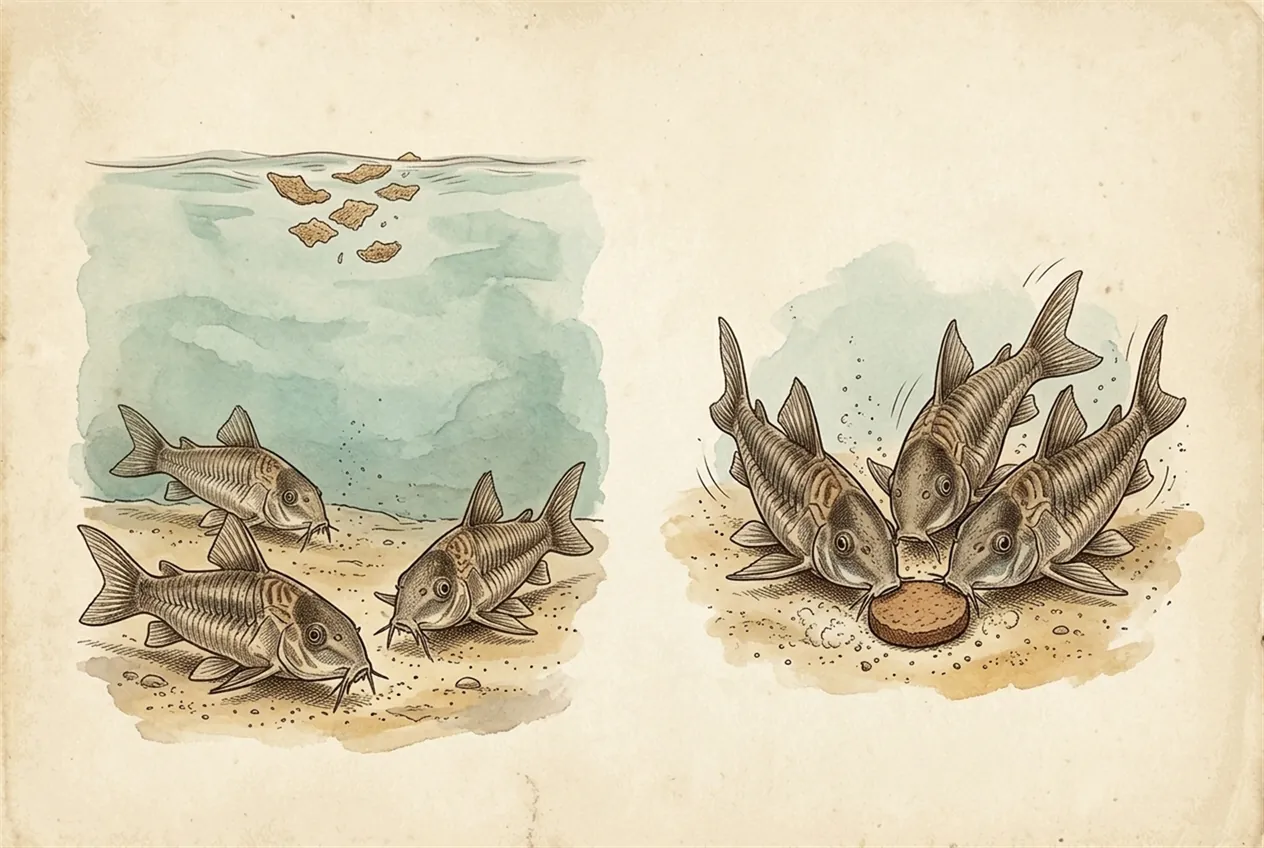
- Flakes only
- Sinking food
- Flakes only
- The food stays up top. Corys go hungry.
- Sinking food
- A wafer or granule reaches the bottom.
- Flakes alone don't work for bottom feeders. The top fish eat them first, and little reaches the floor.
- Add a sinking food such as a wafer or granule for corys, loaches or a pleco.
- Many bottom feeders feed at night. Our bottom-feeder guide covers wafers and timing.
How much and how often
What they finish in 1 to 3 minutes, two or three times a day. The label is the final word.
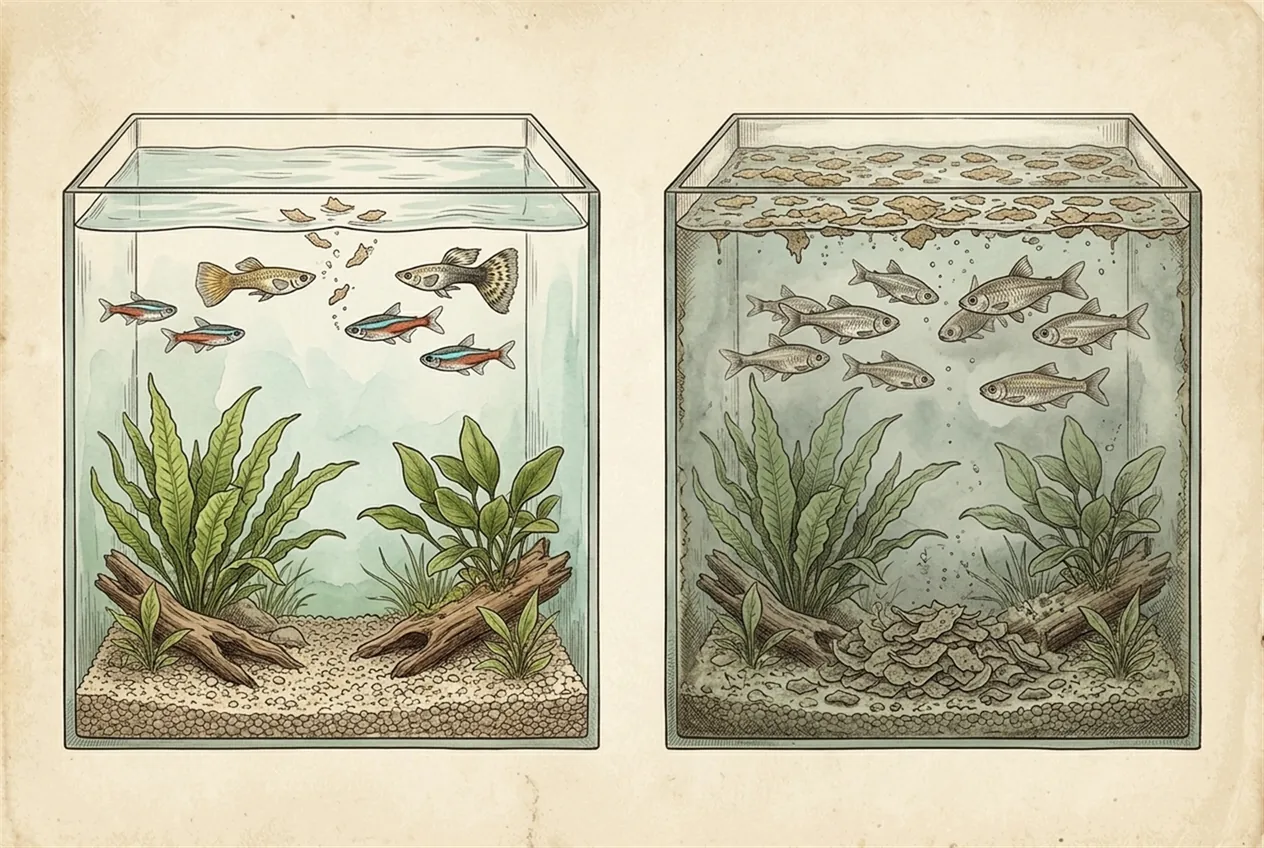
- Right amount
- Too much
- Right amount
- Gone in a minute or two.
- Too much
- Leftovers on the gravel rot.
Makers agree on small meals but differ on the clock:
- Hikari: what your fish eat in about a minute, two or three times a day.
- Fluval granules: what they eat in two minutes, two or three times a day.
- Tetra: what they eat in three minutes, two or three times a day.
One label disagrees
One Fluval flake page says two or three times a week. Follow the label on the food you feed.
When in doubt, feed less
If food is still on the bottom after three minutes, that was too much.
| Fish | Best food | How often |
|---|---|---|
| Top swimmers | Flakes | 2-3 times a day, small meals |
| Middle swimmers | Micro pellets or crushed flake | 2-3 times a day, small meals |
| Bottom swimmers | A sinking granule or wafer | As the label on the sinking food says |
What each label says
| Food | How much | How often |
|---|---|---|
| TetraMin and TetraColor flakes | What they eat in 3 minutes | 2-3 times a day |
| Hikari Micro Pellets | What they eat in about a minute | 2-3 times a day |
| Hikari Micro Wafers | What they eat in about a minute | 2-3 times a day |
| Hikari Vibra Bites | What they eat in a few minutes | 2-3 times a day |
| Fluval Bug Bites Tropical Granules | What they eat in 2 minutes | 2-3 times a day |
| Fluval Bug Bites Tropical Flakes | Up to 1 minute | 2-3 times a week on one page, 3 a day on another |
| Aqueon, New Life Spectrum | not listed online | not listed online |
Directions are paraphrased from each maker's product page.
Feeding, step by step
Measure a pinch, watch them eat, take out what's left.
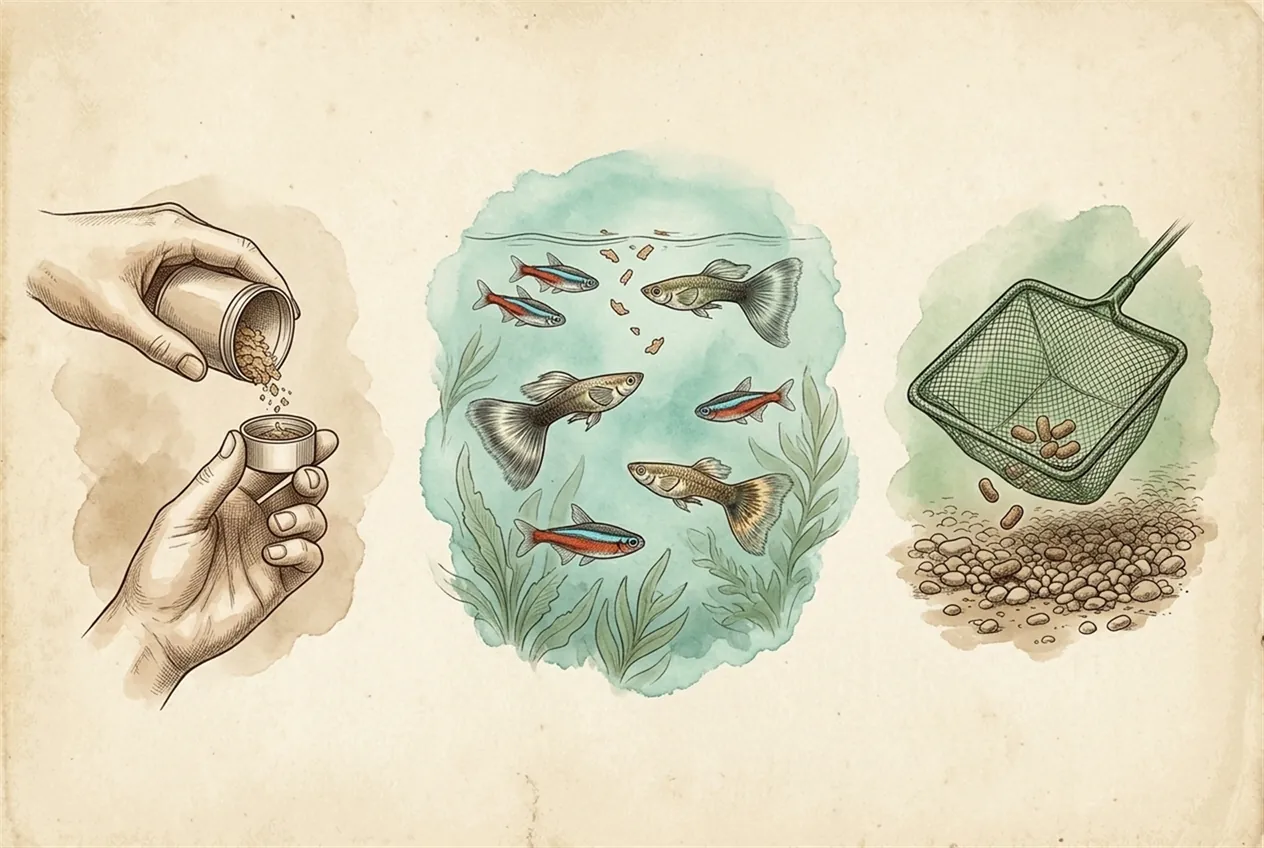
Measure: shake a small pinch into the cap, as Fluval suggests, not your fingers.
Watch: sprinkle it in and watch. Most labels say it should be gone in 1 to 3 minutes.
Clean up: net or siphon out anything left after a few minutes.
Pinch, watch, clean up.
Is it the right amount?
A slightly curved belly is what you want, per Fluval. Clear water is the other sign.
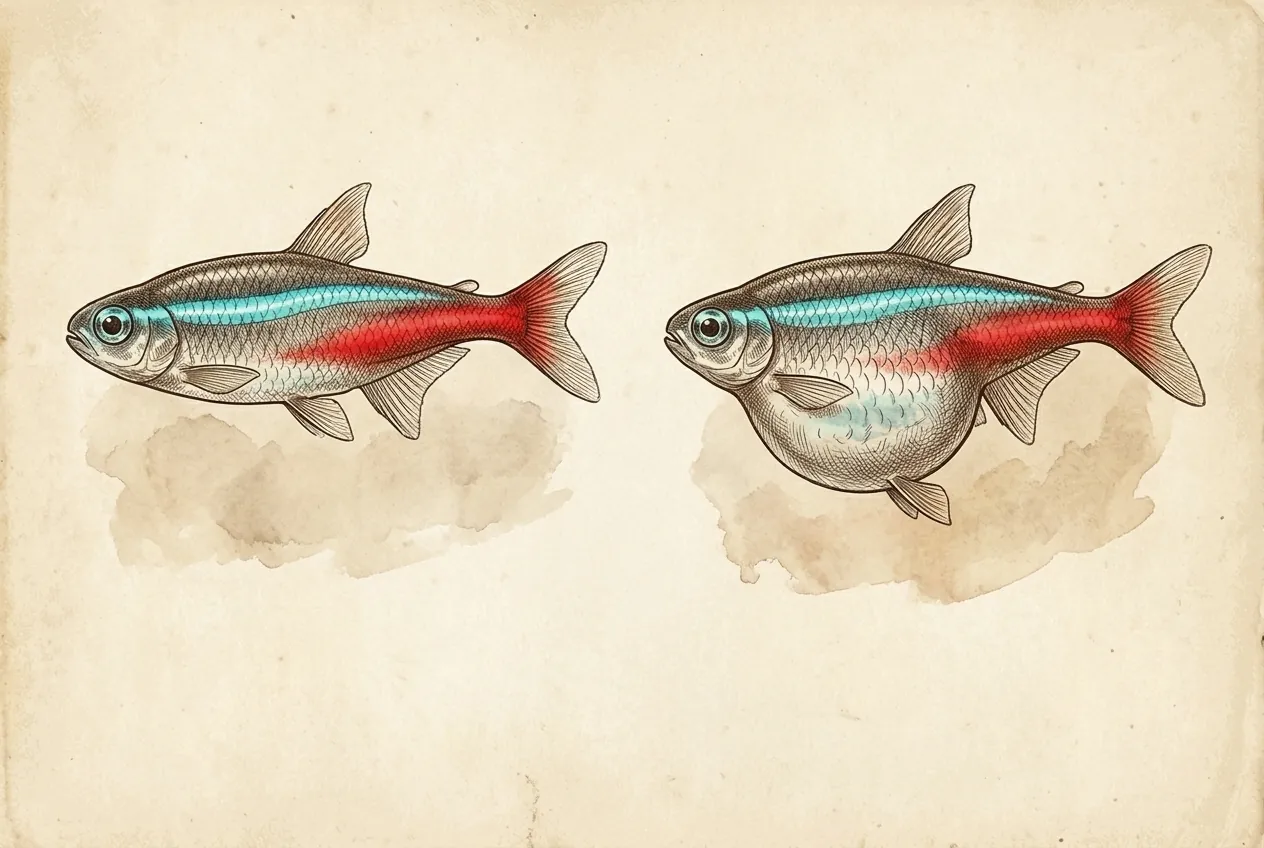
- Just right
- Overfed
- Just right
- A slightly curved belly.
- Overfed
- A swollen, round belly.
Belly
Fluval says slightly curved bellies are ideal.
Cloudy water
New cloudiness after you add fish is often too much food. Tetra's own label says uneaten food causes water problems.
What to do
Cut back the pinch, skip a day of feeding, and test for ammonia.
Bloated or floating sideways? Overfeeding is one common cause of swim bladder trouble.
Treats and color foods
Frozen and freeze-dried foods are treats on top of a staple. Color foods bring out color your fish already has.
Treats
Bloodworms, brine shrimp and daphnia are extras, not the main food. Frozen cubes can go into a community tank still frozen. Never heat them. Our [frozen fish food guide](/care-guide/frozen-fish-food/) has the details.
Color foods
Tetra, Aqueon and Hikari all make color claims for ingredients such as spirulina, krill, astaxanthin and marigold. These bring out color the fish already has.
A pale fish
is usually a water or stress problem, not a food problem. A stressed fish stays pale on any food.
Bettas
have their own guide. Hikari and Fluval both list bettas among the fish their micro pellets suit.
Keeping food fresh
Use an open can within a few months, and keep it closed, cool and dry.
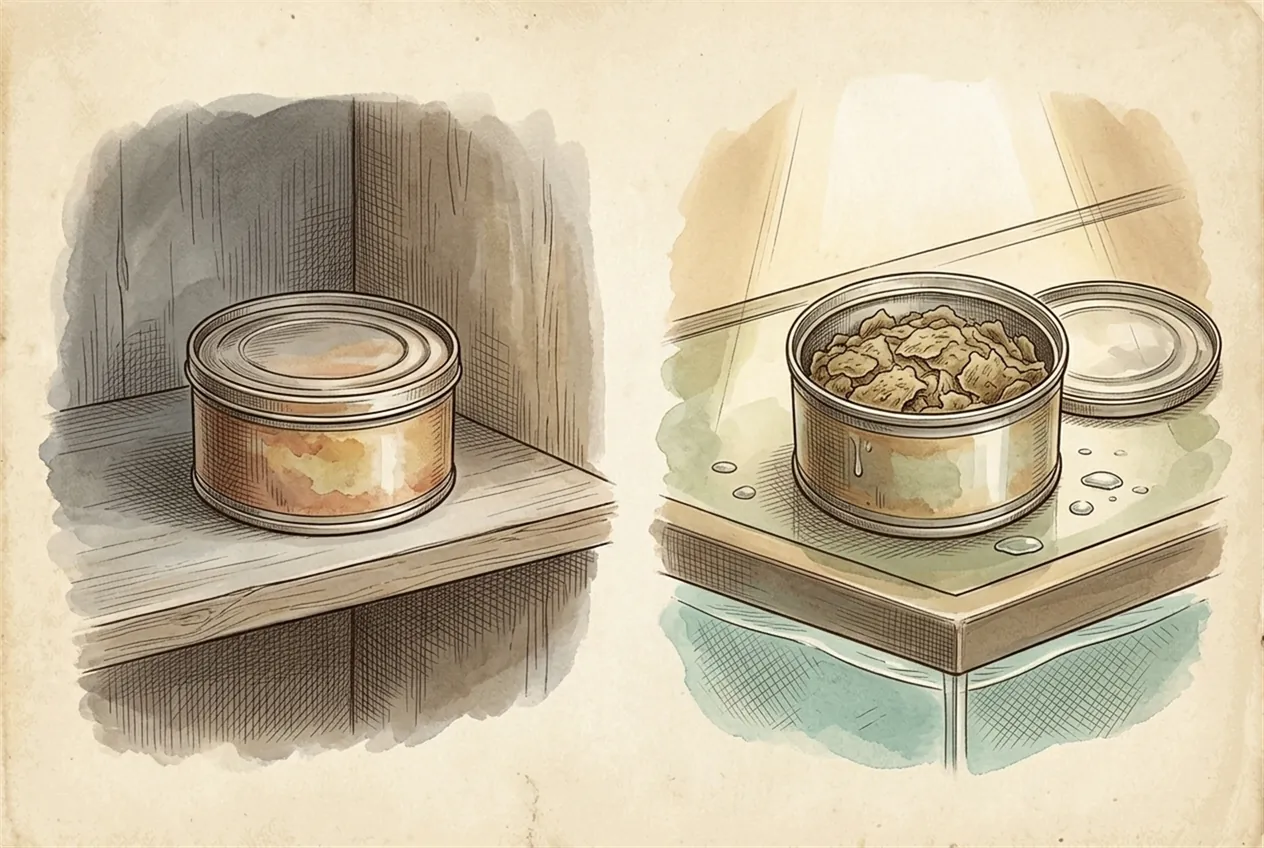
- Fresh
- Spoiling
- Fresh
- Lid on, cool and dry.
- Spoiling
- Open, damp and warm.
- Hikari says use the package within 90 days of opening.
- Fluval says it should be eaten within 6 months.
- Keep the lid on, out of sun and heat, in a dry spot.
- Buy the size you'll finish. A big can at a pinch a day can outlast both windows.
Quick answers
How much do I feed? What your fish finish in about 1 to 3 minutes, depending on the label. If food sits on the bottom after three minutes, that was too much.
How often? Most labels say two or three small meals a day. Follow the label on your food.
Flakes or pellets? Flakes for top swimmers, micro pellets for small mouths and mid-water, and a sinking food for the bottom.
Will my corys eat the flakes? Not enough of them. Add a sinking wafer or granule.
My water got cloudy after I added fish. Why? Usually too much food. Cut back, skip a day, and bring us a water sample.
How long is an open can good for? Hikari says 90 days and Fluval says 6 months. Keep it closed, cool and dry.
Do color flakes work? They bring out color your fish already has. A pale fish usually needs better water, not new food.
Shop this
Pick up in store or have it shipped.
Reviewed by our team 2026-11-09. Nutrition figures are each maker's published guaranteed analysis.