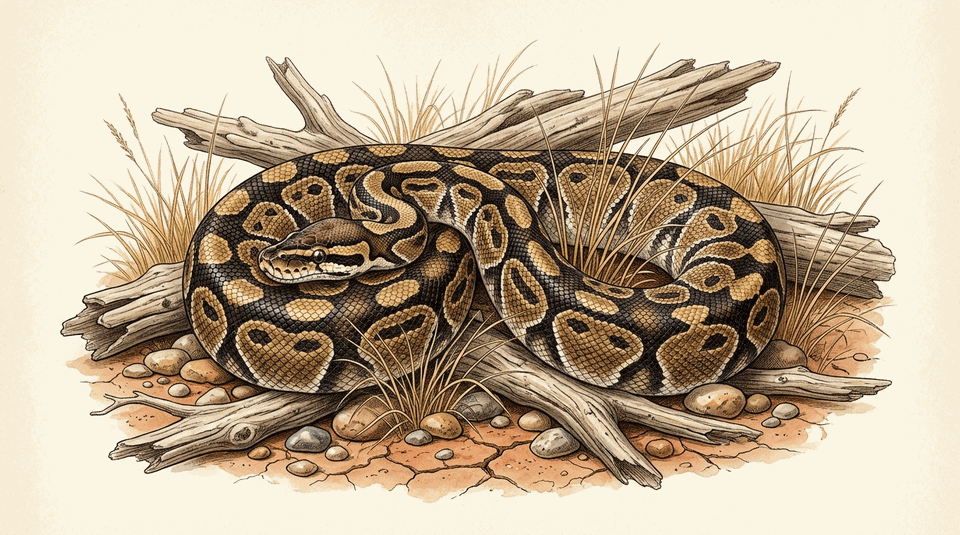
Ball Python
Python regius
1. Warm, Humid & Cluttered Tank Setup

2. Two Great Ways to Set Up Your Habitat
Tank Setup: Front-Opening Terrarium vs. Screen-Top Tank
Ball Pythons thrive in glass tanks as long as you hold in 60–75% humidity and give them cozy privacy:
Option A: Front-Opening Glass Terrarium (Our Top Pick!)
Front doors let you reach in from the side instead of overhead like a hawk! Just cover 70% of the screen top with a clear liner or foil tape to lock humidity in.
Option B: 20L / 40-Gal Breeder Tank + Locking Screen Cover
Roomy and budget-friendly! Clip the screen lid down tight, cover two-thirds of the mesh top to trap moisture, and tape dark paper on 3 outside walls.
Bedding That Actually Holds Moisture
Big No-No: skip dry shredded aspen for Ball Pythons! It sucks moisture out of the air, causes stuck shed, and molds when misted:
Option A: Forest Floor Cypress Mulch & ReptiBark Blend
Holds moisture down underneath while keeping the top layer dry under your snake's belly so they never get scale rot.
Option B: Reptisoil / Eco Earth + Sphagnum Moss Mix
Keeper trick: pour a cup of water into the 4 corners once a week so moisture wicks up! Going bioactive? Seed with our Dwarf White or Powder Orange/Blue Isopods + Tropical Springtails!
24/7 Heating (Without Nighttime Glare)
Because Ball Pythons need 75–80°F temps even at midnight, pair your setup with a digital thermostat:
Option A: Under-Tank Heat Mat + Daytime Basking / DHP Bulb
A thermostat-controlled heat mat under the warm cave keeps their belly at 90°F 24/7 without drying out the air, paired with a gentle overhead lamp.
Option B: Deep Heat Projector (DHP) or Ceramic Heat Emitter
Heats both the warm cave and tank air day and night with zero visible light—always plug into a digital thermostat!

3. Feeding Guide (Frozen/Thawed Rats & Mice)
How to Beat the Famous Ball Python 'Hunger Strike':
They aim using heat-pit sensors on their upper lip!
Thaw inside a Ziploc bag, or hit the head with a hairdryer
Wait till dusk and wiggle the rat right outside their warm cave
90% of picky eaters just have hides that are too big & drafty!

4. Four Keys to a Happy, Thriving Ball Python
Twin Snug Caves
Give them two identical, low-ceiling caves (one on the 90°F side, one on the 78°F side) that barely fit their coiled body. If one cave feels tighter, they'll stay in it even if they're too cold!
Whole-Sock Sheds
A healthy shed rolls off in one piece like a tube sock (including both clear eye caps). If an eye cap ever sticks, put them in a warm damp pillowcase for 20 mins—never use tweezers on eyes!
48-Hour Belly Rest
Wait a full 2 days after feeding before picking your python up so they can curl up in the warm hide and digest in peace.
Listen for Whistles
If you ever hear little clicking/whistling breaths or see bubbly spit, check that your humidity is 70%+ and warm side is 90°F, and call an exotic vet right away.

Bring-Home Shopping Checklist
Tap items to check them off on your phone while you shop at Critter Cabana.
Tank & Humidity Bedding
Heating, Thermostat & Temp Gun
Snug Caves, Bowl & Tongs
Complete Reference Notes & Oregon Keeping Guide
Species: Python regius | Difficulty: 2/5 — Easy | Hardiness: 4/5 — Hardy
Critter Cabana & Gresham Pet Supply — Keeping Your Pet Healthy & Thriving
At a Glance
| Common Name | Ball Python (Royal Python) |
| Species | Python regius |
| Origin | West and Central Africa (Ghana, Togo, Benin, Nigeria, Cameroon) — grasslands, savannas, and sparse woodlands |
| Adult Size | 3–5 feet (90–150 cm). Females are typically larger (4–5 ft) than males (3–4 ft) |
| Weight | Males: 800–1,500g / Females: 1,200–3,000g+ |
| Lifespan | 20–30 years in captivity. Record: 62 years (Philadelphia Zoo) |
| Diet Type | Strict carnivore (rodents) |
| Activity | Nocturnal / crepuscular (most active at dusk and night) |
| Temperament | Extremely docile, calm, gentle. Known for curling into a tight "ball" when stressed (hence the name) |
| Handleability | Excellent — one of the most handleable snakes. Rarely bites. Slow-moving and predictable |
| Difficulty | 2/5 — Easy |
| Hardiness | 4/5 — Hardy |
Why We Love Them: Ball pythons are the #1 most popular pet snake in the world — and for good reason. They're gentle, beautiful, long-lived, and come in thousands of morph combinations. Their main "challenge" is that they can be picky eaters, but with proper husbandry this is manageable. They are an outstanding first snake for anyone willing to commit to their 20–30+ year lifespan.
Commitment Note: Ball pythons routinely live 25–30 years. The record is over 60 years. This is a lifetime commitment comparable to getting a dog. We encourage all buyers to understand this before purchasing.
Habitat & Enclosure
Enclosure Size (Minimum)
- Hatchling/Juvenile (up to 1 year): 20-gallon long tank (30" x 12" x 12") is acceptable temporarily. Add extra clutter and hides so the baby feels secure.
- Sub-adult (1–3 years): 40-gallon breeder (36" x 18" x 18") minimum.
- Adult: 48" x 24" x 24" (120 x 60 x 60 cm) — the modern gold standard. This is a 4-foot x 2-foot x 2-foot enclosure.
- Enclosure Type: PVC enclosures are strongly recommended over glass tanks. PVC holds heat and humidity far better than screen-top glass tanks, dramatically reducing the #1 and #2 problems ball python keepers face (low humidity and temperature instability).
- If using glass: You MUST cover 70–80% of the screen top with aluminum foil, HVAC tape, or a cut acrylic sheet to retain humidity.
- Enclosure Recommendations: Exo Terra Glass Terrarium 36x18x18 (sub-adult) or Zen Habitats 4x2x2 PVC (adult). For budget glass: Zilla Front-Opening Terrarium (cross-ref: Reptile Enclosures)
Do NOT cohabitate ball pythons. They are solitary animals. Housing together causes chronic stress, competition, and risk of constriction injury — even among same-sex pairs.
Substrate
- Recommended:
- Coconut fiber (Eco Earth) — excellent humidity retention, naturalistic, easy to spot-clean
- Cypress mulch — holds humidity well, attractive, natural look
- Topsoil/play sand mix (70/30) — great for bioactive or naturalistic setups
- Coconut husk chips — good airflow, decent humidity retention
- Sphagnum moss (as a humidity boost layer, not sole substrate)
- Avoid:
- Avoid: Cedar or pine shavings — toxic phenol oils, can cause respiratory damage and death
- Avoid: Aspen shavings — molds rapidly in the humidity levels ball pythons need; only viable in very dry setups
- Avoid: Sand (alone) — not appropriate for this species; impaction and dehydration risk
- Avoid: Newspaper/paper towels — functional for quarantine but doesn't support humidity
- Avoid: Reptile carpet — catches teeth and scales, difficult to sanitize, harbors bacteria
- Depth: 3–4 inches minimum to allow burrowing behavior
- Cleaning: Spot-clean waste immediately. Full substrate change every 30–45 days with enclosure disinfection.
- (cross-ref: Reptile Substrate)
Décor & Enrichment
- 2 hides minimum (3 is better): Warm hide, cool hide, and a humid/moist hide for shedding. Hides should be snug — the snake should touch multiple sides when coiled inside. Too-large hides don't provide security.
- Humid/moist hide: Container with entry hole, filled with damp sphagnum moss. Place on or near the warm side.
- Climbing opportunities: Despite being labeled "terrestrial," ball pythons are semi-arboreal and will use sturdy branches, cork bark flats, and elevated platforms, especially at night.
- Foliage: Artificial or live plants provide visual barriers, which reduce stress significantly.
- Water dish: Large enough for the snake to soak in if desired. Heavy ceramic to prevent tipping.
- Clutter is key: Ball pythons are ambush predators that feel vulnerable in open spaces. A "cluttered" enclosure with lots of cover = a confident, stress-free snake that eats reliably.
- (cross-ref: Reptile Décor, Hides & Caves, Snake Accessories)
Temperature
| Zone | Temperature |
|---|---|
| Basking Spot / Warm Hide | 88–92°F (31–33°C) |
| Warm Side Ambient | 83–86°F (28–30°C) |
| Cool Side | 76–80°F (24–27°C) |
| Nighttime Drop | 72–78°F (22–26°C) — no lower than 70°F |
Critical: A thermostat is NON-NEGOTIABLE with any heating device. Unregulated heat sources are the #1 cause of thermal burns in snakes. Use a digital thermometer with probe for accuracy — never rely on stick-on dial gauges.

Why Temperature Matters So Much: Ball pythons cannot digest food properly below 80°F on their warm side. Low temperatures are the #1 cause of feeding refusal and regurgitation.
Heating Options
- Primary (recommended): Overhead radiant heat — deep heat projector (DHP), ceramic heat emitter (CHE), or halogen flood lamp. Overhead heating mimics natural sun exposure and creates a natural thermal gradient through the air.
- Secondary: Under-tank heater (UTH) — effective belly heat for digestion when used WITH a thermostat. Best used as supplemental heat, not sole source.
- For PVC enclosures: Radiant heat panels (RHP) are ideal — they mount to the ceiling and provide even, thermostat-controlled warmth.
- Avoid: Red/blue "night" bulbs (disrupts circadian rhythm — snakes CAN see red/blue light), hot rocks (uneven heating = burns), unregulated heat tape.
- Heating Recommendations: Zoo Med ReptiTherm UTH + Exo Terra Ceramic Heat Emitter 100W + Zoo Med ReptiTemp Digital Thermostat (cross-ref: Reptile Heating, Thermostats)
Lighting
- Photoperiod: 12 hours light / 12 hours dark. Ambient room lighting is adequate if near a window with indirect light.
- UVB: Beneficial but not strictly required. Current research suggests low-level UVB (Ferguson Zone 2, shade-dweller level) supports immune function, vitamin D3 synthesis, and natural circadian behavior.
- If providing UVB: Use a low-output linear bulb with plenty of shaded areas so the snake can escape the UV. Ensure they can get within 12–18 inches of the bulb for benefit.
- UVB Recommendations: Zoo Med ReptiSun T5 HO 5.0 or Arcadia ShadeDweller 7% (cross-ref: UVB Lighting)
- If no UVB: Not a critical concern for ball pythons since they absorb dietary D3 from whole prey (rodents).
Humidity
- Ambient Target: 55–65% (this is the most critical husbandry factor for ball pythons)
- During Shed: 70–80% — increase misting, moisten substrate, ensure moist hide is available
- How to Achieve:
- Use moisture-retentive substrate (coconut fiber, cypress mulch)
- Large water dish on the warm side (evaporation adds humidity)
- Cover 70–80% of screen tops (if using glass tanks)
- Pour water into a corner of the substrate to create a moisture gradient
- Mist 1–2x daily if needed
- PVC enclosures naturally retain humidity much better than glass
- Too Low (<40%): Stuck shed, dehydration, respiratory issues
- Too High (>80% consistently): Scale rot, respiratory infections, bacterial growth in substrate
The #1 Ball Python Problem: Low humidity from screen-top glass tanks is the single most common husbandry failure. If you're fighting humidity, switch to a PVC enclosure or extensively cover the screen top.
Water
- Large, heavy ceramic water dish. Must be large enough for the snake to soak its entire body.
- Change water every 1–2 days minimum, or immediately if soiled.
- Ball pythons often soak before shedding — this is normal. If soaking excessively outside of shed cycles, check for mites or low humidity.
Diet & Nutrition
Primary Diet
Ball pythons eat whole rodents exclusively — mice and rats. They do not eat insects, fish, or any other food items.
- Hatchlings/Juveniles: Start on hopper mice or fuzzy/hopper rats, graduating to larger prey as they grow
- Sub-adults: Small to medium rats
- Adults: Medium rats (typically). Large females may take medium-large rats.
Frozen-Thawed (F/T) is strongly recommended over live prey. Live rodents can and do inflict serious, sometimes fatal bite wounds to snakes. Frozen-thawed is safer, more convenient, easier to store, and more humane.
Prey Size Rule
- Choose a prey item no wider than 1–1.5x the widest point of the snake's body.
- A small visible lump after eating is normal and expected. An enormous bulge means the prey was too large.
Feeding Schedule
| Life Stage | Frequency | Prey Size |
|---|---|---|
| Hatchling (0–6 months) | Every 5–7 days | Hopper mice → weaned rats |
| Juvenile (6–18 months) | Every 7–10 days | Small rats |
| Sub-adult (18–36 months) | Every 10–14 days | Small-medium rats |
| Adult (3+ years) | Every 14–21 days | Medium rats |
Do NOT handle your ball python for 48–72 hours after feeding. Handling too soon after a meal is one of the most common causes of regurgitation, which is a serious medical event.
Feeding Tips for Picky Eaters
Ball pythons are notorious for going off food. This is often normal (especially during winter/breeding season) but can be caused by husbandry issues. Before panicking:
- Check temperatures — warm side below 88°F = most common cause of feeding refusal
- Check humidity — dry enclosure stresses the snake
- Ensure adequate hides — insecure snakes don't eat
- Minimize handling — reduce to zero during feeding strikes
- Warm the prey — thaw frozen rodent in warm water, then use a hair dryer to warm the head to ~100°F. This activates the snake's heat pits.
- Feed at night — offer prey after lights-out when the snake is naturally active
- Try different prey types — some prefer mice over rats, or African Soft Furs (if available)
- Leave-and-walk-away method — place the prey in the enclosure on a dish, cover the enclosure, leave the room, check in 12 hours
- Seasonal fasting — healthy adult males may fast 2–6 months during winter. Monitor weight; if body condition is stable, this is normal.
Weight Monitoring: Use a digital kitchen scale monthly. A healthy ball python maintains steady weight (or gains slowly if juvenile). Weight loss exceeding 10% over a few weeks warrants a vet visit.
Supplements
- None required when feeding whole prey (rodents). Whole mice and rats are nutritionally complete for ball pythons.
- Gut-loading and calcium dusting are not needed for snake prey items.
Foods to Avoid
- Avoid: Insects — ball pythons are obligate rodent feeders
- Avoid: Wild-caught rodents — may carry parasites, pesticides, or diseases
- Avoid: Prey that is too large (wider than 1.5x the snake's body) — can cause regurgitation or internal injury
- Avoid: Chicken, raw meat, eggs, fish — not nutritionally complete and not recognized as food
- Avoid: Live prey left unattended — a live rat can kill or seriously injure a snake that isn't hungry
Health & Husbandry
Common Health Issues
- Respiratory Infection (RI) — Symptoms: Wheezing, clicking/crackling sounds when breathing, mucus or bubbles from nostrils or mouth, open-mouth breathing, lethargy, loss of appetite / Cause: Temperatures too cold, humidity too low OR too high (with poor ventilation), bacterial infection / Prevention: Maintain proper temp gradient and humidity. Ensure adequate ventilation. Requires veterinary treatment with antibiotics — RIs do not resolve on their own.
- Stuck Shed (Dysecdysis) — Symptoms: Retained patches of old skin, retained eye caps (dull, bluish-gray film over the eyes after shed), constriction bands on tail tip / Cause: Humidity too low, dehydration, no moist hide / Prevention: Maintain 55–65% ambient humidity, provide moist hide with damp sphagnum moss, ensure adequate hydration. For stuck shed: soak in lukewarm water for 20–30 minutes, gently assist with damp cloth. NEVER pull retained eye caps off yourself — see an exotic vet.
- Scale Rot (Ulcerative/Necrotic Dermatitis) — Symptoms: Red, brown, or black discoloration on belly scales; blistering; scales appearing pitted, lifted, or eroded; in severe cases open wounds / Cause: Sitting in wet, dirty substrate; chronically high humidity with poor ventilation; bacterial/fungal infection / Prevention: Spot-clean immediately, ensure substrate isn't waterlogged, maintain proper ventilation. Mild cases: clean with dilute betadine, move to paper towel substrate until healed. Severe cases: veterinary treatment required.
- Regurgitation — Symptoms: Partially or fully undigested prey item expelled from mouth, foul smell / Cause: Handling too soon after feeding, enclosure too cold for digestion, prey too large, stress, illness / Prevention: Do NOT handle for 48–72 hours after feeding. Ensure warm side is 88–92°F. Size prey appropriately. After regurgitation: DO NOT offer food for 14 days minimum to allow the esophageal lining to heal (stomach acid causes chemical burns during regurgitation). Then restart with a smaller-than-normal prey item.
- Inclusion Body Disease (IBD) — Symptoms: "Stargazing" (head tilted upward), inability to right itself when flipped, corkscrewing, chronic respiratory infections, regurgitation, loss of coordination / Cause: Arenavirus; spread through snake mites (Ophionyssus natricis) and direct contact. There is no cure. / Prevention: Quarantine ALL new snakes for 90 days minimum. Treat mites aggressively and immediately. Source snakes from reputable breeders with clean collections. If IBD is suspected, isolate immediately and consult a reptile vet.
- Mites (Ophionyssus natricis) — Symptoms: Tiny black or red dots moving on the snake, especially around eyes, chin, and heat pits; excessive soaking; rubbing against décor; tiny black specks in water dish / Cause: Introduced via new snakes, contaminated substrate or equipment, reptile expos / Prevention: Quarantine new animals, inspect thoroughly before introducing. Treatment: Remove all substrate, soak snake in lukewarm water, treat enclosure and snake with mite-specific treatment. Mites vector IBD — treat aggressively.
- Obesity — Symptoms: Visible fat rolls along the body, round cross-section (healthy snakes should be roughly triangular in cross-section with a visible spine ridge), scale spreading / Cause: Overfeeding, prey items too large, feeding too frequently / Prevention: Follow the feeding schedule by age/weight. Monitor body condition, not just weight. Adult ball pythons do NOT need to eat every week.
Signs of Good Health
- Alert, tongue-flicking, responsive to stimuli
- Smooth, clean scales with no stuck shed, discoloration, or lesions
- Clear, bright eyes (cloudy only during the 3–5 day "blue" pre-shed period)
- Clean nostrils — no discharge or bubbles
- Healthy body condition — slight triangle cross-section, visible spine ridge, no fat rolls
- Regular, clean sheds (one complete piece is ideal)
- Active at night — exploring, tongue-flicking, investigating the enclosure
- Consistent feeding response (with normal seasonal variation)
Signs of Illness
- Red Flag: Wheezing, clicking, or open-mouth breathing
- Red Flag: Mucus or bubbles around nostrils or mouth
- Red Flag: Stargazing, corkscrewing, or inability to right itself (neurological signs)
- Red Flag: Rapid weight loss (>10% in a few weeks)
- Red Flag: Refusal to eat for more than 3 months WITH weight loss (fasting without weight loss is often normal)
- Red Flag: Regurgitation (even once is a significant medical event)
- Red Flag: Red, brown, or black discoloration on belly scales
- Red Flag: Retained eye caps after shed
- Red Flag: Visible mites (tiny moving dots) on the snake or in water dish
- Red Flag: Excessive, prolonged soaking (outside of shed cycle)
- Red Flag: Lumps, bumps, or swelling
Shedding
- Normal Cycle: Every 4–6 weeks (juveniles shed more frequently due to rapid growth; adults every 6–8 weeks)
- Pre-Shed Signs: Eyes turn milky/opaque ("in blue"), colors dull and appear faded, reduced appetite, increased hiding — lasts 7–14 days
- Process: Eyes clear up 2–3 days before the actual shed, then the snake rubs its nose on décor to start peeling the skin off in one piece
- Ideal shed: One complete inside-out piece, like a sock being pulled off
- Stuck Shed Protocol:
- Increase humidity to 70–80%
- Provide a "sauna" — place snake in a sealed container (with air holes) lined with warm, damp paper towels for 20–30 minutes
- Gently help work stuck pieces off with a damp cloth or cotton swab — NEVER pull
- Retained eye caps: Do NOT attempt to remove yourself. This requires a reptile vet.
- If stuck shed is chronic, re-evaluate humidity and hydration in the enclosure
Brumation
- Ball pythons do not truly brumate, but many (especially males) go through a winter "slow period" with reduced appetite, lasting 1–6 months (typically November–March).
- This is normal if the snake maintains body weight.
- Maintain normal temperatures during this period.
- Continue offering food every 2–3 weeks even if refused — they'll eat when they're ready.
Veterinary Needs
- We recommend an exotic-specialized veterinarian with reptile experience. Annual wellness checks are ideal.
- Fecal exam for parasites at least once per year.
- Quarantine ALL new ball pythons for 90 days before introducing them to a room with other snakes. IBD is not curable and is devastating to a collection.
Common Morphs
Ball pythons have the largest morph market in the entire reptile hobby, with thousands of documented genetic mutations and combination morphs. Morphs are color and pattern variations produced through selective breeding. They do NOT affect care requirements (with rare exceptions noted below). Here are the most popular and commonly available morphs:
Single-Gene / Foundation Morphs
- Normal (Wild Type) — Rich brown and tan coloring with dark brown/black alien-head pattern. The original, classic look. Beautiful in its own right and the most affordable option.
- Pastel — Co-dominant. Brighter yellows, faded blacks, blushing head stamps, and green/hazel eyes. One of the most common and versatile breeding morphs. Foundation for many designer combos.
- Fire — Co-dominant. Subtle brightening and cleaning of the pattern. Two Fires bred together produce a Black-Eyed Leucistic (BEL) — a solid white snake with black eyes.
- Lesser (Lesser Platinum) — Co-dominant. Subtle lightening. Two Lessers produce a Blue-Eyed Leucistic (BEL) — solid white with piercing blue eyes. Extremely popular.
- Mojave — Co-dominant. Dark-bordered alien heads with flaming and a patternless belly. Mojave x Mojave = BEL.
- Banana (Coral Glow) — Co-dominant. Bright yellow/orange/lavender with dark freckles that develop with age. One of the most popular morphs of the last decade.
- Enchi — Co-dominant. Enhanced orange and yellow tones with unique side-banding. Incredible in combination morphs.
- Cinnamon — Co-dominant. Dark, rich brown tones. Two Cinnamons = Super Cinnamon (solid chocolate/black). Foundation for many dark combos.
Recessive Morphs
- Albino (Amelanistic) — Recessive. One of the original "big three" morphs. Bright yellow and white with red eyes. No melanin (dark pigment).
- Piebald (Pied) — Recessive. Dramatic high-contrast patches of solid white alongside normal-colored sections. Every piebald has a unique pattern. Extremely popular.
- Clown — Recessive. Reduced, busy dorsal stripe pattern with a distinctive "teardrop" head marking. Highly sought after in breeding projects.
- Axanthic — Recessive. Removes yellow pigment, producing a striking black, white, and silver/gray "grayscale" snake. Multiple lines exist (VPI, TSK, Jolliff, MJ).
- GHI (Gotta Have It) — Recessive. Deep blacks and rich contrast. Spectacular in combination with other genes.
- Desert Ghost — Recessive. Muted, hazy pastel tones with reduced pattern. Creates dreamy, ethereal combinations.
Premium / Designer Combinations
- Blue-Eyed Leucistic (BEL) — Solid pure white body with brilliant blue eyes. Created by combining two co-dominant genes (Lesser x Lesser, Mojave x Mojave, Fire x Fire, or combos). One of the most iconic ball python morphs.
- Killer Bee — Pastel + Spider. Bright yellow with thin banding. (Note: carries Spider gene — see wobble warning below.)
- Bumblebee — Pastel + Spider. Similar to Killer Bee. (Note: carries Spider gene.)
- Black Night — Premium line-bred morph. Intense, near-solid black body. Among the most expensive morphs available.
Morph Health Warnings:
- Spider gene (and Spider complex: Champagne, Woma, Hidden Gene Woma, Super Sable, Super Cypress): Associated with "wobble" — a neurological condition causing head tremors, head swaying, corkscrewing, and disorientation. Severity varies from barely noticeable to debilitating. This is a lifelong, genetic condition with no cure. Some reptile shows and organizations have banned the Spider morph. We recommend researching this gene before purchasing any morph containing it.
- Super Lesser / Super Butter: Can produce "bug eye" (abnormally large or protruding eyes) in some individuals.
- Caramel Albino: Associated with higher rates of fertility issues.
- Super Cinnamon / Super Black Pastel: Some individuals are born with "duck bill" (shortened snout). Usually mild and does not affect quality of life.
Can They Live Together? (Housing & Handling)
- Cohabitation: Never. Ball pythons are strictly solitary. Even "bonded" snakes living together are merely tolerating each other under chronic stress. Risk of constriction, competition, disease transmission, and feeding aggression.
- Handling Tips:
- Allow 5–7 days after arrival to settle before first handling (longer is better)
- Do NOT handle for 48–72 hours after feeding
- Do NOT handle during shed ("in blue" period)
- Start with 5–10 minute sessions, gradually increase to 20–30 minutes
- Support the body — never grab from above (predator response). Scoop from below.
- If the snake balls up, it's stressed. Return to enclosure and try again another day.
- Frequent, gentle, short handling sessions build trust over time
- Wash hands before handling (especially if you've touched rodents — your hand smells like food)
Oregon & Local Keeping Notes
- Oregon: Legal to own. No special permits required for captive-bred ball pythons.
- General: Ball pythons are legal in all 50 US states. CITES Appendix II (international trade regulated, but captive-bred animals are widely available and unrestricted domestically).
- Lacey Act: Interstate transport of live reptiles is legal for captive-bred ball pythons.
What We Stock & Use in Our Stores
These are products we carry and recommend for this species. Ask any associate for help finding them in-store.
| Category | Product | Notes |
|---|---|---|
| Enclosure (Glass) | Exo Terra Glass Terrarium 36x18x18 | Good for sub-adults; cover screen top for humidity |
| Enclosure (PVC) | Ask about PVC options | 4x2x2 PVC is the gold standard for adults |
| Heating (UTH) | Zoo Med ReptiTherm UTH | Supplemental belly heat; MUST use with thermostat |
| Heating (Overhead) | Exo Terra Ceramic Heat Emitter 100W | No light output, 24/7 safe, primary heat source |
| Thermostat | Zoo Med ReptiTemp Digital Thermostat | NON-NEGOTIABLE with any heat source |
| UVB (Optional) | Zoo Med ReptiSun T5 HO 5.0 | Low-level UVB; provide shaded areas |
| Substrate | Zoo Med Eco Earth (Coconut Fiber) | Excellent humidity retention |
| Substrate (Alt) | Zoo Med Forest Floor (Cypress Mulch) | Natural look, holds humidity |
| Hides | Exo Terra Reptile Cave (2–3 sizes) | Snug fit is important; min 2 hides |
| Humid Hide | Zoo Med Repti Shelter + sphagnum moss | Fill with damp moss, place warm side |
| Water Dish | Exo Terra Water Dish (Large) | Big enough for full-body soaking |
| Thermometer | Zoo Med Digital Thermometer | Probe-style for accurate readings |
| Hygrometer | Zoo Med Digital Hygrometer | Monitor humidity — critical for this species |
| Décor | Exo Terra Jungle Vines & Forest Branches | Climbing + visual barriers |
| Spray Bottle | Exo Terra Mister | For maintaining humidity |
| Frozen Rodents | Frozen mice & rats (various sizes) | Ask at register; keep frozen until feeding |
The 3 Things That Matter Most
If a new ball python owner remembers only three things from this care sheet:
- Warm side 88–92°F with a thermostat. Cold snakes don't eat and get sick.
- Humidity 55–65%. Low humidity = stuck shed = misery. Cover screen tops.
- Snug hides + clutter = a confident snake that eats. An insecure snake is a picky snake.
Care sheet compiled by Critter Cabana & Gresham Pet Supply. For questions, ask any livestock specialist in-store.
Last updated: 2026-08-04
How We Keep Them at Critter Cabana & Gresham Pet Supply
- Beating Dry Oregon Furnace Air (and Summer Heat Spikes): Across the Willamette Valley and Portland Metro, running the house furnace all winter drops indoor humidity to 25–35%, which quickly causes stuck sheds and dehydration in screen-top tanks. To hold
55-65%reliably for Ball Python, our crew uses a deep 3–5" substrate bed (or our store-shelf 10-Part Bioactive Mix of ReptiSoil, Coco Fiber, Orchiata Bark, Sphagnum Moss, and Leaf Litter), a dedicated humid hide packed with damp sphagnum moss, and partial screen cover when needed. - Thermostat & Linear UVB Standard: Every heating element in our Newberg and Gresham reptile rooms runs on a thermostat probe set to
88-92°Fon the warm side with a76-80°Fcool retreat, paired withbeneficialon a 12-hour day/night timer. In summer, if an upstairs room climbs above 82°F, a dimming thermostat automatically backs down the basking lamp so the cool side never overheats. - Stocked at Newberg & Gresham: We stock reptile enclosures, thermostats, Arcadia & Zoo Med UVB lighting, bioactive substrate ingredients, live Springtails, Dwarf White, Powder Blue/Orange, Dairy Cow, and Giant Canyon isopods, and gut-loaded crickets, dubia roaches, hornworms, and frozen-thawed rodents at Critter Cabana (Newberg) and Gresham Pet Supply.
Common Questions (FAQ)
What size tank does an adult Ball Python actually need?
An adult Ball Python needs at least 40-Gallon Breeder / 36"×18"×18" Terrarium so you can maintain a true thermal gradient from 88-92°F on the warm/basking side down to 76-80°F on the cool side.
How do I keep Ball Python humidity at 55-65% during dry Oregon winters?
Oregon winter furnace heat dries out thin bedding fast. Use a 3–5 inch moisture-retaining substrate mix (such as Zoo Med ReptiSoil blended with coco fiber, Orchiata bark, and sphagnum moss), provide an enclosed humid hide, and cover 50–70% of an open screen top with HVAC foil tape or a PVC panel if ambient humidity drops too low.
What is the best bioactive clean-up crew for a Ball Python?
Pair Temperate White Springtails with a humidity-matched isopod species (such as Powder Blue/Orange for semi-arid setups or Dwarf White / Dairy Cow isopods for humid forest setups) in a 3–5 inch bioactive soil and leaf-litter bed. You can pick up our 1-Page or Tri-Fold Bioactive Substrate Recipe Guide and live cultures at Critter Cabana (Newberg) or Gresham Pet Supply.
Where can I get Ball Python setup supplies, live feeders, and thermostats in Oregon?
We stock our full reptile, amphibian, and bioactive setup supplies—including enclosures, thermostats, Arcadia and Zoo Med UVB lighting, bioactive substrates, live isopods/springtails, and live or frozen feeders—at Critter Cabana in Newberg (514 E First St, 503-537-2887) and Gresham Pet Supply (2185 NW Burnside Rd, 503-665-7606).