
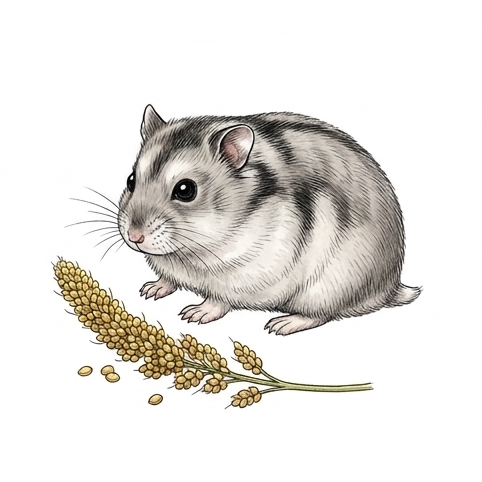
Russian Dwarf Hamster
Phodopus campbelli / Phodopus sungorus
1. Escape-Proof Glass Tank, Deep Bedding & Sand Zone
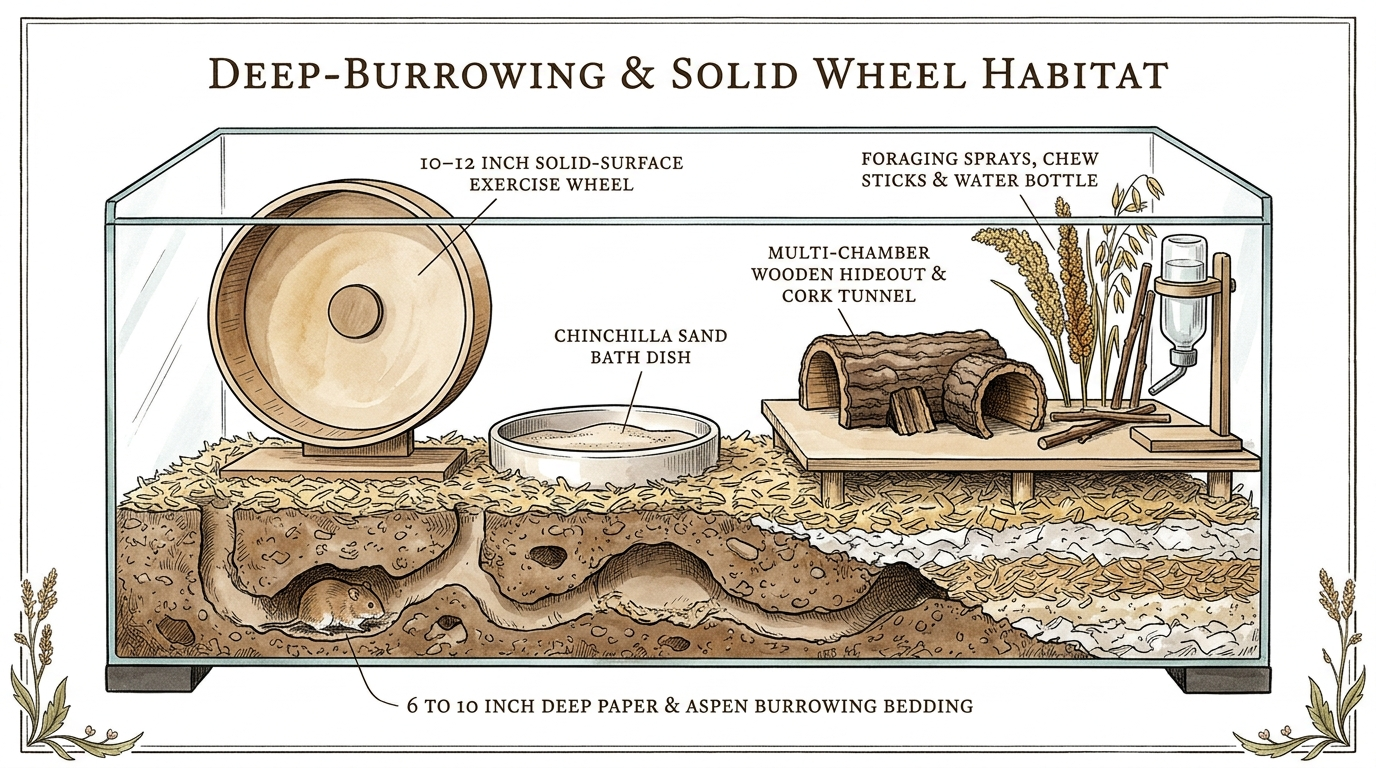

2. Two Great Ways to Set Up Your Habitat
Enclosure: Glass Breeder Tank vs. Wire Bar Cages
Dwarf hamsters are master escape artists that can flatten their bodies like a coin and slip right through standard wire bars:
Option A: 20-Gallon Long to 40-Gallon Breeder Glass Tank + Mesh Lid (Our Top Pick!)
100% escape-proof, holds 6–8 inches of deep burrowing substrate, and gives you a front-row view of their tunnels and sand bath antics.
Option B: Why We Recommend Housing Dwarf Hamsters Singly
While books sometimes say dwarfs can live in pairs, in a home enclosure they frequently turn on each other once mature. Housing one dwarf per tank guarantees zero midnight fights!
The Big Desert Sand Bath & Tunnel Bedding
Dwarf hamsters have fur on the soles of their feet and oilier coats than Syrians—sand is a daily necessity, not a luxury:
Option A: Baking Dish or Acrylic Tray Filled with Natural Sand
Give them an 8"×6" dish of natural calcium-free reptile sand or chinchilla bath sand (skip dusty powder!). Roborovski hamsters love having up to 1/4 of their tank as a sand beach!
Option B: 6–8" Paper Bedding + Toilet Paper Roll Starter Tunnels
Bury cardboard tubes and a multi-chamber wooden hide underneath 6–8 inches of Carefresh or Clean & Cozy paper bedding to jump-start their burrows.
8–10" Solid Wheel & Cup-Taming Fast Little Sprinters
Dwarf hamsters move twice as fast as Syrians—especially tiny Roborovskis:
Option A: 8" to 10" Smooth Solid-Surface Wheel
Tiny 4–5" starter wheels bend their spine, and flying-saucer discs can launch fast Robo hamsters into the glass! Use an 8–10" upright solid wheel.
Option B: The Ceramic Mug 'Elevator' Trick for Handling
Instead of chasing a fast dwarf from above like a hawk, let them walk into a ceramic mug or tunnel with a mealworm inside, then lift them into a playpen or over your lap!

3. Low-Sugar Diet (Diabetes Prevention for Dwarfs!)
Safe Dwarf Treats vs. Sugary Foods to Skip:
Freeze-dried mealworms, millet spray, pumpkin seed, sunflower seed
Broccoli, cucumber, dandelion leaf, bok choy, green bell pepper
Apples, bananas, berries, raisins, carrots, sweet corn, peas
Yogurt drops, honey-glued seed sticks, and colorful sugary puffs

4. Four Keys to a Happy, Thriving Russian Dwarf Hamster
Hold Over a Soft Surface
Because dwarf hamsters are fast and fearless, always hold them sitting down over your lap, a bed, or a playpen—a fall from standing height can seriously injure a 40-gram hamster.
Watch Water Intake
If your Russian Dwarf starts drinking a whole bottle of water fast and peeing constantly, double-check that all fruit, corn, and sugary treats are out of their diet.
Keep the Sand Bath Clean
If your dwarf looks greasy or stringy, their sand bath needs refreshing! Sift out any droppings or clumps every couple of days with a small strainer.
Wash Hands Before Taming
Dwarf hamsters have poor eyesight and navigate by smell. If your fingertips smell like dinner or soap, they'll do a polite 'test nibble' to see if you're a snack!

Bring-Home Shopping Checklist
Tap items to check them off on your phone while you shop at Critter Cabana.
Escape-Proof Tank & Bedding
Wheel, Sand Bath & Chews
Sugar-Free Diet & Water
Complete Reference Notes & Oregon Keeping Guide
Species: Phodopus campbelli (Campbell's) & Phodopus sungorus (Winter White) | Difficulty: 2/5 — Easy | Hardiness: 3/5 — Moderate
Critter Cabana & Gresham Pet Supply — Keeping Your Pet Healthy & Thriving
At a Glance
| Common Name | Russian Dwarf Hamster (Campbell's, Winter White / Djungarian, or Hybrids) |
| Species | Phodopus campbelli and/or Phodopus sungorus |
| Origin | Steppes of Central Asia, Russia, and Northern China |
| Adult Size | 3–4 inches |
| Weight | 30–50 grams |
| Lifespan | 1.5–2 years (sometimes up to 2.5 years) |
| Diet Type | Omnivore (Seeds, Grains, Insects) |
| Activity | Crepuscular / Nocturnal (most active at dawn, dusk, and night) |
| Temperament | Very fast and active. Can be nippy when young but tame down beautifully. |
| Handleability | Good, but they are very quick and can jump out of hands easily. |
| Social Needs | Strictly Solitary. |
| Odor Level | Low (if the enclosure is spot-cleaned regularly) |
| Difficulty | 2/5 — Easy (Care is simple, but they are harder to hold than Syrian hamsters) |
| Hardiness | 3/5 — Moderate (Genetically prone to diabetes) |
Why We Love Them: Dwarf hamsters are incredibly entertaining to watch. Because they are so small, you can create massive, intricate habitats for them in relatively small spaces (like a 40-gallon aquarium). They are highly active and will spend hours running on their wheels, digging elaborate tunnel systems, and hoarding food in their cheeks.
Housing & Enclosure
Enclosure Size (Minimum)
- Minimum: 775 square inches of continuous floor space (approx. a 40-gallon breeder aquarium).
- Type: Glass tanks (aquariums/terrariums) or large DIY bin cages are best. Wire cages rarely have deep enough pans for the amount of bedding they require.
- Enclosure Recommendations: Do not use small, modular plastic tube cages (like CritterTrails). These are far too small, have poor ventilation, and the tubes can trap the hamster.
Bedding & Substrate
- Depth (CRITICAL): Hamsters are burrowing animals. You must provide a minimum of 6 to 8 inches of deep bedding so they can build tunnel systems.
- Recommended: Unscented paper bedding (Carefresh, Kaytee Clean & Cozy) or Aspen shavings.
- Avoid: Cedar shavings (highly toxic), pine shavings, and scented bedding (causes respiratory distress).
- Cleaning Schedule: Spot clean soiled corners every 2-3 days. Do a 50% bedding change every 3-4 weeks. Never change 100% of the bedding at once, as removing their scent completely causes extreme stress.
Décor & Enrichment
- The Wheel (CRITICAL): They must have an 8-inch to 10-inch solid-surface wheel. Never use wire or mesh wheels, as their tiny feet will fall through, causing broken legs or a severe infection called "Bumblefoot." The wheel must be large enough that their back is perfectly flat while running.
- Hideouts/Huts: Provide at least 2-3 small hides (wooden houses, coconut shells, or ceramic mugs).
- Sand Bath: Provide a small dish filled with ReptiSand (pure quartz desert sand without calcium or dyes). They roll in the sand to strip oils from their fur and keep clean. Do not use chinchilla "dust" as it causes respiratory infections.
- Chewing: Provide plenty of wooden chew toys, apple sticks, and willow balls to keep their teeth filed down.
Diet & Nutrition
The Diabetes Warning (CRITICAL)
Russian Dwarf Hamsters (especially hybrids and Campbell's) are highly prone to developing diabetes. Because of this, their diet must be strictly managed:
- Avoid: NO SUGAR: Never feed yogurt drops, honey sticks, molasses-bound seed rings, or commercial fruits.
- Avoid: NO FRUIT: Apples, bananas, and berries have too much natural sugar.
Primary Diet
- High-Quality Seed Mix: Feed a high-variety seed and grain mix (like Higgins Sunburst) mixed 50/50 with a high-protein lab block (like Mazuri Rat & Mouse or Oxbow).
- Feeding Amount: 1 to 1.5 tablespoons per day. Scatter-feed the food by sprinkling it around the cage rather than using a bowl; this encourages natural foraging behavior and prevents boredom.
Fresh Vegetables & Greens
- Safe Veggies: Broccoli, cucumber, zucchini, spinach, and celery.
- Frequency: A piece the size of the hamster's ear, offered 2-3 times a week.
Treats
- Safe Treats: Mealworms (dried or live), plain unflavored oats, flax sprays, or millet sprays.
Handling & Behavior
Taming & Handling
- Taming Process: Allow the hamster 3 days to settle into a new home before touching them. Start by offering treats from your fingers. Once they are comfortable, lay your hand flat in the cage and let them walk onto you.
- Biting: Dwarf hamsters are known to give "test nibbles" to see if your fingers are food (especially if you smell like food). Wash your hands before handling.
Social Needs
- Solitary: While some sources claim littermates can live together, we highly recommend keeping them solitary. As they mature, pairs almost always become territorial and will violently fight, often to the death. They do not get lonely; they are highly territorial.
Behavioral Notes
- Hoarding: They have large cheek pouches and will stuff them full of food to carry back to their burrow. You will often find massive piles of hoarded food when you clean the cage.
- Scent Glands: Dwarf hamsters have a visible scent gland on their belly (it looks like a small yellow scab or belly button). This is normal.
Health & Husbandry

Common Health Issues
- Diabetes — Symptoms: Excessive drinking, excessive urination, sudden weight loss or gain, lethargy. / Cause: Genetic predisposition combined with a high-sugar diet. / Prevention: Strict low-sugar diet.
- Wet Tail — Symptoms: Severe diarrhea, lethargy, a wet and soiled tail/rear end. / Cause: Severe stress (usually from a dirty cage, rapid diet change, or moving to a new home) leading to a bacterial infection. / Treatment: Highly fatal. Requires emergency veterinary antibiotics.
- Overgrown Teeth — Symptoms: Inability to eat, drooling, teeth curling into the roof of the mouth. / Cause: Lack of wooden chew toys. / Treatment: Requires a vet to trim the teeth.
What We Stock & Use in Our Stores
These are products we carry and recommend for this species. Ask any associate for help finding them in-store.
| Category | Product | Notes |
|---|---|---|
| Enclosure | Aqueon 40-Gallon Breeder Aquarium + Screen Lid | Provides 648 sq inches of floor space and allows for deep bedding |
| Bedding | Carefresh Unscented Paper Bedding | Holds burrows incredibly well. Fill at least 6 inches deep! |
| Food | Higgins Sunburst Gourmet Blend + Mazuri Rat & Mouse Diet | Mix these 50/50 for a balanced, low-sugar diet |
| Wheel | Exotic Nutrition Silent Runner (9-inch) | Safe, solid track that protects their backs and feet |
| Sand Bath | Zoo Med ReptiSand (Natural Red or White) | Safe, dust-free sand for bathing. Never use calcium sand. |
| Chew Toys | Oxbow Enriched Life Apple Sticks | Essential for keeping their constantly growing teeth filed down |
Care sheet compiled by Critter Cabana & Gresham Pet Supply. For questions, ask any livestock specialist in-store.
Last updated: 2026-08-04
How We Keep Them at Critter Cabana & Gresham Pet Supply
- Pacific Northwest Seasonal Drafts & Indoor Air Quality: In Oregon, damp chilly winters and sudden August heatwaves are the two biggest environmental stressors for Russian Dwarf Hamster. Keep their habitat (
40-gallon breeder or 775+ square inches) away from drafty windows, exterior doors, and direct furnace vents, and maintain a steadyspecies-appropriate warm zonetemperature zone. - What Our Store Crew Uses Daily: In our Newberg and Gresham animal rooms, we use dust-extracted, scent-free bedding (never cedar or raw phenols), fresh Pacific Northwest grass hays or species-specific pelleted staples (Oxbow, Harrison's, Roudybush, or Higgins), and daily foraging enrichment so young animals are already hand-accustomed and eating a balanced diet before they go home with you.
- Local Exotic Vet Planning: Before an emergency ever happens, save the number of an experienced Oregon avian/exotic veterinarian in the Portland Metro or Willamette Valley area (such as Avian & Exotic Veterinary Care or Scales & Tails Exotic Pet Clinic).
Common Questions (FAQ)
What size cage or habitat does a Russian Dwarf Hamster actually need?
Plan on at least 40-gallon breeder or 775+ square inches as a true minimum—bigger horizontal floor space (or flight width for birds) is always better for daily exercise, mental health, and clean air quality.
How do I keep Russian Dwarf Hamster comfortable through Oregon winters and summers?
Keep indoor temperatures steady around species-appropriate warm zone with balanced humidity humidity, well away from cold window drafts in winter and direct afternoon sun in summer.
What do you feed Russian Dwarf Hamster at Critter Cabana and Gresham Pet Supply?
Our store crew feeds a balanced omnivore regimen built on high-quality pellets/hay and daily fresh produce or foraging items—never all-seed junk mixes that cause vitamin deficiencies and fatty liver disease.
Where can I meet Russian Dwarf Hamster and talk to the animal care crew in Oregon?
Visit our live animal departments at Critter Cabana in Newberg (514 E First St, 503-537-2887) or Gresham Pet Supply (2185 NW Burnside Rd, 503-665-7606) to meet our animals and get hands-on setup advice.