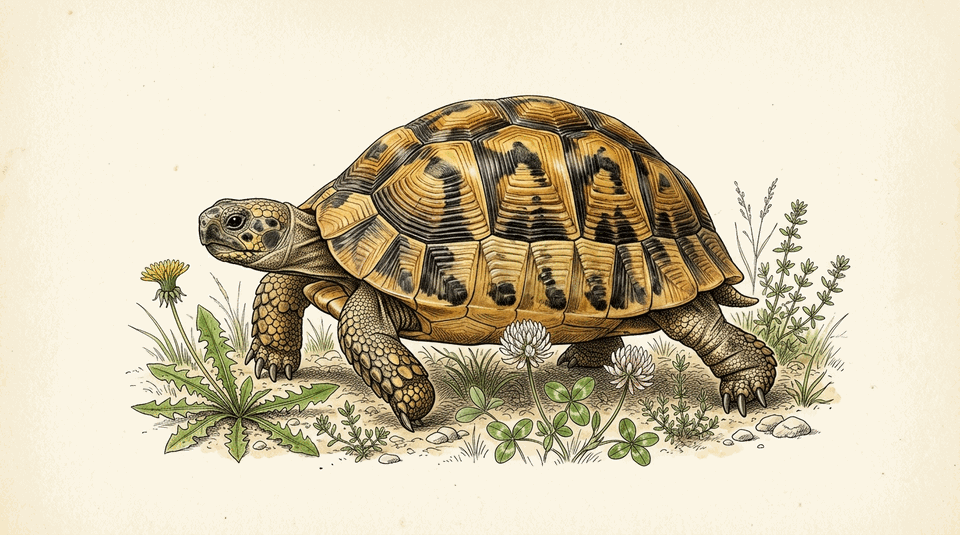
Sulcata Tortoise
Centrochelys sulcata
1. Habitat Layout & Temperature Gradient
Species: Centrochelys sulcata | Difficulty: 3/5 — Intermediate (Due to size) | Hardiness: 4/5 — Hardy

Critter Cabana & Gresham Pet Supply — Keeping Your Pet Healthy & Thriving
At a Glance

| Common Name | Sulcata Tortoise, African Spurred Tortoise |
| Species | Centrochelys sulcata |
| Origin | Sub-Saharan Africa (Arid, dry scrublands) |
| Adult Size | 24–30+ inches long. They can weigh between 100 and 200 pounds! |
| Lifespan | 70–100+ years. This is a multi-generational pet. |
| Diet Type | Strict Herbivore (Grasses, Hay, Weeds) |
| Activity | Diurnal (active during the day, burrows to escape extreme heat) |
| Temperament | Docile and friendly, but incredibly strong. They are living bulldozers. |
| Handleability | Easy to handle as babies. As adults, they are too heavy to lift safely. |
| Social Needs | Mostly solitary, though multiple females can cohabitate in massive yards. |
| Difficulty | 3/5 — Intermediate (Care is easy, but accommodating their massive size is very difficult) |
| Hardiness | 4/5 — Hardy (Very strong immune systems if kept warm) |
Why We Love Them: The Sulcata is the third-largest tortoise species in the world (and the largest mainland tortoise). They start out as adorable, golf-ball-sized hatchlings, but they grow incredibly fast. They are incredibly personable, often learning to recognize their owners and following them around the yard like a puppy looking for treats.
THE COMMITMENT WARNING: Do not buy a Sulcata tortoise on impulse. Within 5-10 years, they will outgrow an indoor enclosure and must be moved to a permanent outdoor yard. They are incredibly strong and will dig massive burrows (sometimes 10+ feet deep), destroying gardens and breaking through weak fences. You must have the property space, the climate (or heated outdoor sheds), and the commitment to care for an animal that will likely outlive you.

Notable Morphs & Locales
Tortoises are generally wild-type, but the Sulcata has one highly prized, captive-bred mutation:
- Ivory Sulcata: A leucistic mutation. These tortoises lack dark pigmentation on their shell and skin, resulting in a stunning, solid cream or pale yellow color with bright ruby or black eyes. Their care is identical to wild-types, but they may be slightly more sensitive to harsh UV exposure.
Housing & Enclosure
Enclosure Size
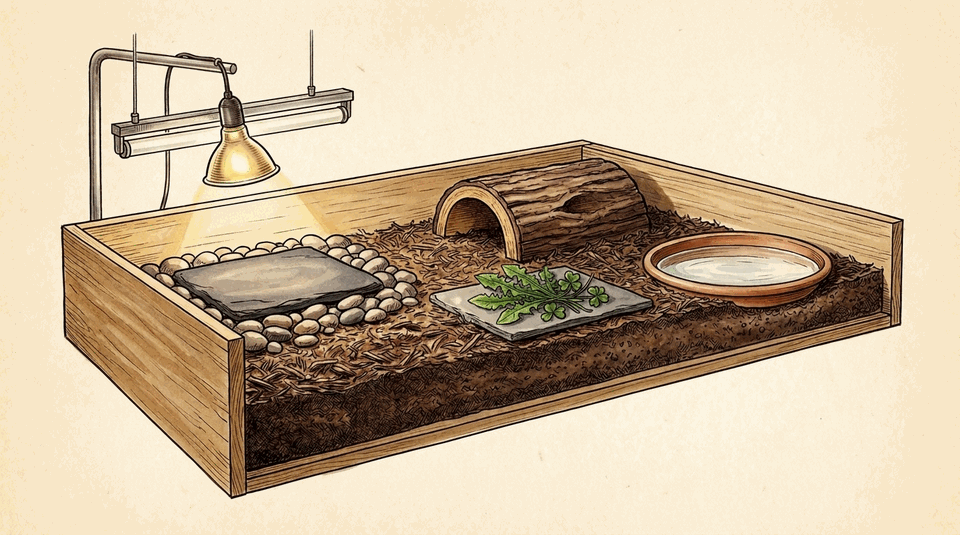
- Hatchlings & Juveniles: A large tortoise table, minimum 4x2 feet, moving up to an 8x4 foot indoor enclosure quickly.
- Adults: Must be housed outdoors. A minimum of 100 square feet per tortoise, though much larger is preferred.
Enclosure Setup (Outdoor)
- Fencing: Fences must be extremely strong (solid wood or reinforced metal). The bottom of the fence must be sunk at least 1-2 feet underground, as Sulcatas are expert diggers and will easily tunnel under a standard fence.
- Heated Hide: If you live in an area that drops below 60°F (15°C) at night, they MUST have a heated outdoor shed or "tortoise house" they can retreat into.
Humidity & Pyramiding (CRITICAL FOR BABIES)
- The Pyramiding Problem: Pyramiding is a permanent, debilitating bone deformity where the shell grows upward into sharp cones instead of remaining smooth. It was once thought to be caused by diet, but modern veterinary science has proven it is primarily caused by dehydration and low humidity during the first 3 years of life.
- Hatchling Humidity: Baby Sulcatas must be kept at 70%–80% humidity in a closed-chamber enclosure (not an open-topped table). They must be soaked in shallow, warm water for 15 minutes, 3–4 times a week.
- Adult Humidity: Adults do fine in standard ambient outdoor humidity, provided they have a muddy wallow or deep burrow to retreat into during the heat of the day.
Temperature & Lighting (Indoors)
- Basking Spot: 95–105°F (35–40°C).
- Ambient Temperature: 80–90°F (26–32°C).
- Nighttime: Should not drop below 70°F (21°C).
- Lighting: A high-output UVB bulb (like a T5 12% or 14% Desert bulb) is absolutely critical for indoor tortoises to prevent Metabolic Bone Disease. Outdoors, the sun provides all necessary UVB.
Diet & Nutrition

The 80/20 Herbivore Rule
Sulcatas require a massive amount of fiber and very low protein. Feeding them dog food, high-protein tortoise pellets, or lots of fruit will destroy their kidneys and deform their shells.
- 80% Grasses & Hay: The bulk of their diet should be Timothy Hay, Orchard Grass, Bermuda Grass, and pesticide-free yard grass.
- 20% Edible Weeds & Greens: Dandelion greens, clover, hibiscus flowers/leaves, cactus pads (Opuntia), turnip greens, and collard greens.
- Fruits & Veggies: Treat ONLY. Once a month max. Their digestive tracts cannot process the sugar in fruits or carrots properly, leading to severe gastrointestinal issues.
Supplements
- Calcium: Dust their greens with calcium powder (with D3 if indoors, without D3 if outdoors) 2-3 times a week.
- Cuttlebone: Leave a whole cuttlebone in the enclosure. They will chew on it when they need calcium, and it helps keep their powerful beak trimmed.
Health & Husbandry
Common Health Issues
- Pyramiding / Metabolic Bone Disease — Symptoms: Lumpy, raised scutes on the shell, weak legs. / Cause: Lack of humidity (for babies), lack of calcium/UVB, or too much protein in the diet. / Treatment: The damage is permanent, but correcting husbandry stops it from worsening.
- Respiratory Infection — Symptoms: Bubbles blowing from the nose, wheezing, lethargy. / Cause: Cold temperatures combined with wet conditions. / Treatment: Needs immediate veterinary antibiotics and increased heat.
- Impaction — Symptoms: Lack of feces, lethargy, loss of appetite. / Cause: Eating sand, gravel, or unnatural bedding. / Prevention: Never house on calcium sand or pure sand.
What We Stock & Use in Our Stores
These are products we actively carry and recommend for Juvenile/Indoor Sulcata Tortoise setups. Ask any associate for help finding them in-store.
| Category | Product | Notes |
|---|---|---|
| Enclosure | Zoo Med Tortoise House | Best for babies. Must cover the screen top to trap humidity. |
| Substrate | Zilla Jungle Mix mixed with Zilla Coconut Husk | Excellent for holding the high humidity babies need |
| Heating | Exo Terra Intense Basking Spot Bulb (100w+) | Creates a wide, hot basking zone |
| UVB Lighting | Exo Terra Reptile UVB150 (Desert) | High-output UVB is absolutely critical indoors |
| Diet | Zoo Med Natural Grassland Tortoise Food | A safe, high-fiber pellet to mix with fresh greens |
| Supplements | Zoo Med ReptiCalcium (With D3) | Dust onto greens to ensure strong bone and shell growth |
Care sheet compiled by Critter Cabana & Gresham Pet Supply. For questions, ask any livestock specialist in-store.
Last updated: 2026-08-04
How We Keep Them at Critter Cabana & Gresham Pet Supply
- Beating Dry Oregon Furnace Air (and Summer Heat Spikes): Across the Willamette Valley and Portland Metro, running the house furnace all winter drops indoor humidity to 25–35%, which quickly causes stuck sheds and dehydration in screen-top tanks. To hold
balanced humidityreliably for Sulcata Tortoise, our crew uses a deep 3–5" substrate bed (or our store-shelf 10-Part Bioactive Mix of ReptiSoil, Coco Fiber, Orchiata Bark, Sphagnum Moss, and Leaf Litter), a dedicated humid hide packed with damp sphagnum moss, and partial screen cover when needed. - Thermostat & Linear UVB Standard: Every heating element in our Newberg and Gresham reptile rooms runs on a thermostat probe set to
species-appropriate warm zoneon the warm side with acomfortable room temperaturecool retreat, paired withspecies-appropriate lightingon a 12-hour day/night timer. In summer, if an upstairs room climbs above 82°F, a dimming thermostat automatically backs down the basking lamp so the cool side never overheats. - Stocked at Newberg & Gresham: We stock reptile enclosures, thermostats, Arcadia & Zoo Med UVB lighting, bioactive substrate ingredients, live Springtails, Dwarf White, Powder Blue/Orange, Dairy Cow, and Giant Canyon isopods, and gut-loaded crickets, dubia roaches, hornworms, and frozen-thawed rodents at Critter Cabana (Newberg) and Gresham Pet Supply.
Common Questions (FAQ)
What size tank does an adult Sulcata Tortoise actually need?
An adult Sulcata Tortoise needs at least Indoors (Juvenile): 8x4 feet / Outdoors (Adult): 100+ sq ft so you can maintain a true thermal gradient from species-appropriate warm zone on the warm/basking side down to comfortable room temperature on the cool side.
How do I keep Sulcata Tortoise humidity at balanced humidity during dry Oregon winters?
Oregon winter furnace heat dries out thin bedding fast. Use a 3–5 inch moisture-retaining substrate mix (such as Zoo Med ReptiSoil blended with coco fiber, Orchiata bark, and sphagnum moss), provide an enclosed humid hide, and cover 50–70% of an open screen top with HVAC foil tape or a PVC panel if ambient humidity drops too low.
What is the best bioactive clean-up crew for a Sulcata Tortoise?
Pair Temperate White Springtails with a humidity-matched isopod species (such as Powder Blue/Orange for semi-arid setups or Dwarf White / Dairy Cow isopods for humid forest setups) in a 3–5 inch bioactive soil and leaf-litter bed. You can pick up our 1-Page or Tri-Fold Bioactive Substrate Recipe Guide and live cultures at Critter Cabana (Newberg) or Gresham Pet Supply.
Where can I get Sulcata Tortoise setup supplies, live feeders, and thermostats in Oregon?
We stock our full reptile, amphibian, and bioactive setup supplies—including enclosures, thermostats, Arcadia and Zoo Med UVB lighting, bioactive substrates, live isopods/springtails, and live or frozen feeders—at Critter Cabana in Newberg (514 E First St, 503-537-2887) and Gresham Pet Supply (2185 NW Burnside Rd, 503-665-7606).