
Domestic Rabbit
Oryctolagus cuniculus
1. Spacious Exercise Pen (X-Pen), Litter Box & Bunny-Proofing
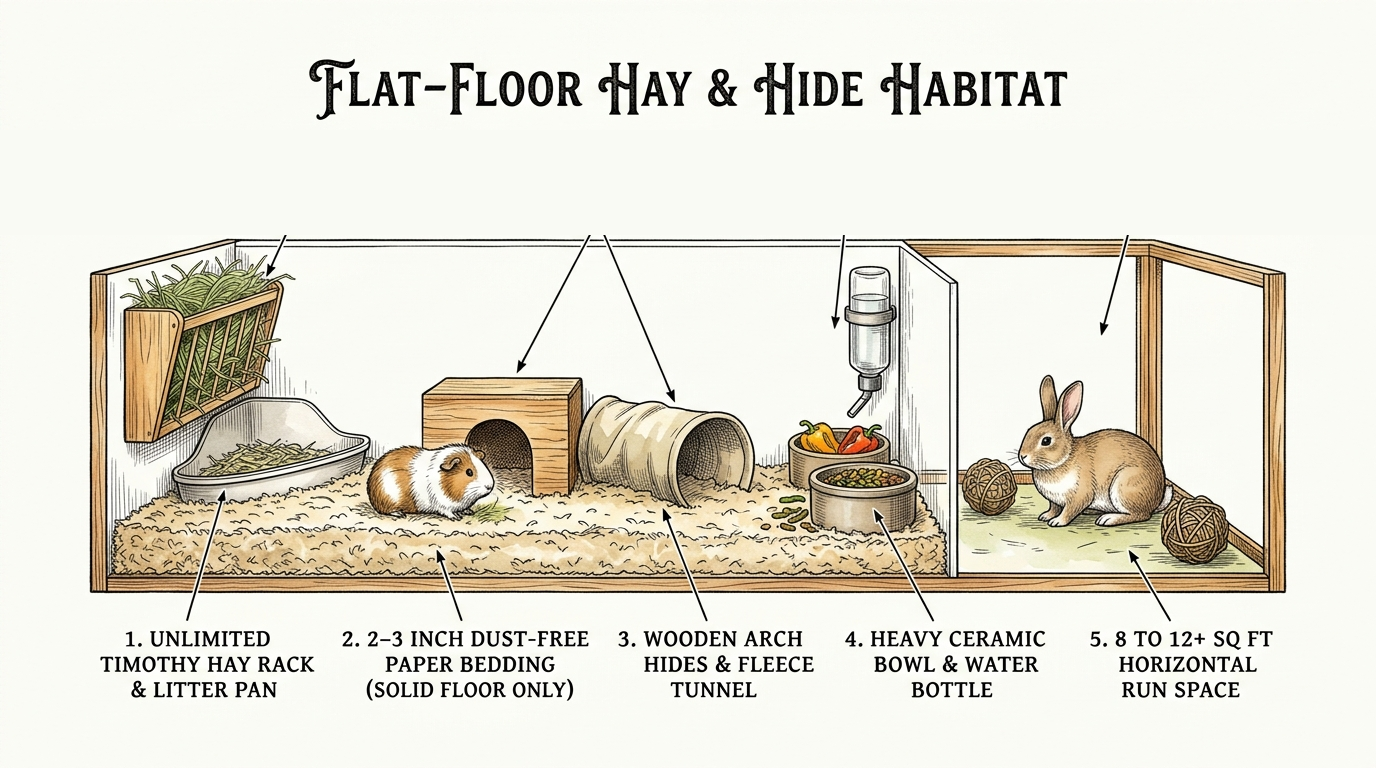

2. Two Great Ways to Set Up Your Habitat
Home Base: 4×4 Exercise Pen (X-Pen) vs. Small Hutch/Cage
A rabbit needs to take 3–4 full hops in a straight line and stand flat on its hind legs without its ears touching a ceiling:
Option A: 30"–36" Tall Dog Exercise Pen (X-Pen) Over a Washable Rug (Our Top Pick!)
Gives 16 sq ft of floor space, walks right open for easy sweeping, and fits a full-sized cat litter box, cardboard castle, and lounge mat!
Option B: Large Cage With Door Left Open Into an X-Pen Yard
If you use a standard cage as a bedroom/bathroom station, leave the front door open into an attached pen + give 3–4 hours of supervised room exercise daily.
Effortless Litter Box Training & Cord Bunny-Proofing
Rabbits naturally poop while they munch hay—making them almost as easy to litter train as a cat!
Option A: Cat-Sized Litter Pan + Paper Pellets + Hay Pile
Put 1" of unscented paper pellet litter in a large cat pan (never use clumping or clay cat litter!) and hang your hay rack right over one end.
Option B: Protect Baseboards & "Spicy Hay" (Electrical Cords!)
To a rabbit, phone chargers and lamp cords look just like tree roots! Wrap all floor cords in split plastic cord tubing and give plenty of willow & applewood chews.
Floor-Level Bonding & Safe Two-Handed Support
Because rabbits are ground-dwelling prey animals with light, fragile skeletons, being lifted high off the floor feels like being caught by an eagle:
Option A: Sit on the Floor and Let Them Hop Into Your Lap
Rabbits bond fastest when you sit on the rug with cilantro and let them nudge your hand for forehead rubs! When happy, they softly purr by clicking their teeth.
Option B: Always Support the Hindquarters (Never Lift by Ears!)
If a rabbit kicks out in mid-air without back-leg support, it can fracture its own spine. Always scoop one hand under the chest and the other firmly under the rump.

3. High-Fiber Herbivore Diet (85% Hay + Greens + Limited Pellets)
Gut Health & Cecotrope Facts Every Bunny Owner Should Know:
Dry round cocoa puffs + soft blackberry-shaped 'cecotropes' they eat directly for B-vitamins
Rabbits drink way more water from a heavy ceramic dog bowl than a sipper bottle!
Seeds, corn, nuts, and yogurt drops ferment in a rabbit's cecum and cause fatal bloat
If a rabbit refuses treats or doesn't poop for 12 hours, go to an exotic vet immediately!

4. Four Keys to a Happy, Thriving Domestic Rabbit
Never Bathe or Trance a Rabbit
Submerging a rabbit in water can cause fatal shock and hypothermia, and flipping them onto their back ('trancing') triggers a terrifying tonic-immobility prey freeze.
Keep Critical Care on Hand
Every rabbit first-aid kit should include a pouch of Oxbow Critical Care herbivore recovery food, baby gas drops (simethicone), and an exotic vet's phone number.
Brush Heavily During Molts
Rabbits cannot vomit hairballs! Brush them daily during spring and autumn coat blows and keep hay flowing so swallowed fur passes right through.
Ask an Exotic Vet About RHDV2
Rabbit Hemorrhagic Disease (RHDV2) is present in the Pacific Northwest—ask your Oregon exotic vet about the annual RHDV2 vaccine, even for indoor bunnies.

Bring-Home Shopping Checklist
Tap items to check them off on your phone while you shop at Critter Cabana.
X-Pen, Flooring & Litter Setup
Hay, Pellets & Recovery Kit
Bowls, Hides & Enrichment
Complete Reference Notes & Oregon Keeping Guide
Species: Oryctolagus cuniculus | Difficulty: 3/5 — Intermediate | Hardiness: 2/5 — Delicate
Critter Cabana & Gresham Pet Supply — Keeping Your Pet Healthy & Thriving
At a Glance
| Common Name | Rabbit, Bunny |
| Species | Oryctolagus cuniculus |
| Origin | Domesticated from wild European rabbits |
| Adult Size | Heavily depends on breed. Miniatures stay around 3 lbs, giant breeds exceed 12 lbs. |
| Lifespan | 8–12 years |
| Diet Type | Strict Herbivore (Hay, Greens, Pellets) |
| Activity | Crepuscular (highly active at dawn and dusk, naps during the day) |
| Temperament | Highly intelligent, easily litter-trained, but skittish as prey animals. |
| Handleability | Do not pick them up often. They hate being suspended in the air. Sit on the floor and let them come to you for pets. |
| Social Needs | Strongly bonded pairs are highly recommended. |
| Odor Level | Low (if litter boxes are cleaned daily and they are spayed/neutered) |
| Difficulty | 3/5 — Intermediate (They require as much space and veterinary care as a dog or cat) |
| Hardiness | 2/5 — Delicate (Extremely fragile digestive systems and skeletons) |
Why We Love Them: Rabbits are not "cage pets"—they are intelligent, affectionate companions that act much like quiet, vegan cats. They can be fully litter-trained, learn their names, and perform "binkies" (jumping and twisting in the air) when they are happy. When treated as free-roam house pets, their true, massive personalities shine.
THE "STARTER PET" MYTH: Rabbits are not cheap starter pets for children. They have fragile spines that can snap if dropped, they require expensive specialized exotic vet care, and their digestive systems will shut down and kill them within 24 hours if fed an improper diet. Treat a rabbit commitment exactly as you would a dog or cat.
Notable Breeds (The Rex Rabbit)
While all domestic rabbits belong to the same species, the Rex and Mini Rex breeds are highly sought after and require slightly specialized care:
- The Velvet Coat: Rex rabbits carry a genetic mutation that removes the long, coarse "guard hairs" from their coat. This leaves only the extremely dense undercoat, making them feel literally like crushed velvet.
- Sore Hocks Warning: Because they lack guard hairs, the bottoms of their feet have significantly less padding than other breeds. Rex rabbits are highly prone to Sore Hocks (painful, bleeding ulcers on their heels) if kept on hard tile, rough carpet, or wire floors. They must be kept on soft fleece, thick rugs, or vet bedding.
- Standard vs. Mini: The Standard Rex grows to 7.5–10.5 lbs, while the highly popular Mini Rex stays around 3–4.5 lbs.
Housing & Enclosure
The End of the "Hutch" Era
Modern rabbit care has entirely moved away from small wire cages and wooden hutches.
- Minimum Enclosure: An indoor exercise pen (X-pen) measuring at least 4x4 feet (16 square feet) for a single rabbit, though pairs need more.
- Free-Roaming: Many owners bunny-proof a bedroom or the entire house (covering baseboards and hiding all electrical cords in PVC pipes) and let the rabbit free-roam like a cat.
- Flooring: Solid, soft flooring only. Wire bottoms are cruel and will cause permanent, crippling foot injuries.
Litter Training
- Rabbits are naturally very clean and will choose one corner to use the bathroom. Place a large, cat-sized litter box in that corner.
- Litter: Use unscented paper pellets (like Yesterday's News) or kiln-dried pine pellets. Do not use clumping cat litter (it is fatal if ingested) or cedar shavings.
- Place a massive pile of fresh hay directly inside one end of the litter box. Rabbits love to eat and poop at the same time.
Diet & Nutrition (The 80/10/10 Rule)
A rabbit's digestive system is in a constant state of motion. If they stop eating, they will die.
- 80% Hay (CRITICAL): Unlimited, fresh Timothy Hay or Orchard Grass must be available 24/7. Eating hay is the only way they keep their constantly growing teeth filed down, and the long-strand fiber prevents GI Stasis. (Only feed Alfalfa to babies under 6 months; it is too rich in calcium for adults).
- 10% Fresh Greens: 1-2 cups per day of romaine lettuce, cilantro, parsley, basil, or dandelion greens. Avoid iceberg lettuce (no nutrition) and limit spinach/kale (too high in oxalates).
- 5-10% Pellets: Only 1/4 cup of high-quality, plain Timothy-based pellets (like Oxbow Essentials) per day. Never feed seed/nut mixes or "fiesta" blends.
- Treats: Carrots and fruits (apples, bananas) are extremely high in sugar and should only be given as a tiny treat (the size of your thumb) once or twice a week.
Health & Husbandry

Spaying and Neutering (Mandatory)
It is highly recommended that ALL pet rabbits be spayed or neutered by an exotic vet.
- Females: Up to 80% of unspayed female rabbits will develop fatal uterine cancer by age 3 or 4. Spaying saves their lives.
- Males: Unneutered males will spray urine aggressively and can be extremely territorial.
Common Health Issues
- GI Stasis (Gastrointestinal Stasis) — Symptoms: The rabbit suddenly stops eating and stops pooping. Sitting hunched in pain. / Cause: Lack of hay, stress, or eating something they shouldn't. / Treatment: This is a life-threatening emergency. You have 12-24 hours to get them to an exotic vet for gut motility drugs before they die.
- Sore Hocks — Symptoms: Red, raw, or bleeding sores on the bottom of the heels (highly common in Rex breeds). / Cause: Hard flooring, wire cages, or obesity. / Treatment: Move to soft fleece flooring and seek veterinary care.
- Overgrown Teeth (Malocclusion) — Symptoms: Drooling, inability to eat, front teeth curling upwards. / Cause: Lack of hay or genetics. / Treatment: Vet must file them down.
What We Stock & Use in Our Stores
These are products we carry and recommend for this species. Ask any associate for help finding them in-store.
| Category | Product | Notes |
|---|---|---|
| Enclosure | Midwest Exercise Pen (30" or 36" high) | The gold standard for indoor rabbit housing |
| Litter | Oxbow Eco-Straw or Fresh News Paper Pellets | Safe, absorbent, and non-clumping |
| Pellets | Oxbow Essentials Adult Rabbit Food | Plain, high-fiber timothy pellets (no seeds/nuts) |
| Hay | Oxbow Western Timothy Hay | Buy in bulk. Your rabbit should eat a pile the size of its body daily. |
| Hay Rack | Oxbow Enriched Life Wooden Hay Feeder | Keeps hay clean and off the floor |
| Chew Toys | Oxbow Enriched Life Apple Sticks & Willow Balls | Essential for keeping teeth trimmed and preventing boredom |
Care sheet compiled by Critter Cabana & Gresham Pet Supply. For questions, ask any livestock specialist in-store.
Last updated: 2026-08-04
How We Keep Them at Critter Cabana & Gresham Pet Supply
- Pacific Northwest Seasonal Drafts & Indoor Air Quality: In Oregon, damp chilly winters and sudden August heatwaves are the two biggest environmental stressors for Domestic Rabbit. Keep their habitat (
16+ square feet (X-Pen or Free Roam)) away from drafty windows, exterior doors, and direct furnace vents, and maintain a steadyspecies-appropriate warm zonetemperature zone. - What Our Store Crew Uses Daily: In our Newberg and Gresham animal rooms, we use dust-extracted, scent-free bedding (never cedar or raw phenols), fresh Pacific Northwest grass hays or species-specific pelleted staples (Oxbow, Harrison's, Roudybush, or Higgins), and daily foraging enrichment so young animals are already hand-accustomed and eating a balanced diet before they go home with you.
- Local Exotic Vet Planning: Before an emergency ever happens, save the number of an experienced Oregon avian/exotic veterinarian in the Portland Metro or Willamette Valley area (such as Avian & Exotic Veterinary Care or Scales & Tails Exotic Pet Clinic).
Common Questions (FAQ)
What size cage or habitat does a Domestic Rabbit actually need?
Plan on at least 16+ square feet (X-Pen or Free Roam) as a true minimum—bigger horizontal floor space (or flight width for birds) is always better for daily exercise, mental health, and clean air quality.
How do I keep Domestic Rabbit comfortable through Oregon winters and summers?
Keep indoor temperatures steady around species-appropriate warm zone with balanced humidity humidity, well away from cold window drafts in winter and direct afternoon sun in summer.
What do you feed Domestic Rabbit at Critter Cabana and Gresham Pet Supply?
Our store crew feeds a balanced herbivore regimen built on high-quality pellets/hay and daily fresh produce or foraging items—never all-seed junk mixes that cause vitamin deficiencies and fatty liver disease.
Where can I meet Domestic Rabbit and talk to the animal care crew in Oregon?
Visit our live animal departments at Critter Cabana in Newberg (514 E First St, 503-537-2887) or Gresham Pet Supply (2185 NW Burnside Rd, 503-665-7606) to meet our animals and get hands-on setup advice.